

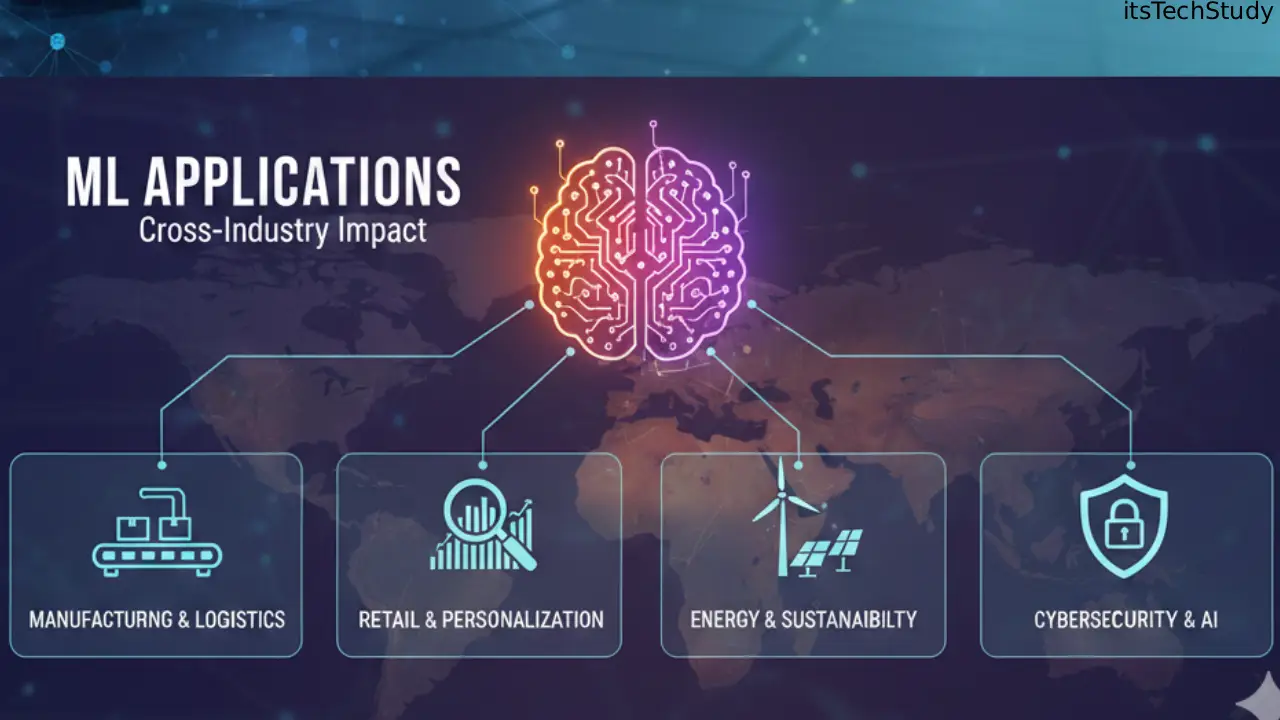
Introduction: From Static Software to Learning Systems
Not long ago, software followed rigid rules written line by line by human developers. If conditions changed, systems broke or required manual updates. As data exploded across devices, platforms, and industries, this rule-based approach became a serious limitation. Businesses were sitting on massive datasets but lacked tools that could truly learn from them..
This challenge gave rise to machine learning (ML)-a branch of artificial intelligence that allows systems to learn patterns, improve over time, and make decisions with minimal human intervention. Today, machine learning applications are no longer experimental. They power everything from personalized shopping recommendations to disease detection systems. Across industries, ML is reshaping workflows, improving accuracy, reducing costs, and unlocking insights that were once impossible to uncover.
In this article, we’ll explore how machine learning is being applied across key industries, the benefits and trade-offs involved, and what the future holds for this transformative technology.
What Is Machine Learning and Why It Matters Today
Machine learning is a subset of artificial intelligence that enables systems to learn from historical data, identify patterns, and make predictions without being explicitly programmed. Instead of hard-coded instructions, ML models evolve as they process more data.
Key Types of Machine Learning
- Supervised learning – Trained on labeled data for prediction and classification
- Unsupervised learning – Finds hidden patterns in unlabeled data
- Reinforcement learning – Learns through trial and error with feedback
The rapid growth of cloud computing, big data, and powerful processors has made machine learning accessible to organizations of all sizes, accelerating adoption across industries.
Machine Learning Applications Across Major Industries
Machine Learning in Healthcare
Healthcare is one of the most impactful areas for machine learning applications. ML models analyze medical images, patient records, and genomic data to support faster and more accurate diagnoses.
Common applications include:
- Disease prediction and early detection
- Medical image analysis (X-rays, MRIs, CT scans)
- Personalized treatment recommendations
- Hospital resource optimization
By reducing diagnostic errors and improving efficiency, machine learning in healthcare is saving lives while lowering operational costs.
Machine Learning in Finance and Banking
Financial institutions handle enormous volumes of transactions every second. Machine learning helps make sense of this data in real time.
Key use cases include:
- Fraud detection and prevention
- Credit scoring and risk assessment
- Algorithmic trading
- Personalized financial advice
ML systems can detect suspicious activity faster than traditional rule-based systems, making finance more secure and responsive.
Machine Learning in Manufacturing
Manufacturing relies heavily on precision, timing, and efficiency-areas where machine learning excels.
Applications include:
- Predictive maintenance for machinery
- Quality inspection using computer vision
- Demand forecasting
- Supply chain optimization
By predicting failures before they happen, manufacturers reduce downtime and extend equipment lifespan.
Machine Learning in Retail and E-Commerce
Retailers use machine learning to better understand customer behavior and improve the shopping experience.
Popular ML applications in retail:
- Personalized product recommendations
- Dynamic pricing strategies
- Inventory management
- Customer sentiment analysis
These systems help businesses increase conversion rates while delivering more relevant experiences to consumers.
Machine Learning in Transportation and Logistics
From navigation apps to autonomous vehicles, machine learning is transforming how goods and people move.
Use cases include:
- Route optimization
- Traffic prediction
- Autonomous driving systems
- Fleet management
Machine learning improves safety, reduces fuel consumption, and enhances delivery efficiency.
Industry-Wise Comparison of Machine Learning Applications
| Industry | Key ML Applications | Primary Benefits |
|---|---|---|
| Healthcare | Diagnosis, imaging, treatment planning | Accuracy, early detection |
| Finance | Fraud detection, risk analysis | Security, faster decisions |
| Manufacturing | Predictive maintenance, quality control | Cost reduction, efficiency |
| Retail | Recommendations, inventory forecasting | Personalization, higher sales |
| Transportation | Route optimization, autonomous systems | Safety, fuel efficiency |
Pros and Cons of Machine Learning Across Industries
Advantages of Machine Learning
- Improves decision-making accuracy
- Automates complex and repetitive tasks
- Scales efficiently with large datasets
- Enables predictive and personalized services
Challenges and Limitations
- Requires high-quality data
- Can be expensive to implement initially
- Lack of transparency in complex models
- Needs skilled professionals for development
Understanding these trade-offs helps organizations adopt machine learning responsibly and effectively.
How Businesses Can Successfully Adopt Machine Learning
To maximize value, organizations should follow a structured approach:
- Identify clear business problems
- Ensure data availability and quality
- Choose the right ML model and tools
- Start with pilot projects
- Continuously monitor and refine models
Strategic planning is key to turning machine learning investments into measurable results.
The Future of Machine Learning Across Industries
As data continues to grow and computing power becomes more accessible, machine learning will become deeply embedded in everyday business operations. Future systems will be more explainable, ethical, and adaptive, enabling smarter automation without sacrificing trust.
Organizations that invest early in machine learning capabilities will gain a significant competitive advantage in innovation, efficiency, and customer experience.
Conclusion
Machine learning applications across industries are no longer optional-they are becoming essential. From healthcare and finance to retail and transportation, ML is helping organizations solve complex problems, uncover insights, and deliver smarter services. While challenges remain, thoughtful adoption and continuous learning can unlock tremendous long-term value. The future belongs to systems that don’t just follow rules—but learn, adapt, and improve.

About the Author
Amelia Morgan is a Editor at itsTechStudy.com with 15+ years of experience in the technology industry. I write about emerging innovations, AI, and digital trends-making complex topics simple and engaging for readers.
Frequently Asked Questions (FAQ)
Q1: What are the most common machine learning applications today?
Ans: Some of the most common applications include recommendation systems, fraud detection, image recognition, predictive analytics, and natural language processing used in chatbots and virtual assistants.
Q2: Is machine learning only for large enterprises?
Ans: No. With cloud-based ML platforms and open-source tools, small and medium businesses can also deploy machine learning solutions at affordable costs.
Q3: How does machine learning differ from traditional programming?
Ans: Traditional programming follows fixed rules, while machine learning systems learn patterns from data and improve over time without manual reprogramming.
Q4: What skills are required to work with machine learning?
Ans: Key skills include data analysis, statistics, programming (Python, R), and a basic understanding of algorithms and model evaluation.
Q5: Are machine learning systems always accurate?
Ans: Accuracy depends on data quality, model selection, and continuous monitoring. Poor data can lead to biased or unreliable predictions.





No Comments Yet
Be the first to share your thoughts.
Leave a Comment