

Introduction: From Rule-Based Software to Learning Systems
For decades, traditional software followed a simple rule: humans write the logic, machines execute it. This approach worked well when problems were predictable and data volumes were manageable. But as digital systems began generating massive amounts of data-from smartphones, sensors, social platforms, and cloud applications-this rigid model started to crack.
Today’s biggest challenge in technology isn’t a lack of data; it’s making sense of it in real time. This is where machine learning algorithms have reshaped the landscape. Instead of being explicitly programmed for every scenario, modern systems can learn patterns, adapt to change, and improve performance over time.
From personalized recommendations and fraud detection to autonomous vehicles and predictive maintenance, machine learning algorithms now sit at the core of innovation. Understanding how these algorithms work-and how to choose the right one-is no longer optional for tech professionals. It’s a foundational skill in today’s data-driven world.
What Are Machine Learning Algorithms?
Machine learning algorithms are mathematical models that enable computers to identify patterns in data and make decisions with minimal human intervention. Rather than following fixed instructions, these algorithms learn from examples and continuously refine their output as more data becomes available.
At a high level, machine learning sits within the broader field of artificial intelligence, but its practical value comes from its ability to solve real-world problems efficiently.
Core Components of Machine Learning
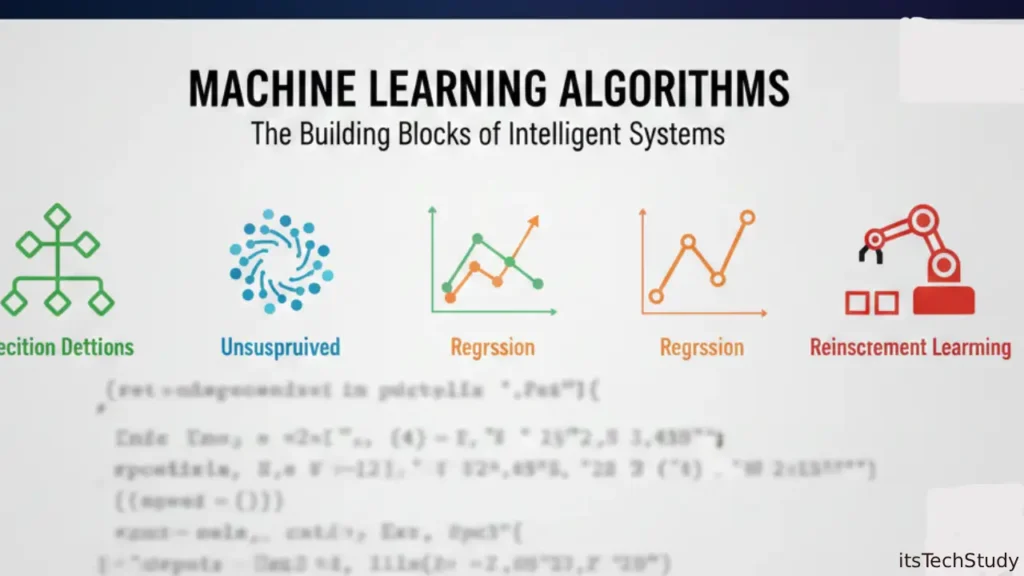
To understand machine learning algorithms, it helps to break them into three core elements:
- Data: Structured or unstructured information used for training
- Model: The algorithm that learns patterns from data
- Learning Process: Optimization techniques that improve accuracy over time
Together, these components allow systems to predict outcomes, classify information, or discover hidden trends without manual programming.
Types of Machine Learning Algorithms
Machine learning algorithms are generally categorized based on how they learn from data. Each type is suited for different use cases and problem domains.
Supervised Learning Algorithms
Supervised learning algorithms work with labeled data, meaning the input data comes with known outputs. The algorithm learns by comparing its predictions to the correct answers and adjusting accordingly.
Common examples include:
- Linear Regression
- Logistic Regression
- Decision Trees
- Support Vector Machines (SVM)
- k-Nearest Neighbors (KNN)
Typical use cases:
- Email spam detection
- Credit scoring
- Medical diagnosis
- Price prediction
Unsupervised Learning Algorithms
Unsupervised learning algorithms analyze data without labeled outcomes. Their goal is to discover hidden patterns, relationships, or groupings within the data.
Popular algorithms include:
- K-Means Clustering
- Hierarchical Clustering
- Principal Component Analysis (PCA)
- Association Rule Learning
Typical use cases:
- Customer segmentation
- Market basket analysis
- Anomaly detection
- Data compression
Semi-Supervised Learning
Semi-supervised learning bridges the gap between supervised and unsupervised learning by using a small amount of labeled data combined with a large pool of unlabeled data. This approach is especially useful when labeling data is expensive or time-consuming.
Reinforcement Learning Algorithms
Reinforcement learning algorithms learn by interacting with an environment and receiving feedback in the form of rewards or penalties. Over time, the system learns optimal actions through trial and error.
Common applications include:
- Robotics
- Game AI
- Autonomous navigation
- Recommendation systems optimization
Popular Machine Learning Algorithms Explained
Understanding the strengths and weaknesses of individual algorithms helps teams make better technical decisions.
Linear Regression
Linear regression is one of the simplest and most widely used machine learning algorithms. It models the relationship between dependent and independent variables by fitting a linear equation.
Best for: Predicting numerical values when relationships are relatively simple.
Decision Trees
Decision trees break data into branches based on feature values, making them highly interpretable and easy to visualize.
Best for: Classification problems and scenarios where model explainability is critical.
Random Forest
Random forest is an ensemble algorithm that combines multiple decision trees to improve accuracy and reduce overfitting.
Best for: High-accuracy predictions with complex datasets.
Support Vector Machines (SVM)
SVMs work by finding an optimal boundary that separates data points into different classes.
Best for: High-dimensional datasets and clear classification margins.
Neural Networks
Neural networks mimic the structure of the human brain and form the foundation of deep learning. They excel at processing complex, non-linear data.
Best for: Image recognition, speech processing, and natural language tasks.
Comparison Table: Machine Learning Algorithm Overview
| Algorithm | Learning Type | Best Use Case | Strengths | Limitations |
|---|---|---|---|---|
| Linear Regression | Supervised | Numeric prediction | Simple, fast | Limited complexity |
| Decision Tree | Supervised | Classification | Interpretable | Prone to overfitting |
| Random Forest | Supervised | Complex prediction | High accuracy | Computationally heavy |
| K-Means | Unsupervised | Clustering | Scalable | Requires preset clusters |
| Neural Networks | Supervised/Unsupervised | Pattern recognition | Highly powerful | Low explainability |
Pros and Cons of Machine Learning Algorithms:
Advantages of Machine Learning Algorithms
- Automate decision-making at scale
- Continuously improve with more data
- Handle complex and non-linear relationships
- Enable predictive and personalized experiences
- Reduce human bias in repetitive tasks
Limitations and Challenges
- Require large, high-quality datasets
- Can be computationally expensive
- Risk of bias if training data is flawed
- Difficult to interpret complex models
- Maintenance and retraining are ongoing needs
How to Choose the Right Machine Learning Algorithm
Selecting the right algorithm depends on several technical and business factors.
Key Considerations
- Nature of the problem (classification, regression, clustering)
- Data availability and quality
- Model interpretability requirements
- Performance and scalability needs
- Computational resources
Practical Tips
- Start simple before moving to complex models
- Compare multiple algorithms using validation data
- Balance accuracy with explainability
- Continuously monitor real-world performance
Real-World Applications of Machine Learning Algorithms
Machine learning algorithms are no longer experimental-they are deeply embedded in everyday technology.
- Healthcare: Disease prediction, medical imaging analysis
- Finance: Fraud detection, algorithmic trading
- Retail: Recommendation engines, demand forecasting
- Manufacturing: Predictive maintenance, quality control
- Cybersecurity: Threat detection, behavior analysis
Conclusion: The Future of Machine Learning Algorithms
Machine learning algorithms have evolved from academic concepts into practical tools powering modern technology. As data volumes grow and computing power advances, these algorithms will become even more adaptive, efficient, and accessible.
For businesses and developers alike, the real opportunity lies not just in using machine learning-but in understanding which algorithms fit specific problems. Those who master this balance will shape the next generation of intelligent systems.

About the Author
Amelia Morgan is a Editor at itsTechStudy.com with 15+ years of experience in the technology industry. I write about emerging innovations, AI, and digital trends-making complex topics simple and engaging for readers.
Frequently Asked Questions (FAQ)
Q1: What are machine learning algorithms in simple terms?
Ans: Machine learning algorithms are techniques that allow computers to learn from data and improve their performance without being explicitly programmed for every task.
Q2: Which machine learning algorithm is best for beginners?
Ans: Linear regression and decision trees are excellent starting points due to their simplicity and interpretability.
Q3: How are machine learning algorithms different from traditional programming?
Ans: Traditional programming follows predefined rules, while machine learning algorithms learn patterns from data and adapt over time.
Q4: Do machine learning algorithms require large datasets?
Ans: Not always, but larger and higher-quality datasets generally lead to better performance and more reliable models.
Q5: Are machine learning algorithms the same as deep learning?
Ans: Deep learning is a subset of machine learning that uses multi-layer neural networks to process complex data.








No Comments Yet
Be the first to share your thoughts.
Leave a Comment