

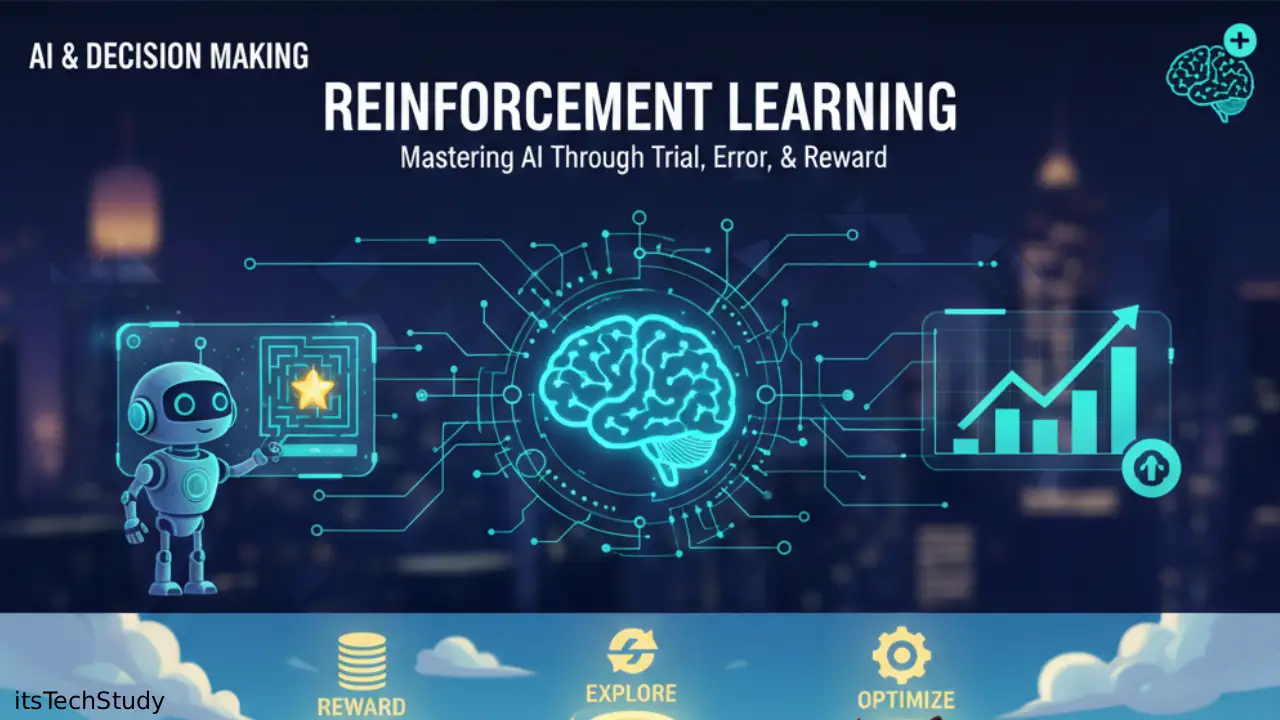
Introduction: From Rule-Based Systems to Learning by Experience
For decades, software systems followed strict rules written line by line by human developers. If this happens, do that. While effective for predictable problems, this approach started to crack as technology entered messy, real-world environments-autonomous driving, robotics, game playing, recommendation engines, and real-time decision systems. The challenge was clear: how do we build machines that can learn from experience, adapt to changing environments, and improve over time without being explicitly programmed for every scenario?
This challenge gave rise to Reinforcement Learning (RL)-a powerful branch of machine learning inspired by how humans and animals learn. Instead of learning from labeled data, reinforcement learning models learn by interacting with an environment, making decisions, receiving feedback in the form of rewards or penalties, and gradually improving their behavior.
Today, reinforcement learning sits at the heart of some of the most impressive breakthroughs in artificial intelligence-from AlphaGo defeating world champions to robots learning how to walk, balance, and manipulate objects. Yet, despite its growing importance, RL is often misunderstood or seen as overly complex. This article breaks it down clearly, practically, and conversationally—whether you’re a beginner exploring AI concepts or a tech enthusiast looking to deepen your understanding.
What Is Reinforcement Learning?
Reinforcement learning is a machine learning paradigm where an agent learns to make optimal decisions by interacting with an environment and maximizing cumulative rewards over time.
Unlike supervised learning, where models learn from labeled examples, or unsupervised learning, where patterns are discovered in unlabeled data, reinforcement learning focuses on decision-making under uncertainty.
Core Components of Reinforcement Learning
At its foundation, reinforcement learning consists of a few key elements:
- Agent – The learner or decision-maker (e.g., a robot, software program)
- Environment – The world the agent interacts with
- State – A representation of the current situation
- Action – A decision taken by the agent
- Reward – Feedback received after an action
- Policy – A strategy that maps states to actions
The agent’s goal is not to win immediately, but to learn a policy that maximizes long-term rewards.
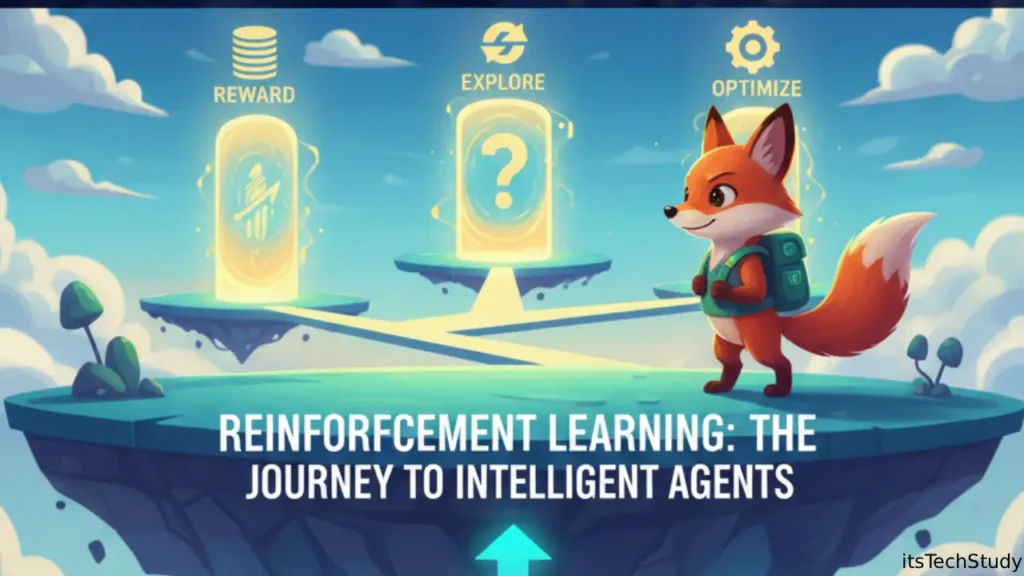
How Reinforcement Learning Actually Works
The Trial-and-Error Learning Loop
Reinforcement learning mimics natural learning behavior. Think about teaching a child to ride a bicycle. You don’t give them a manual with perfect instructions-you let them try, fall, adjust, and improve. RL systems follow the same philosophy.
The process typically looks like this:
- The agent observes the current state
- It selects an action based on its policy
- The environment responds with a new state and reward
- The agent updates its knowledge
- The cycle repeats thousands or millions of times
Over time, the agent learns which actions lead to better outcomes.
Exploration vs Exploitation Dilemma
One of the biggest challenges in reinforcement learning is balancing:
- Exploration – Trying new actions to discover better rewards
- Exploitation – Using known actions that already yield good results
Too much exploration wastes time. Too much exploitation can trap the agent in suboptimal behavior. Designing this balance is a core challenge in RL system design.
Types of Reinforcement Learning
Reinforcement learning algorithms can be broadly categorized based on how they model the environment and learning process.
Model-Based Reinforcement Learning
In model-based RL, the agent attempts to learn a model of the environment, predicting outcomes before acting.
Key traits:
- Plans ahead using simulations
- More sample-efficient
- Computationally complex
Model-Free Reinforcement Learning
Model-free RL skips modeling the environment and learns directly from experience.
Key traits:
- Simpler to implement
- Requires more data
- Widely used in real-world applications
Popular Reinforcement Learning Algorithms Explained
Q-Learning
Q-Learning is one of the most foundational reinforcement learning algorithms. It learns the value of taking a specific action in a specific state.
Why it matters:
- Simple and effective
- Forms the basis for many advanced RL methods
Deep Q-Networks (DQN)
DQN combines reinforcement learning with deep neural networks, allowing agents to handle complex environments like video games.
Policy Gradient Methods
Instead of learning value functions, these methods directly optimize the policy.
Actor-Critic Algorithms
These hybrid methods combine the strengths of value-based and policy-based approaches.
Reinforcement Learning vs Other Machine Learning Approaches
| Feature | Supervised Learning | Unsupervised Learning | Reinforcement Learning |
|---|---|---|---|
| Data Requirement | Labeled data | Unlabeled data | Reward signals |
| Learning Style | Pattern matching | Pattern discovery | Trial and error |
| Feedback Type | Immediate | None | Delayed rewards |
| Typical Use Cases | Image recognition | Clustering | Robotics, games |
This distinction explains why reinforcement learning is especially powerful in dynamic and interactive environments.
Real-World Applications of Reinforcement Learning
Gaming and Simulations
Reinforcement learning gained massive attention when DeepMind’s AlphaGo defeated professional Go players. Similar techniques are used in:
- Chess and strategy games
- Game AI behavior modeling
- Simulation-based training
Robotics and Automation
Robots use reinforcement learning to:
- Learn walking and balancing
- Optimize grip and manipulation
- Adapt to physical environments
Recommendation Systems
RL helps platforms improve recommendations by learning from user interactions over time.
Finance and Trading
In algorithmic trading, RL agents learn strategies based on market feedback and long-term returns.
Pros and Cons of Reinforcement Learning
Advantages of Reinforcement Learning
- Learns from interaction, not static data
- Adapts to dynamic environments
- Suitable for complex decision-making
- Capable of discovering novel strategies
Limitations of Reinforcement Learning
- Requires large amounts of data
- Training can be computationally expensive
- Difficult to debug and interpret
- Sensitive to reward design
Key Challenges in Reinforcement Learning
Reward Engineering
Designing a reward function that encourages correct behavior without unintended consequences is notoriously difficult.
Sample Inefficiency
Many RL systems require millions of interactions, making real-world deployment challenging.
Stability and Safety
In high-risk environments (healthcare, robotics), unsafe exploration can be costly.
Reinforcement Learning and Deep Learning: A Powerful Combination
The fusion of deep learning and reinforcement learning-often called Deep Reinforcement Learning-has unlocked new capabilities. Neural networks help RL agents handle:
- High-dimensional state spaces
- Raw sensory data like images and audio
- Complex control tasks
This synergy is driving innovation in autonomous systems and artificial intelligence research.
Best Practices for Implementing Reinforcement Learning
- Start with simulations before real-world deployment
- Carefully design reward functions
- Monitor learning stability
- Use transfer learning where possible
- Balance exploration intelligently
The Future of Reinforcement Learning
Reinforcement learning continues to evolve as research improves efficiency, safety, and interpretability. With advances in simulation environments, hardware acceleration, and hybrid AI systems, RL is moving from research labs into practical, real-world solutions.
As technology pushes toward more autonomous and adaptive systems, reinforcement learning will play a critical role in shaping how machines learn, decide, and interact with the world around them.
Conclusion: Why Reinforcement Learning Matters
Reinforcement learning represents a major shift in how we build intelligent systems-moving from static programming to adaptive learning through experience. While challenges remain, its ability to handle complex, uncertain, and dynamic environments makes it one of the most exciting areas in artificial intelligence today.
For developers, researchers, and tech enthusiasts, understanding reinforcement learning is no longer optional-it’s a window into the future of intelligent decision-making systems.

About the Author
Amelia Morgan is a Editor at itsTechStudy.com with 15+ years of experience in the technology industry. I write about emerging innovations, AI, and digital trends-making complex topics simple and engaging for readers.
Frequently Asked Questions (FAQ)
Q1: What is reinforcement learning in simple terms?
Ans: Reinforcement learning is a way for machines to learn by trying actions and receiving rewards or penalties, improving their decisions over time based on experience.
Q2: How is reinforcement learning different from supervised learning?
Ans: Supervised learning relies on labeled data, while reinforcement learning learns through interaction and feedback from an environment.
Q3: Is reinforcement learning used in real products today?
Ans: Yes, reinforcement learning is used in robotics, recommendation engines, autonomous vehicles, gaming AI, and financial systems.
Q4: Does reinforcement learning require deep learning?
Ans: Not always. Basic reinforcement learning algorithms work without neural networks, but deep learning helps scale RL to complex problems.
Q5: Is reinforcement learning hard to learn?
Ans: It has a steeper learning curve than other ML techniques, but understanding the fundamentals makes advanced concepts much more approachable.






No Comments Yet
Be the first to share your thoughts.
Leave a Comment