

Introduction: Why Rule-Based Chatbots Still Deserve Attention
Before artificial intelligence, machine learning, and large language models became everyday buzzwords, businesses still needed a way to automate conversations. Customer queries were piling up, support teams were overwhelmed, and users expected instant responses-24/7. This gap gave rise to rule-based chatbots, the earliest form of conversational automation.
Fast forward to today, and the tech landscape looks very different. AI-powered chatbots can understand context, emotions, and even sarcasm. Yet, rule-based chatbots haven’t disappeared. In fact, they are quietly powering customer support systems, internal tools, banking workflows, and compliance-heavy industries where predictability and control matter more than creativity.
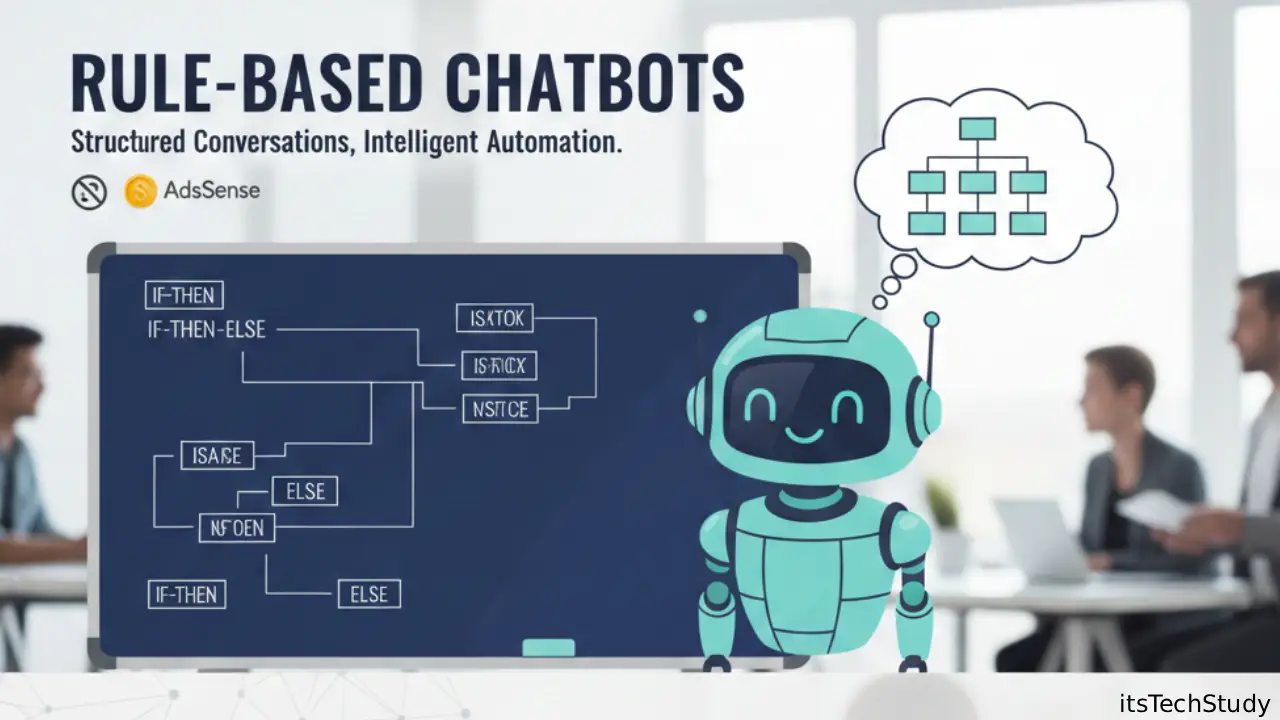
The real challenge today isn’t choosing the “most advanced” chatbot-but choosing the right chatbot. Many organizations still struggle with over-engineered AI solutioRule-based chatbot workflow diagram showing predefined conversation pathss that are expensive, complex, and unnecessary for simple use cases. That’s where rule-based chatbots shine..
In this article, we’ll explore what rule-based chatbots are, how they work, their advantages and limitations, real-world use cases, and how they compare with AI-driven chatbots-helping you decide whether they’re the right fit for your business or project.
What Is a Rule-Based Chatbot?
A rule-based chatbot is a conversational system that follows predefined rules to interact with users. Instead of learning from data, it responds based on if–then logic, decision trees, or pattern matching.
If a user says X, the bot responds with Y.
If the user selects option A, the bot moves to step B.
There’s no guessing, no learning, and no interpretation beyond what has been explicitly programmed.
Key Characteristics of Rule-Based Chatbots
- Operate on predefined scripts and logic
- Do not learn from user interactions
- Provide consistent, predictable responses
- Best suited for structured and repetitive conversations
Rule-based chatbots are often described as deterministic systems, meaning their behavior is entirely predictable-an advantage in many regulated or customer-facing environments.
How Rule-Based Chatbots Work
Understanding how rule-based chatbots function helps clarify both their strengths and their limitations.
Core Components of a Rule-Based Chatbot
1. Input Recognition
The chatbot captures user input through:
- Button clicks
- Menu selections
- Keyword-based text input
2. Rule Engine
The rule engine evaluates the input against predefined conditions, such as:
- Keywords
- Exact phrases
- Pattern matches
- Decision-tree paths
3. Response Generator
Once a rule is triggered, the chatbot delivers a fixed response, redirects the user, or asks the next predefined question.
4. Conversation Flow
The entire interaction follows a scripted flow, often visualized as:
- Decision trees
- Flowcharts
- State machines
Common Types of Rule-Based Chatbots
Rule-based chatbots aren’t one-size-fits-all. They come in different formats depending on complexity and use case.
Menu-Based Chatbots
These bots guide users through clickable options.
Example:
- “Press 1 for Billing”
- “Press 2 for Technical Support”
Best for:
- Customer service
- IVR systems
- Simple websites
Keyword-Based Chatbots
They respond when specific words or phrases are detected.
Example:
- User types “refund”
- Bot triggers refund-related response
Best for:
- FAQs
- Help desks
- Knowledge bases
Decision-Tree Chatbots
These bots follow structured paths based on user answers.
Best for:
- Troubleshooting
- Lead qualification
- Onboarding processes
Rule-Based Chatbots vs AI Chatbots
Understanding the difference is critical before choosing a chatbot solution.
Comparison Table: Rule-Based vs AI Chatbots
| Feature | Rule-Based Chatbots | AI-Powered Chatbots |
|---|---|---|
| Learning capability | None | Learns from data |
| Response flexibility | Fixed | Dynamic |
| Development complexity | Low | High |
| Cost | Affordable | Expensive |
| Accuracy | High for defined cases | Varies |
| Best for | Simple, structured tasks | Complex conversations |
Rule-based chatbots prioritize control and accuracy, while AI chatbots focus on adaptability and scalability.
Advantages of Rule-Based Chatbots:
Despite the AI hype, rule-based chatbots still offer several compelling benefits.
Pros of Rule-Based Chatbots
- Predictable behavior – No unexpected replies
- High accuracy – Perfect for fixed workflows
- Easy to develop – No training data required
- Cost-effective – Lower setup and maintenance costs
- Compliance-friendly – Ideal for regulated industries
- Fast deployment – Can be launched quickly
These benefits make them especially attractive for startups, SMEs, and enterprises with clearly defined user journeys.
Limitations of Rule-Based Chatbots
While powerful in the right context, rule-based chatbots have clear drawbacks.
Cons of Rule-Based Chatbots
- Cannot handle open-ended questions
- Break down when users deviate from expected inputs
- Require manual updates for new scenarios
- Poor at understanding natural language
- Limited scalability for complex conversations
As user expectations rise, these limitations become more noticeable-especially in customer-facing applications.
Real-World Use Cases of Rule-Based Chatbots
Rule-based chatbots continue to play a critical role across industries.
Customer Support Automation
- Order tracking
- Refund status
- Account updates
- Password resets
Banking and Finance
- Balance inquiries
- Transaction history
- KYC workflows
- Regulatory compliance support
Healthcare Administration
- Appointment booking
- Prescription reminders
- Policy explanations
HR and Internal Tools
- Leave management
- Payroll queries
- Employee onboarding
E-commerce
- Product availability
- Shipping information
- Return policies
In these scenarios, precision matters more than personality-making rule-based systems ideal.
When Should You Choose a Rule-Based Chatbot?
Choosing the right chatbot depends on your goals, budget, and audience.
Rule-Based Chatbots Are Ideal When:
- Conversations are repetitive and predictable
- Accuracy is more important than flexibility
- Budget is limited
- Compliance and control are critical
- You need fast implementation
Consider AI Chatbots If:
- User inputs are unpredictable
- You need personalization
- Conversations are complex
- You expect high query volume diversity
Best Practices for Designing Rule-Based Chatbots
To maximize effectiveness, design matters just as much as logic.
Design Tips
- Keep conversation flows simple
- Use buttons instead of free-text where possible
- Anticipate common user paths
- Include fallback responses
- Test with real users
- Regularly update rules
A well-designed rule-based chatbot can feel surprisingly smooth and helpful.
Conclusion: The Quiet Power of Simplicity
In a world obsessed with AI, rule-based chatbots remind us that simple solutions still solve real problems. They may not sound impressive, but they deliver reliability, accuracy, and efficiency where it matters most.
For businesses with clear workflows, limited budgets, or strict compliance requirements, rule-based chatbots are not outdated-they’re practical. And when designed thoughtfully, they can still provide a smooth, satisfying user experience.
The future of conversational technology isn’t about choosing between rule-based or AI chatbots. It’s about using the right tool for the right job.

About the Author
Amelia Morgan is a Editor at itsTechStudy.com with 15+ years of experience in the technology industry. I write about emerging innovations, AI, and digital trends-making complex topics simple and engaging for readers.
Frequently Asked Questions (FAQs)
Q1: Are rule-based chatbots still relevant in 2026?
Ans: Yes. They are widely used for structured workflows, compliance-heavy industries, and cost-sensitive applications where AI is unnecessary.
Q2: Can rule-based chatbots use NLP?
Ans: Basic keyword matching is possible, but they lack true natural language understanding compared to AI chatbots.
Q3: Are rule-based chatbots cheaper than AI chatbots?
Ans: Absolutely. They require no training data, no ML infrastructure, and minimal maintenance.
Q4: Can rule-based and AI chatbots work together?
Ans: Yes. Many modern systems use hybrid models where rule-based logic handles simple tasks and AI handles complex queries.
Q5: Do rule-based chatbots work well on websites?
Ans: They work very well for FAQs, lead capture, booking systems, and support pages with predictable user intent.







No Comments Yet
Be the first to share your thoughts.
Leave a Comment