

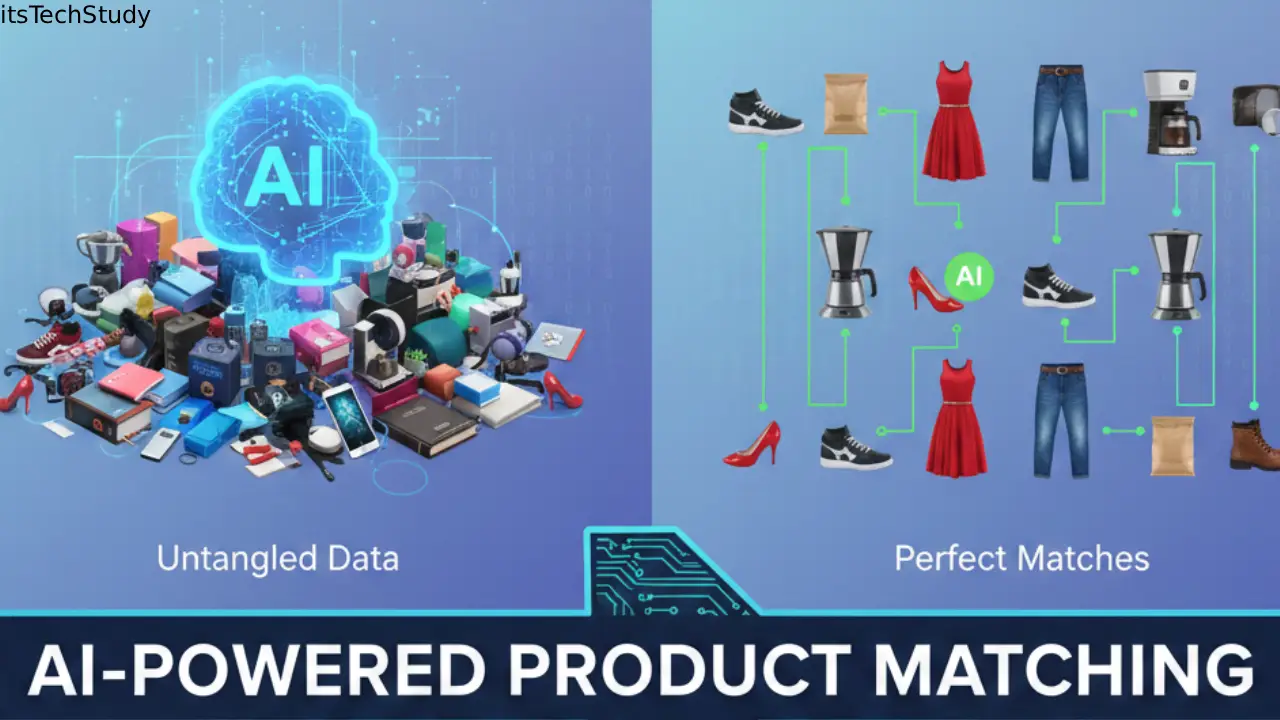
Introduction: Why Product Discovery Is Still Broken (And How AI Is Fixing It)
Not long ago, online shopping felt revolutionary. You could browse thousands of products without leaving your couch. But as e-commerce exploded, so did the complexity of finding the right product.
Search bars often misunderstand queries. Filters don’t always narrow results accurately. Two similar products from different brands appear disconnected. And shoppers frequently abandon carts because they can’t easily compare or discover relevant alternatives..
In today’s hyper-competitive digital marketplace, poor product discovery equals lost revenue. According to trends seen across platforms like Amazon and Alibaba, intelligent product matching systems have become a critical competitive advantage. These platforms don’t just list products—they understand relationships between them.
That’s where AI-powered product matching comes in.
Using artificial intelligence, machine learning, and natural language processing, modern systems can identify similar, duplicate, complementary, or substitute products across massive catalogs. Whether you’re running a marketplace, price comparison site, retail aggregator, or B2B procurement platform, AI-driven product matching is becoming essential infrastructure.
In this deep-dive guide, we’ll explore:
- What AI-powered product matching is
- How it works technically
- Real-world use cases
- Benefits and limitations
- Implementation strategies
- FAQs and practical insights
Let’s unpack the technology shaping the future of intelligent e-commerce.
What Is AI-Powered Product Matching?
AI-powered product matching is the process of using artificial intelligence algorithms to identify relationships between products across catalogs, marketplaces, or databases.
These relationships may include:
- Identical products (duplicate listings)
- Variants of the same product (size, color, configuration)
- Similar alternatives
- Complementary products
- Competitive substitutes
Unlike traditional rule-based systems, AI-driven product matching learns from data patterns rather than relying only on fixed rules.
Traditional Matching vs AI Matching
| Feature | Rule-Based Matching | AI-Powered Matching |
|---|---|---|
| Approach | Manual rules & keywords | Machine learning models |
| Scalability | Limited | Highly scalable |
| Accuracy | Moderate | High (with training data) |
| Handles messy data | Poorly | Well |
| Learns over time | No | Yes |
As product catalogs grow into millions of SKUs, rule-based systems simply can’t keep up. AI changes the game.
How AI-Powered Product Matching Works
AI-powered product matching combines multiple technologies. Let’s break it down.
1. Natural Language Processing (NLP)
NLP allows systems to understand product titles, descriptions, and attributes.
For example:
- “Apple iPhone 14 Pro Max 256GB Space Black”
- “iPhone 14 Pro Max – 256 GB – Black”
A traditional keyword system might treat these as different. AI understands they represent the same product.
NLP extracts:
- Brand
- Model
- Specifications
- Attributes
- Product category
This semantic understanding is foundational.
2. Machine Learning Models
Machine learning models are trained on labeled product pairs (matched and unmatched examples).
Popular approaches include:
- Supervised learning – Trained on known product matches
- Deep learning models – Neural networks that analyze embeddings
- Transformer models – Context-aware understanding of text
- Graph-based learning – Connects related products in networks
Over time, the system improves as it processes more product data.
3. Product Embeddings
Modern AI systems convert product data into numerical vectors called embeddings.
These embeddings allow systems to:
- Measure similarity scores
- Cluster related products
- Identify near-duplicates
For example:
- Two nearly identical smartphones will have very close vector representations.
- A phone case and a charging cable might have related but distinct vectors.
4. Computer Vision (Optional but Powerful)
For marketplaces with images, computer vision adds another layer of intelligence.
AI can:
- Compare visual similarity
- Detect logos
- Identify packaging differences
- Spot counterfeit variations
This is especially useful in fashion, electronics, and furniture industries.
Real-World Use Cases of AI Product Matching
AI-powered product matching isn’t theoretical. It’s actively driving results across industries.
1. Marketplace Deduplication
Large marketplaces often face duplicate listings. AI identifies and merges:
- Identical products from different sellers
- Slightly altered titles
- Incomplete listings
This improves user experience and prevents confusion.
2. Price Comparison Engines
Websites that compare prices across retailers rely heavily on product matching.
If the system mismatches products:
- Price comparisons become inaccurate
- Consumer trust drops
- Revenue declines
AI ensures high-precision matching across multiple catalogs.
3. Cross-Selling & Upselling
AI identifies:
- Compatible accessories
- Alternative models
- Higher-end upgrades
This improves average order value and customer satisfaction.
4. B2B Procurement Matching
In B2B environments, matching products across supplier catalogs saves procurement teams hours of manual work.
Enterprise resource planning systems can automatically align SKUs between vendors.
Benefits of AI-Powered Product Matching
Let’s look at the major advantages.
Pros
- Higher matching accuracy
- Scales to millions of products
- Reduces manual catalog work
- Improves product search relevance
- Boosts conversion rates
- Enhances personalized recommendations
- Minimizes duplicate listings
- Improves data quality
Challenges and Limitations
No system is perfect. AI-powered product matching also has hurdles.
Cons
- Requires training data
- Initial setup can be complex
- Needs continuous monitoring
- Risk of bias in training datasets
- Computationally intensive
However, with proper model training and evaluation, these challenges are manageable.
Key Technologies Behind AI Product Matching
Let’s highlight the most important components.
Core Technologies
- Machine Learning Algorithms
- Natural Language Processing (NLP)
- Deep Learning Models
- Product Embeddings
- Knowledge Graphs
- Vector Databases
- API Integration
Many modern e-commerce platforms integrate AI services into their backend infrastructure to handle large-scale product intelligence.
Implementation Strategy: How Businesses Can Adopt AI Product Matching
If you’re considering implementation, here’s a simplified roadmap.
Step 1: Clean and Structure Product Data
AI performs best when:
- Titles are standardized
- Attributes are consistent
- Categories are clearly defined
Even though AI handles messy data better than rule-based systems, clean input always improves results.
Step 2: Choose the Right Model Approach
Options include:
- Building in-house ML models
- Using third-party AI platforms
- Hybrid approach (API + customization)
Startups often choose APIs. Larger enterprises may build custom models.
Step 3: Train and Validate
You’ll need:
- Matched product pairs
- Negative examples (non-matches)
- Evaluation metrics (precision, recall, F1 score)
Continuous testing ensures performance remains high.
Step 4: Monitor and Improve
AI models degrade if not maintained.
Track:
- False positives
- False negatives
- Customer feedback
- Search abandonment rates
Regular retraining is essential.
AI Product Matching vs Traditional Catalog Management
Let’s summarize the difference clearly.
| Factor | Manual Catalog Matching | AI-Powered Matching |
|---|---|---|
| Time Required | Very High | Low |
| Accuracy | Inconsistent | Consistently High |
| Scalability | Poor | Excellent |
| Maintenance | Labor-Intensive | Automated |
| Cost (Long-Term) | High | Cost-Efficient |
The long-term ROI strongly favors AI-driven systems.
SEO Benefits of AI-Powered Product Matching
From an SEO perspective, AI-powered product matching helps:
- Eliminate duplicate content
- Improve structured product data
- Strengthen internal linking
- Enhance product schema accuracy
- Improve search result relevancy
This indirectly boosts organic traffic and user engagement metrics.
Industries Benefiting Most
AI-powered product matching is especially valuable in:
- E-commerce marketplaces
- Electronics retail
- Fashion and apparel
- Automotive parts
- B2B supply chains
- Grocery and FMCG
- Furniture & home décor
The larger and more dynamic the catalog, the greater the benefit.
Future Trends in AI Product Matching
AI is evolving rapidly.
Emerging trends include:
- Real-time matching at ingestion
- Multilingual product understanding
- Multimodal AI (text + image + structured data)
- Generative AI for attribute enrichment
- Federated learning across platforms
As AI models become more advanced, matching accuracy will continue to improve dramatically.
Conclusion: The Smart Infrastructure Behind Modern Commerce
AI-powered product matching is no longer optional for large-scale e-commerce operations-it’s foundational.
As online catalogs grow more complex, traditional rule-based systems simply can’t handle the scale and variability of modern product data. AI introduces intelligence, adaptability, and precision into catalog management and product discovery.
By leveraging machine learning, NLP, embeddings, and even computer vision, businesses can:
- Improve search relevance
- Reduce duplicates
- Boost conversions
- Enhance user experience
- Save operational costs
For companies serious about digital transformation, AI-driven product matching is one of the most impactful investments in e-commerce infrastructure today.
The future of online retail belongs to intelligent systems-and product matching is right at the core of it.

About the Author
Amelia Morgan is a Editor at itsTechStudy.com with 15+ years of experience in the technology industry. I write about emerging innovations, AI, and digital trends-making complex topics simple and engaging for readers.
Frequently Asked Questions (FAQ)
Q1: What is the main purpose of AI-powered product matching?
Ans: The primary purpose is to automatically identify identical or similar products across catalogs using artificial intelligence, improving accuracy and efficiency.
Q2: Is AI-powered product matching suitable for small businesses?
Ans: Yes. Many AI tools are available via APIs, making them accessible to small and mid-sized businesses without requiring deep technical expertise.
Q3: How accurate are AI product matching systems?
Ans: With proper training and clean data, accuracy can exceed 90–95%. Performance depends on dataset quality and model optimization.
Q4: Does AI product matching require image data?
Ans: No. It can work with text alone. However, adding computer vision improves results for visually driven categories like fashion and furniture.
Q5: Can AI reduce duplicate product listings?
Ans: Absolutely. AI excels at detecting duplicate or near-duplicate listings, helping marketplaces maintain cleaner catalogs.
Q6: How often should AI models be retrained?
Ans: Retraining frequency depends on catalog growth and changes. Many businesses retrain monthly or quarterly to maintain performance.







No Comments Yet
Be the first to share your thoughts.
Leave a Comment