

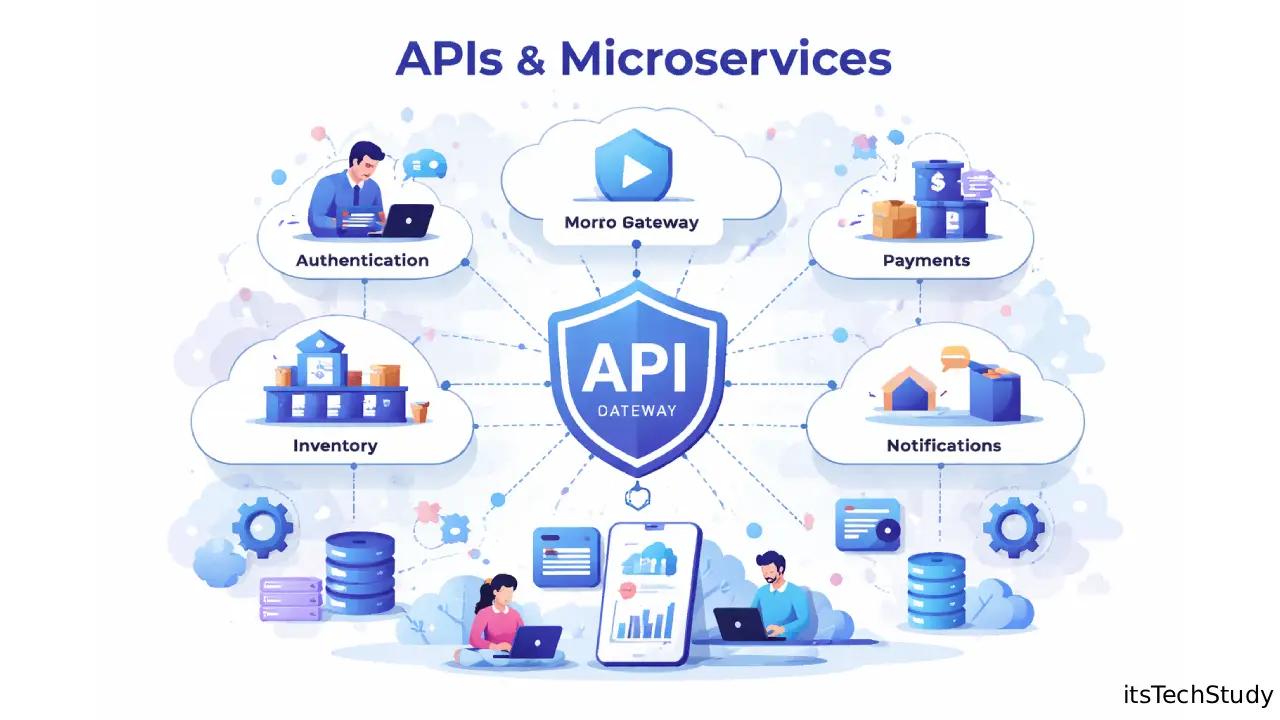
If you’ve spent any time around software architecture over the last decade, you’ve probably noticed a clear shift: applications are no longer being built as giant, all-in-one systems. Instead, teams are moving toward API-first development and microservices architecture to build software that scales faster, integrates more easily, and evolves without bringing the whole product down.
A few years ago, the conversation was mostly about “breaking the monolith.” In 2026, that conversation is much more mature. Now the real challenge isn’t whether to use APIs and microservices-it’s how to manage complexity, security, observability, and developer productivity once you do. As cloud-native systems expand and organizations run dozens-or even hundreds-of services, architecture decisions have become tightly connected to cost, performance, and business agility. Recent industry discussions from the cloud-native ecosystem show that platform engineering, API governance, and self-service infrastructure are becoming central to keeping microservices manageable at scale, especially in Kubernetes-heavy environments.
In simple terms, APIs are the contracts, and microservices are the building blocks. Together, they power everything from mobile apps and SaaS dashboards to AI workflows, eCommerce platforms, fintech systems, and enterprise automation. But while they offer huge flexibility, they also introduce real trade-offs: more network calls, more security exposure, more deployment overhead, and more moving parts to monitor.
This guide breaks down what APIs and microservices really mean in 2026, why they matter, where they shine, where they fail, and how to use them intelligently. Whether you’re a beginner, a startup founder, a developer, or a tech-savvy decision-maker, this article will help you understand why API-first architecture, microservices design, and cloud-native application development continue to shape the future of software.
What Are APIs and Microservices?
Before we go deeper, let’s clarify the fundamentals.
What Is an API?
An API (Application Programming Interface) is a defined way for one software system to communicate with another. Think of it like a waiter in a restaurant: the waiter takes your request, sends it to the kitchen, and brings the result back.
In software, APIs let different components exchange data or trigger actions without exposing internal implementation details.
Common API types in 2026 include:
- REST APIs for broad compatibility and simplicity
- GraphQL APIs for flexible frontend data fetching
- gRPC APIs for high-performance service-to-service communication
- Webhook APIs for event-driven integrations
- Async APIs using messaging systems like Kafka or NATS for distributed workflows
What Are Microservices?
Microservices are a software architecture style where an application is broken into small, independently deployable services, each responsible for a specific business capability.
For example, instead of one giant eCommerce app, you might have separate services for:
- User authentication
- Product catalog
- Shopping cart
- Payments
- Order processing
- Notifications
- Search
Each service can have its own codebase, database, deployment cycle, and scaling rules.
Why APIs and Microservices Matter More in 2026
Modern applications aren’t just websites anymore. They’re ecosystems.
A single product may need to support:
- Web apps
- Mobile apps
- Smart devices
- Third-party integrations
- AI agents
- Partner portals
- Internal dashboards
That’s exactly why API-first software development has become so important. APIs make it possible to serve all these channels from a shared backend foundation. Meanwhile, microservices let teams move quickly without stepping on each other’s work.
Industry coverage in 2025–2026 increasingly highlights that organizations are moving beyond simple API management into API governance, where design standards, documentation, security rules, and deployment policies are enforced earlier in the lifecycle. This is especially important as APIs become a major attack surface and as teams operate across multi-cloud or hybrid environments.
Key reasons adoption keeps growing
- Scalability – Scale only the services under load
- Faster development – Teams ship independently
- Better fault isolation – One service can fail without crashing the entire app
- Technology flexibility – Different services can use different stacks
- Multi-platform delivery – Same backend powers web, mobile, and external integrations
- AI readiness – AI tools and agents increasingly rely on structured APIs
APIs vs Microservices: What’s the Difference?
A lot of people use these terms together, but they’re not the same thing.
| Aspect | APIs | Microservices |
|---|---|---|
| Definition | Communication interface between systems | Architectural style for building apps |
| Primary Role | Expose data or functionality | Split app into smaller services |
| Can Exist Without the Other? | Yes | Usually rely on APIs |
| Common Use Cases | Integrations, frontend-backend communication | Scalable distributed systems |
| Examples | REST endpoint, GraphQL query, webhook | Auth service, payment service, search service |
The simple way to think about it
- API = the door
- Microservice = the room behind the door
A microservice usually exposes one or more APIs. But not every API belongs to a microservices system—monoliths can expose APIs too.
Core Benefits of API-First Microservices Architecture
When designed properly, APIs and microservices can dramatically improve software quality and business speed.
1. Independent Deployment
Each microservice can be updated without redeploying the entire platform.
Why this matters:
- Faster releases
- Lower deployment risk
- Easier rollback if something breaks
2. Team Autonomy
Different teams can own different services.
For example:
- The payments team handles billing APIs
- The identity team owns authentication
- The search team optimizes search performance
This aligns well with modern platform engineering and DevOps practices.
3. Better Scalability
If your checkout system gets heavy traffic during a sale, you scale that service—not the whole app.
4. Easier Integrations
A clean API layer makes it easier to connect:
- CRM tools
- Analytics platforms
- Payment gateways
- AI assistants
- Partner applications
5. Future-Proofing
API-first architecture supports headless systems, omnichannel delivery, and AI workflows far better than tightly coupled systems.
The Hidden Challenges of APIs and Microservices
This is where many teams get surprised.
Microservices sound elegant on diagrams, but real-world systems can become messy fast.
The biggest challenges in 2026
1. Operational Complexity
Instead of one app, you may now have 20, 50, or 200 services.
That means more:
- Deployments
- Logs
- Metrics
- Alerts
- Network calls
- Configuration files
- Secrets
Cloud-native experts continue to stress that once teams embrace Kubernetes and distributed systems, platform engineering and internal developer platforms become essential to reduce YAML sprawl, infrastructure friction, and cognitive overload.
2. API Security Risks
APIs are now one of the most exposed layers in modern applications. Recent industry reporting notes that as organizations add more APIs for partners, mobile apps, and AI agents, security has to be designed in from day one-not added later.
Common risks include:
- Broken authentication
- Excessive data exposure
- Missing rate limits
- Inconsistent authorization
- Zombie or undocumented APIs
- Weak secrets management
3. Distributed Debugging
A user clicks a button. That action triggers:
- Frontend call
- API gateway
- Auth service
- Product service
- Pricing service
- Inventory service
- Recommendation service
If something is slow, where’s the bottleneck?
Without distributed tracing, you’ll waste hours guessing.
4. Data Consistency
In monoliths, one transaction can update everything at once. In microservices, data often lives in separate databases.
That introduces:
- Eventual consistency
- Retry logic
- Duplicate events
- Saga patterns
- More complex failure handling
Pros and Cons of APIs & Microservices
Pros
- Excellent scalability for growing products
- Faster releases through independent deployments
- Better support for web, mobile, and partner integrations
- Easier team ownership and domain separation
- Improved resilience when designed well
- Strong fit for cloud-native and AI-ready systems
Cons
- More infrastructure and DevOps overhead
- Harder monitoring and troubleshooting
- Increased API security surface
- More complex data consistency patterns
- Risk of over-engineering for small projects
- Requires strong documentation and governance
Best Practices for APIs and Microservices in 2026
If you want the benefits without the chaos, follow these practical rules.
1. Start With Domain Boundaries, Not Tools
Don’t split services randomly.
Design around business domains such as:
- Orders
- Billing
- Users
- Notifications
- Inventory
This reduces coupling and makes ownership clearer.
2. Treat APIs as Products
Every API should have:
- Clear documentation
- Versioning strategy
- Ownership
- Rate limits
- Error standards
- SLAs or expectations
3. Use API Gateways Wisely
An API gateway helps centralize:
- Authentication
- Rate limiting
- Logging
- Request validation
- Traffic routing
It won’t solve bad architecture, but it creates important guardrails.
4. Invest in Observability Early
At minimum, implement:
- Logs for debugging
- Metrics for performance and health
- Traces for request flow across services
Popular stacks often include OpenTelemetry, Prometheus, Grafana, Datadog, or cloud-native alternatives.
5. Standardize Security
Use consistent patterns such as:
- OAuth 2.0 / OIDC
- JWT validation
- mTLS for internal traffic where needed
- Centralized secrets management
- Schema validation
- API inventory and discovery
- CI/CD security checks
6. Avoid “Microservice Everything” Syndrome
Not every app needs microservices.
A modular monolith is often smarter for:
- Early-stage startups
- Small teams
- MVPs
- Internal tools with limited scale
Monolith vs Microservices: Which Should You Choose?
This is still one of the most important architecture decisions.
| Criteria | Monolith | Microservices |
|---|---|---|
| Best for | Small apps, MVPs, simple products | Large systems, fast-growing platforms |
| Deployment | Single deployment | Independent deployments |
| Complexity | Lower initially | Higher from day one |
| Scaling | Scale the whole app | Scale individual services |
| Team Structure | Small/shared teams | Multiple specialized teams |
| Maintenance Over Time | Can become rigid | More flexible, but operationally heavier |
Rule of thumb
- Choose monolith or modular monolith if you’re early-stage
- Choose microservices when:
- You have multiple teams
- Clear domain boundaries exist
- Independent scaling matters
- Release speed is critical
- You can support DevOps and observability properly
Real-World Use Cases for APIs & Microservices
eCommerce Platforms
- Product APIs
- Inventory services
- Cart services
- Payment services
- Recommendation engines
Fintech Apps
- KYC services
- Fraud detection APIs
- Payment orchestration
- Ledger services
- Notifications
SaaS Products
- Multi-tenant account management
- Subscription billing
- Reporting APIs
- Integrations marketplace
AI-Powered Applications
- Model serving endpoints
- Retrieval APIs
- Workflow orchestration
- Agent tool access via APIs
Interestingly, recent academic research suggests AI agents can already generate functional microservices in many cases, especially when API contracts are clear, but fully autonomous generation still requires human oversight due to inconsistent correctness.
Common Mistakes Teams Make
Avoid these if you want a healthier architecture.
1. Splitting Too Early
Teams often break a simple app into too many services before they understand the domain.
2. Ignoring API Governance
Without naming standards, versioning rules, and documentation policies, service sprawl becomes unmanageable.
3. Skipping Observability
If you can’t trace a request end-to-end, production incidents become painful.
4. Inconsistent Security
Different auth methods across services create audit nightmares and risk exposure.
5. Tight Coupling Through Hidden Dependencies
If one service secretly depends on five others synchronously, you’ve recreated a distributed monolith.
Final Thoughts: APIs & Microservices Are Powerful-But Only With Discipline
In 2026, APIs and microservices are no longer just trendy architecture buzzwords. They are the operational backbone of modern digital products. From SaaS platforms and fintech apps to mobile ecosystems and AI-powered services, this architecture style makes it easier to build flexible, scalable, and integration-ready software.
But here’s the truth experienced teams learn the hard way: microservices don’t simplify software-they redistribute complexity.
You gain speed, modularity, and scalability. In exchange, you must invest in:
- API governance
- Security by design
- Observability
- Platform engineering
- Clear service boundaries
- Documentation discipline
If you’re building a small product, don’t force microservices too early. Start simple, stay modular, and evolve when the pain is real. If you’re scaling across teams and platforms, API-first microservices can become one of the smartest long-term bets you make-provided you treat architecture as an ongoing product, not a one-time diagram.
The winning teams in 2026 are not the ones with the most services. They’re the ones with the clearest contracts, strongest guardrails, and simplest developer experience.

About the Author
Amelia Morgan is a Editor at itsTechStudy.com with 15+ years of experience in the technology industry. I write about emerging innovations, AI, and digital trends-making complex topics simple and engaging for readers.
FAQ: APIs & Microservices
Q1: Are APIs and microservices the same thing?
Ans: No. APIs are communication interfaces, while microservices are an architectural pattern. A microservice usually exposes APIs, but APIs can also exist in monolithic applications.
Q2: Should startups use microservices from day one?
Ans: Usually, no. Most startups benefit more from a modular monolith at first. It’s faster to build, easier to debug, and cheaper to operate. Move to microservices when team size, scale, or deployment complexity truly justifies it.
Q3: What is the best API style for microservices in 2026?
Ans: There’s no single winner. REST remains the most common for public and general-purpose APIs gRPC is excellent for internal service-to-service performance GraphQL works well for frontend-heavy apps needing flexible queries Event-driven APIs are ideal for asynchronous workflows The best choice depends on latency, client needs, and system complexity.
Q4: Are microservices more secure than monoliths?
Ans: Not automatically. In fact, they can be less secure if every service implements auth, logging, and validation differently. Strong API gateways, centralized policy enforcement, consistent auth, and runtime visibility are essential.
Q5: What tools are commonly used with APIs and microservices?
Ans: Popular categories include: Containers: Docker Orchestration: Kubernetes API Gateways: Kong, Apigee, NGINX, AWS API Gateway Observability: OpenTelemetry, Prometheus, Grafana, Datadog Messaging: Kafka, RabbitMQ, NATS Service Mesh (optional): Istio, Linkerd
Q6: Can you migrate from a monolith to microservices gradually?
Ans: Yes-and that’s usually the smartest path. The most common strategy is to extract one business capability at a time using patterns like the Strangler Fig approach. Research on monolith-to-microservices migration continues to show that service identification and migration planning remain complex, especially at enterprise scale.







No Comments Yet
Be the first to share your thoughts.
Leave a Comment