


Introduction: Why AI-as-a-Service Matters Today
Just a decade ago, artificial intelligence felt like a distant dream available only to giant tech corporations with massive IT budgets and advanced research facilities. Building AI systems required costly infrastructure, powerful servers, expert data scientists, and years of development time. Most small and medium-sized businesses could never imagine integrating AI into their workflows.
Fast forward to today — the world has changed dramatically. AI now sits at the center of digital transformation, driving advancements in automation, personalization, data analytics, cybersecurity, healthcare, finance, retail, and almost every industry imaginable. But even with rapid adoption, one major challenge remains: implementing AI is still complex and expensive for many organizations.
That’s exactly where AI-as-a-Service (AIaaS) steps in.
AIaaS has emerged as a game-changing model that makes artificial intelligence accessible to everyone – from startups to large enterprises – through cloud-based, pay-as-you-go services. Companies no longer need to invest huge capital in hardware, machine learning platforms, or expert teams. Instead, they can subscribe to pre-built, scalable AI tools and deploy them within days rather than years.
In a world where data grows exponentially and decision-making requires speed and accuracy, AI-as-a-Service helps businesses stay competitive while reducing risk and cost. This article explores everything you need to know about AIaaS, including benefits, challenges, pricing models, use cases, and future trends – so you can determine whether it’s the right solution for your organization.
What Is AI-as-a-Service (AIaaS)?
AI-as-a-Service refers to cloud-based platforms that offer artificial intelligence capabilities and tools – such as machine learning, natural language processing, computer vision, automation, and predictive analytics – through subscription-based or usage-based pricing models.
Instead of building custom AI solutions internally, companies can access ready-to-use AI tools delivered via major cloud providers like Amazon Web Services (AWS), Google Cloud AI, IBM Watson, Microsoft Azure AI, and dozens of specialized AIaaS vendors.
How AIaaS Works
AIaaS providers host AI models, algorithms, computing resources, development tools, and APIs on the cloud. Businesses integrate these services into their software, websites, or workflows without managing the infrastructure behind them.
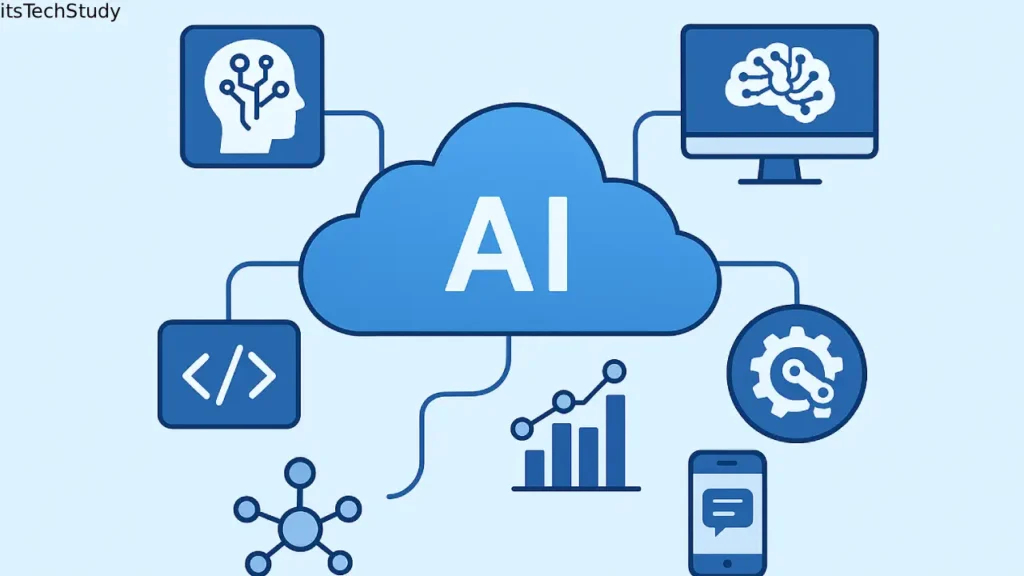
The typical AIaaS stack includes:
- AI model training and deployment tools
- Pre-trained AI models
- API-based integration interfaces
- Data storage & processing resources
- User dashboards & automation workflows
- Security & compliance layers
What Makes AI-as-a-Service So Powerful?
The true advantage of AIaaS lies in democratization. It removes entry barriers and enables:
- Faster implementation
- Lower initial investment
- Real-time scalability
- Experimentation without financial risk
Why Businesses Are Rapidly Adopting AI-as-a-Service
In today’s competitive landscape, speed, automation, accuracy, and efficiency define success. AIaaS helps companies transform operations, personalize experiences, predict outcomes, and reduce workload – all within budget.
Key Benefits of AIaaS for Organizations
| Benefit | Description |
|---|---|
| Cost-Efficiency | Eliminates high infrastructure and development costs. |
| Scalability | Scale resources up or down based on usage with flexibility. |
| Faster Deployment | Pre-built AI tools reduce deployment time from years to weeks. |
| Accessibility | Makes advanced AI technology available to businesses of all sizes. |
| Reduced Risk | Pay-as-you-go pricing minimizes financial uncertainty. |
| Access to Experts | Provider includes technical support and advanced research. |
| Continuous Upgrades | Automatic updates and improvements without disruption. |
Common Use Cases of AI-as-a-Service Across Industries
AIaaS is transforming nearly every sector. Here are real-world examples:
Healthcare
- AI-powered medical diagnostics & radiology image analysis
- Predictive analytics for patient care and treatment planning
- Virtual health assistant chatbots for 24/7 support
Finance & Banking
- Fraud detection using machine learning
- Automated risk scoring and credit assessment
- AI-based algorithmic trading and forecasting
Retail & E-commerce
- Personalized product recommendations
- Customer behavior prediction and inventory forecasting
- Automated chatbot customer service
Manufacturing
- Predictive maintenance for equipment
- Quality inspection with computer vision
- Robotics automation in production lines
Education
- Smart learning platforms and digital tutors
- Student performance analytics
- AI-supported grading & evaluation
Marketing & Customer Experience
- AI-driven content generation and personalization
- Customer segmentation and behavior modeling
- Real-time sentiment and social listening analytics
Popular AIaaS Providers and What They Offer
| Provider | Major AI Services | Target Users |
|---|---|---|
| Google Cloud AI | ML, Vision, NLP, AutoML | Developers, enterprises |
| Microsoft Azure AI | Cognitive services, ML Studio, Speech AI | Large industries & hybrid users |
| IBM Watson | NLP, speech recognition, virtual assistants | Healthcare, finance, enterprises |
| AWS AI & ML | Deep learning, personalization, analytics | Scalable cloud customers |
| OpenAI & Anthropic APIs | LLMs, chatbots, generative AI | SaaS, productivity, automation tools |
AI-as-a-Service Pricing Models
AIaaS pricing varies based on provider and usage. Common models include:
1. Pay-Per-Use
Ideal for testing and small workloads.
- Charges based on number of API calls, processing hours, or data volume.
2. Subscription-Based
Monthly or annual plans with set resource limits.
3. Tiered Plans
Basic, standard, and enterprise levels with different feature sets.
4. Custom Enterprise Contracts
For large-scale organizations needing dedicated infrastructure.
Pros and Cons of AI-as-a-Service
Pros
- Affordable and flexible implementation
- Eliminates technical complexity
- Speeds up innovation and product development
- Easier scalability and resource management
- Access to cutting-edge AI without expertise
Cons
- Potential data security and privacy concerns
- Vendor dependency and lock-in risk
- Limited customization in pre-built models
- Performance relies on cloud connectivity
Challenges and Risks Associated With AI-as-a-Service
Even though AIaaS simplifies AI adoption, businesses should be aware of potential obstacles:
Key Challenges
- Managing sensitive information and compliance regulations
- Integration difficulties with outdated legacy systems
- Model accuracy variations and lack of transparency
- Ethical concerns around algorithmic bias
- Unexpected cost spikes with heavy data usage
How to Overcome These Challenges
- Choose vendors with strong encryption & compliance certifications
- Conduct accuracy testing before deployment
- Use hybrid cloud or on-premise models as needed
- Train internal teams for AI governance
Future Trends in AI-as-a-Service
The future of AIaaS looks incredibly promising. Some upcoming developments include:
- Generative AI expansion across industries for creative automation
- More domain-specific AI models built for healthcare, finance, supply chain, and education
- AI-powered cybersecurity for smarter threat detection
- Edge AI + AIaaS integration reducing latency and enabling real-time processing
- AI automation platforms replacing traditional software
- Multi-cloud AIaaS ecosystems to avoid vendor lock-in
As AI continues to evolve, AIaaS will become a backbone technology for digital transformation, entrepreneurship, large-scale innovation, and global economic growth.
Conclusion: Is AI-as-a-Service Worth It?
AI-as-a-Service is more than a technology trend – it is a revolutionary approach that levels the playing field and brings the power of AI to organizations of all sizes. With its flexible pricing, scalability, low barrier to entry, and rapidly expanding capabilities, AIaaS enables companies to innovate faster, reduce operational costs, and unlock transformative results without massive investment.
As industries continue to digitize and automation becomes essential for survival, AIaaS will remain one of the most impactful enablers of growth and competitive advantage. Whether you are a startup exploring automation or a large enterprise scaling AI models globally, now is the perfect time to adopt AI-as-a-Service and shape the future of intelligent business.

About the Author
Amelia Morgan is a Editor at itsTechStudy.com with 15+ years of experience in the technology industry. I write about emerging innovations, AI, and digital trends-making complex topics simple and engaging for readers.
FAQs About AI-as-a-Service
Q1: Is AI-as-a-Service expensive to implement?
Ans: Not at all. AIaaS follows a pay-as-you-go model, eliminating upfront hardware and development costs, making AI affordable even for small businesses.
Q2: What industries benefit most from AIaaS?
Ans: Retail, manufacturing, healthcare, banking, education, and marketing have seen the biggest transformations, but AIaaS can be applied to almost any industry.
Q3: Can AIaaS replace human employees?
Ans: AIaaS automates tasks, not people. It helps reduce repetitive workloads and allows employees to focus on creative and strategic work.
Q4: Is my data secure when using AIaaS providers?
Ans: Reputable AIaaS vendors follow enterprise-grade security standards, including encryption, access controls, and compliance certifications. Businesses should still evaluate policies before adoption.
Q5: Do I need technical knowledge to use AI-as-a-Service?
Ans: Not always. Many AIaaS tools offer no-code or low-code environments suitable for beginners.
Q6: What is the difference between AIaaS and MLaaS?
Ans: MLaaS focuses specifically on machine learning tools, whereas AIaaS includes a broader set of intelligent capabilities beyond ML — such as NLP, robotics, automation, and computer vision.





No Comments Yet
Be the first to share your thoughts.
Leave a Comment