

Introduction: From Scripted Bots to Intelligent Conversations
Not long ago, interacting with chatbots felt frustrating. You typed a simple question, and the bot responded with something irrelevant or robotic. These early rule-based chatbots were limited, brittle, and often added more friction than value. But as digital platforms scaled and user expectations grew, businesses faced a serious challenge: how do you offer instant, personalized, and scalable communication without overwhelming human support teams?
This problem became even more visible with the rise of e-commerce, SaaS platforms, mobile apps, and 24/7 global users. Customers wanted fast answers, contextual understanding, and human-like conversations – not canned replies.
That’s where AI-powered chatbots using Natural Language Processing (NLP) entered the picture. Powered by machine learning, deep learning, and linguistic models, modern chatbots can understand intent, context, sentiment, and even ambiguity. Today, they are not just support tools – they are digital assistants, sales agents, onboarding guides, and productivity boosters.
In this article, we’ll explore how AI-powered chatbots work, the role of NLP, real-world use cases, benefits, limitations, and where this technology is headed next.
What Are AI-Powered Chatbots?
AI-powered chatbots are software applications that simulate human conversation using artificial intelligence technologies, particularly Natural Language Processing (NLP) and machine learning.
Unlike traditional rule-based bots that follow predefined scripts, AI chatbots learn from data. They interpret user inputs, understand intent, and generate contextually relevant responses.
Key Characteristics of AI Chatbots
- Understand natural, conversational language
- Learn from previous interactions
- Handle complex and multi-turn conversations
- Improve accuracy over time
- Integrate with business systems and APIs
These chatbots are widely used across websites, mobile apps, messaging platforms, and enterprise tools.
Understanding Natural Language Processing (NLP)
Natural Language Processing is the branch of AI that enables machines to read, understand, interpret, and respond to human language.
Human language is messy. It includes slang, typos, sarcasm, multiple meanings, and cultural nuances. NLP bridges the gap between how humans communicate and how machines process data.
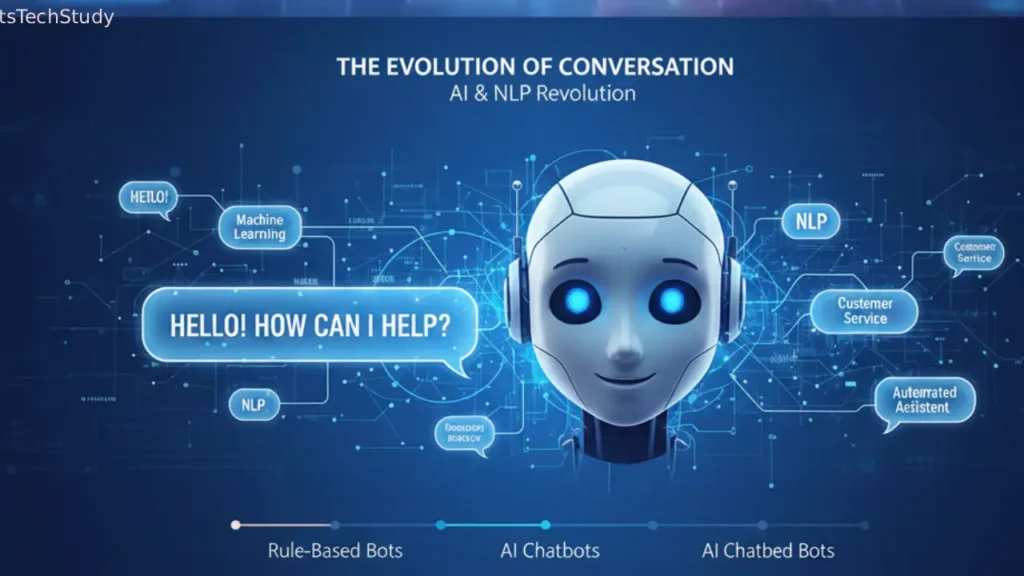
Core Components of NLP in Chatbots
1. Natural Language Understanding (NLU)
NLU helps the chatbot determine:
- User intent (what the user wants)
- Entities (specific details like dates, names, locations)
- Context and meaning
2. Natural Language Generation (NLG)
NLG allows the chatbot to:
- Construct grammatically correct responses
- Maintain conversational tone
- Adapt replies based on context and user history
3. Sentiment Analysis
This helps chatbots detect:
- Emotions (happy, frustrated, angry)
- Urgency or dissatisfaction
- Tone of the conversation
How AI-Powered Chatbots Work Step by Step
To understand the real power of NLP chatbots, let’s break down how a typical interaction works:
- User Input – A user types or speaks a message
- Text Processing – The chatbot cleans and tokenizes the text
- Intent Recognition – NLP models identify what the user wants
- Context Handling – Conversation history is analyzed
- Response Generation – The system generates or retrieves an answer
- Learning Loop – Feedback is stored to improve future responses
This entire process happens in milliseconds, delivering fast and relevant replies.
Types of AI-Powered Chatbots
Rule-Based vs AI-Based Chatbots
| Feature | Rule-Based Chatbots | AI-Powered Chatbots |
|---|---|---|
| Learning Capability | No | Yes |
| NLP Support | Limited | Advanced |
| Flexibility | Low | High |
| Scalability | Limited | Highly scalable |
| User Experience | Rigid | Conversational |
Common AI Chatbot Categories
- Customer Support Chatbots
- Sales & Lead Generation Bots
- Virtual Assistants
- Healthcare Chatbots
- HR & Internal Helpdesk Bots
- Educational Chatbots
Real-World Use Cases of NLP Chatbots
Customer Support Automation
AI chatbots handle FAQs, troubleshoot issues, and escalate complex cases, reducing response times and support costs.
E-commerce & Retail
Chatbots recommend products, track orders, and personalize shopping experiences using user behavior and preferences.
Healthcare Assistance
From appointment scheduling to symptom checking, NLP chatbots help streamline patient communication.
Banking & Finance
Chatbots assist with balance inquiries, transaction history, fraud alerts, and financial advice.
Education & E-Learning
AI tutors help students with instant answers, quizzes, and personalized learning paths.
Benefits of AI-Powered Chatbots:
Key Advantages
- 24/7 Availability – Always online, no downtime
- Cost Efficiency – Reduce dependency on human agents
- Scalability – Handle thousands of conversations simultaneously
- Personalization – Tailored responses based on user data
- Improved Customer Satisfaction – Faster, smarter support
Business Impact
- Higher engagement rates
- Increased conversions
- Reduced operational costs
- Improved customer retention
Pros and Cons of AI-Powered Chatbots
Pros
- Instant responses
- Consistent communication
- Multilingual support
- Continuous learning
- Easy integration with CRM and tools
Cons
- Initial setup cost
- Requires quality training data
- May struggle with sarcasm or humor
- Limited emotional intelligence compared to humans
Understanding these trade-offs helps businesses implement chatbots strategically.
Challenges in NLP Chatbot Development
Despite rapid advancements, NLP chatbots face several challenges:
- Ambiguous language interpretation
- Context retention in long conversations
- Bias in training data
- Privacy and data security concerns
- Handling edge cases gracefully
Overcoming these requires better datasets, model tuning, and human oversight.
Best Practices for Building Effective AI Chatbots
- Define clear use cases
- Train with diverse, real-world data
- Continuously monitor and optimize performance
- Combine AI with human fallback options
- Focus on conversational UX, not just automation
Future Trends in AI-Powered Chatbots
The future of AI chatbots is deeply exciting. We’re moving toward:
- Emotionally aware chatbots
- Voice-enabled conversational AI
- Multimodal chatbots (text + voice + images)
- Hyper-personalized conversations
- Deeper integration with business intelligence systems
As NLP models evolve, chatbots will become even more human-like, intuitive, and proactive.
Conclusion: The Conversational Future Is Already Here
AI-powered chatbots using NLP have transformed how businesses interact with users. They solve real communication challenges by delivering speed, scale, and personalization – all while continuously learning and improving.
As conversational AI matures, organizations that invest early in intelligent chatbot strategies will gain a competitive edge. The key lies in balancing automation with empathy, technology with trust, and innovation with responsibility.
The future of digital interaction isn’t just automated – it’s conversational.

About the Author
Amelia Morgan is a Editor at itsTechStudy.com with 15+ years of experience in the technology industry. I write about emerging innovations, AI, and digital trends-making complex topics simple and engaging for readers.
Frequently Asked Questions (FAQ)
Q1: What makes AI-powered chatbots different from traditional chatbots?
Ans: AI chatbots use NLP and machine learning to understand context and intent, unlike rule-based bots that follow predefined scripts.
Q2: Are NLP chatbots suitable for small businesses?
Ans: Yes. Many cloud-based chatbot platforms offer scalable solutions suitable for startups and small businesses.
Q3: How accurate are AI chatbots?
Ans: Accuracy depends on training data quality, model selection, and continuous optimization.
Q4: Can AI chatbots replace human agents?
Ans: They complement humans by handling routine tasks, but complex or emotional issues still require human involvement.
Q5: Are AI chatbots secure?
Ans: When properly designed with encryption and compliance measures, AI chatbots can be highly secure.

No Comments Yet
Be the first to share your thoughts.
Leave a Comment