

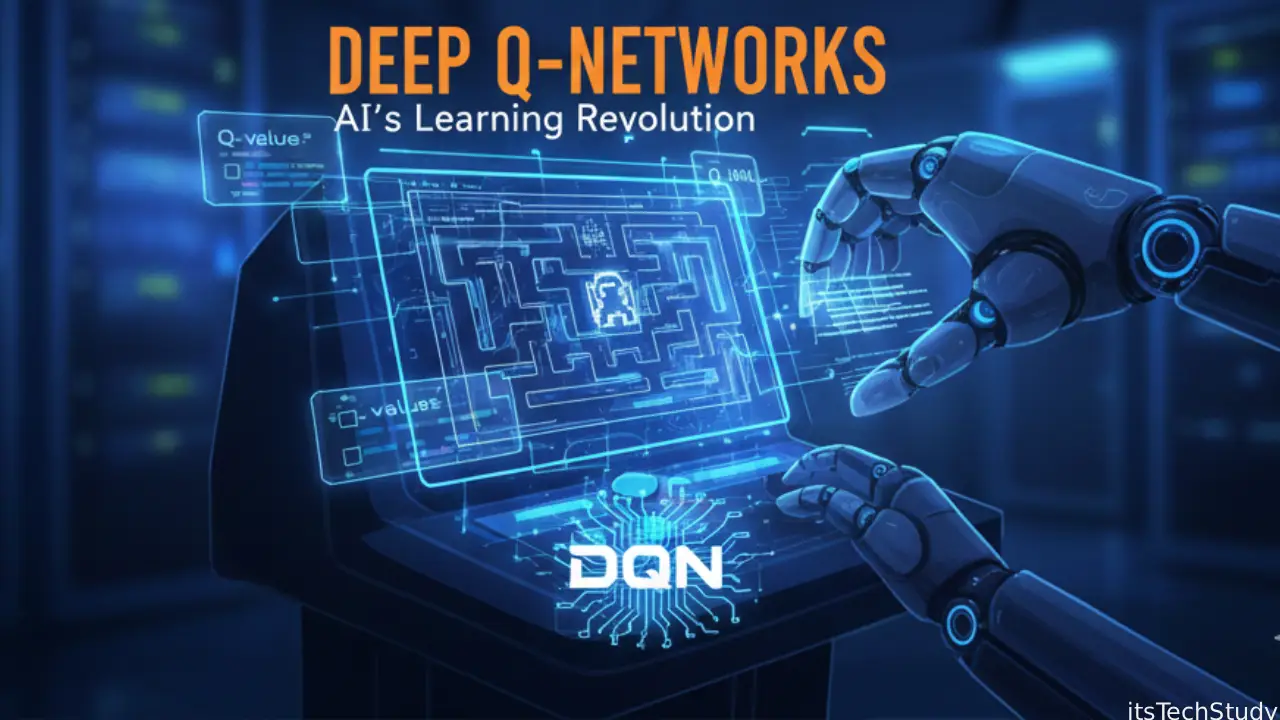
Introduction: Why Traditional Reinforcement Learning Hit a Wall
For years, reinforcement learning (RL) followed a fairly simple promise: let an agent interact with an environment, reward good behavior, punish bad decisions, and eventually intelligence emerges. Early successes using Q-learning proved this idea could work-but only in small, well-defined environments.
As soon as problems became complex-think video games, robotics, or real-world decision systems-classic Q-learning started to collapse under its own weight. The reason was painfully clear: state spaces grew too large to store Q-values in tables. A simple game could require millions of states, making traditional approaches impractical.
This bottleneck forced researchers to ask a critical question:
What if neural networks could approximate Q-values instead of storing them explicitly?
That question led to one of the most important breakthroughs in modern AI: Deep Q-Networks (DQN). By combining deep learning with reinforcement learning, DQN unlocked the ability for machines to learn directly from raw, high-dimensional data-forever changing the trajectory of artificial intelligence.
What Is a Deep Q-Network (DQN)?
A Deep Q-Network (DQN) is an advanced reinforcement learning algorithm that uses a deep neural network to approximate the Q-value function. Instead of relying on a lookup table, DQN learns a function that maps states and actions to expected future rewards.
At its core, DQN answers one fundamental question:
Given the current state, which action should the agent take to maximize long-term reward?
Key Components of DQN
DQN blends concepts from both reinforcement learning and deep learning:
- Agent – The decision-maker (AI model)
- Environment – The world the agent interacts with
- State – The current situation observed by the agent
- Action – A choice the agent can make
- Reward – Feedback received after an action
- Q-function – Estimates the value of taking an action in a state
What makes DQN special is its ability to generalize across unseen states, something classic Q-learning simply cannot do.
Why Deep Q-Networks Were a Game-Changer
The real breakthrough moment for DQN came when researchers demonstrated that an AI could learn to play Atari games directly from raw pixel input-no handcrafted rules, no domain-specific tricks.
This achievement proved that DQN could:
- Handle high-dimensional input
- Learn end-to-end decision-making
- Adapt to complex, dynamic environments
Problems DQN Solved
- State space explosion in traditional Q-learning
- Manual feature engineering
- Limited scalability of tabular methods
In short, DQN made reinforcement learning practical for real-world problems.
How Deep Q-Networks Work (Step-by-Step)
1. Neural Network as a Q-Function Approximator
Instead of storing Q-values, DQN uses a neural network that takes a state as input and outputs Q-values for all possible actions.
2. Experience Replay
To stabilize learning, DQN stores past experiences in a replay buffer. During training, random samples are drawn from this buffer, which:
- Breaks correlation between sequential experiences
- Improves data efficiency
- Reduces variance during updates
3. Target Network for Stability
DQN introduces a target network, a delayed copy of the main network, to compute stable target Q-values. This simple idea dramatically reduces training instability.
Core DQN Architecture Explained
Online Network vs Target Network
- Online Network – Learns and updates weights continuously
- Target Network – Updates periodically to provide stable learning targets
This dual-network setup is one of the most critical innovations behind DQN’s success.
Deep Q-Network Training Process
- Observe the current state
- Choose an action using an ε-greedy strategy
- Receive reward and next state
- Store experience in replay memory
- Sample random mini-batch
- Update neural network using loss minimization
- Periodically update target network
Key Enhancements to Basic DQN
Over time, researchers introduced improvements to fix DQN’s weaknesses:
- Double DQN – Reduces overestimation bias
- Dueling DQN – Separates value and advantage estimation
- Prioritized Experience Replay – Focuses on more informative experiences
DQN vs Traditional Q-Learning
| Feature | Q-Learning | Deep Q-Network (DQN) |
|---|---|---|
| State Representation | Tabular | Neural Network |
| Scalability | Low | High |
| Handles Raw Input | No | Yes |
| Memory Requirement | High | Efficient |
| Real-World Usability | Limited | Practical |
Pros and Cons of Deep Q-Networks
Pros
- Scales to complex environments
- Learns directly from raw data
- Eliminates manual feature engineering
- Proven success in games and simulations
Cons
- Training can be unstable
- Requires large computational resources
- Sensitive to hyperparameters
- Not ideal for continuous action spaces
Real-World Applications of DQN
Gaming and Simulations
- Atari games
- Strategy simulations
- Competitive AI agents
Robotics
- Path planning
- Object manipulation
- Control systems
Business and Technology
- Recommendation systems
- Resource allocation
- Automated decision-making systems
Conclusion: Why DQN Still Matters Today
Deep Q-Networks marked a turning point in artificial intelligence, proving that deep learning and reinforcement learning are far more powerful together than apart. While newer algorithms continue to evolve, DQN remains a foundational concept every AI enthusiast should understand.
If you’re exploring game AI, robotics, or intelligent decision systems, mastering DQN isn’t just useful-it’s essential. As reinforcement learning continues to shape the future of automation, DQN stands as the algorithm that opened the door.

About the Author
Tobias Hale is a technology writer and software analyst with a sharp eye on the ever-evolving world of digital innovation. With a deep passion for clean code, secure systems, and emerging technologies, Tobias brings clarity to complex topics - from the latest in operating system updates to cutting-edge software security practices.
Frequently Asked Questions (FAQ)
Q1: What problem does DQN solve in reinforcement learning?
Ans: DQN solves the limitation of traditional Q-learning by handling large and complex state spaces using neural networks instead of tables.
Q2: Is DQN suitable for beginners in reinforcement learning?
Ans: Yes, but it’s recommended to understand basic Q-learning concepts before diving into DQN implementations.
Q3: Why does DQN use experience replay?
Ans: Experience replay stabilizes learning by breaking correlations between consecutive experiences and improving sample efficiency.
Q4: What is the role of the target network?
Ans: The target network provides stable Q-value targets, preventing rapid oscillations during training.
Q5: Can DQN handle continuous action spaces?
Ans: No, DQN is best suited for discrete action spaces. Other algorithms like DDPG are used for continuous actions.



No Comments Yet
Be the first to share your thoughts.
Leave a Comment