


In the fast-paced software engineering world today, developers continually struggle with creating scalable, efficient, and easy-to-maintain systems. With applications becoming more complex-ranging from cloud computing, AI-based analytics, and distributed systems-code quality and data consistency maintenance is a major issue.
That’s where Abstract Data Types (ADTs) come into play as an ageless yet potent idea in computer science. Although not groundbreaking, ADTs never felt more appropriate. They provide a structured, modular way to design systems, keeping your code tidy, efficient, and resilient to change – the holy grail for contemporary programmers.
In this article, we will delve into how ADTs shape software design in today’s age, why they are important in 2025’s technological era, and how you can use them to construct stable and future-proof systems.
Abstract Data Types (ADTs) play a critical role in designing efficient and scalable software systems, providing a structured way to define data and operations without exposing internal implementation details. By focusing on what a data type should do rather than how it works, ADTs allow developers to build modular, maintainable, and reusable components that can evolve without affecting the overall system architecture. Whether implementing stacks, queues, lists, trees, or more complex structures, ADTs make it easier to manage complexity, improve performance, and ensure reliability in real-world applications. From operating systems and database engines to large-scale enterprise solutions, the use of ADTs helps teams develop cleaner code, enhance system flexibility, and create software that can adapt to future requirements-making them essential for modern software engineering and professional development in computer science.
Designing improved systems with Abstract Data Types (ADT) is a foundational practice in modern software engineering that helps developers build scalable, maintainable, and error-resistant applications. By separating what a data structure does from how it is implemented, ADTs encourage cleaner architecture, better code readability, and stronger abstraction boundaries. This approach allows teams to modify internal logic without affecting dependent components, making systems easier to test, refactor, and extend over time. Whether applied in large enterprise platforms or performance-critical applications, ADTs promote consistency and reliability by enforcing well-defined interfaces, reducing coupling, and improving collaboration across development teams. For tech professionals aiming to design robust systems that adapt to evolving requirements, Abstract Data Types remain a practical and timeless design principle.
What is an Abstract Data Type (ADT)?
An Abstract Data Type (ADT) is a conceptual description of the organization of the data and the operations permitted on the data, without detailing how these operations are performed.
Consider it to be specification of what you do, not how you do it.
For Example:
- A Stack permits push, pop, and peek operations.
- A Queue permits enqueue and dequeue.
- A List permits inserting, deleting, or searching an element.
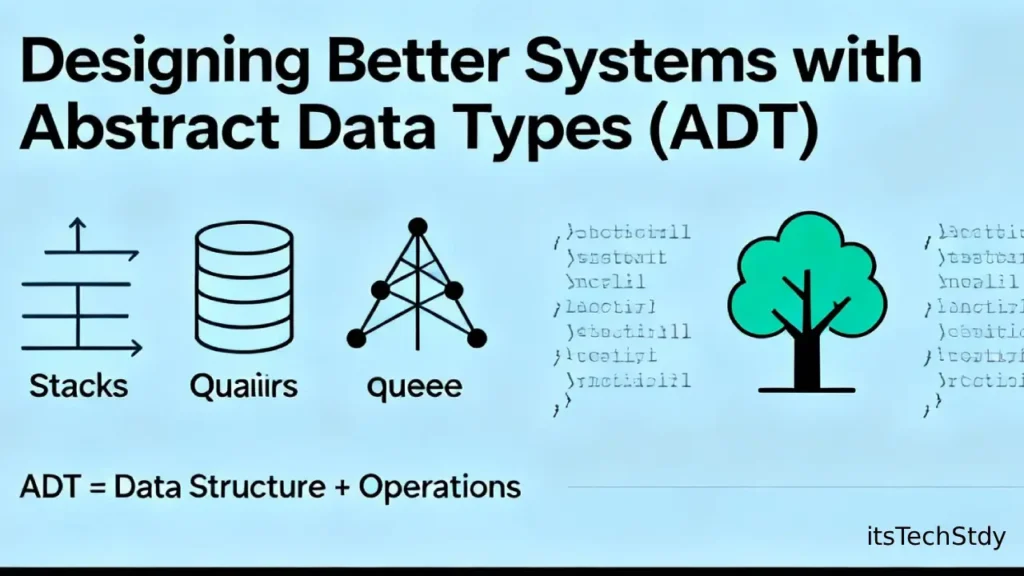
In all these instances, the user is not concerned with how these operations are implemented internally – only that they must function as described. This abstraction enables developers to focus on logic and architecture instead of low-level minutiae.
Why ADTs Are Important in Contemporary System Design
The more complex systems get, the more critical abstraction and modularity become in coping with the complexity. ADTs offer a clean separation between interface (what can be done) and implementation (how it’s done).
The following reasons represent why ADTs are important in today’s development landscape:
- Enhanced Maintainability: It won’t change the rest of the system if implementation details change.
- Code Reusability: ADTs can be defined once and used everywhere in different modules.
- Scalability: Abstracting the data logic makes scaling or porting systems easier.
- Error Reduction: Uniform interfaces minimize logical errors and inconsistencies.
- Encapsulation: Data and behavior remain together, enhancing security and design transparency.
Real-World Applications of ADTs in Software Engineering
Even though you may not know it, you’re already using ADTs on a daily basis. Most programming libraries and APIs depend upon them.
| Use Case | Example ADT | Application Area |
|---|---|---|
| Data Caching | Stack, Queue | Memory optimization, Task scheduling |
| OS Process Management | Queue | Process scheduling and load balancing |
| AI Algorithms | Tree, Graph | Decision trees, Neural network structures |
| Databases | List, Set, Map | Data storage and retrieval operations |
| Cybersecurity | Hash Tables | Encryption, digital signatures |
| Cloud Infrastructure | Graph | Network mapping and dependency tracking |
These are just a few examples of the way abstract data types are central to almost every contemporary software system – from AI models to cyber-security frameworks.
How ADTs Help Build Better Systems
Let’s see how ADTs contribute to making cleaner, more efficient, and scalable systems.
- Encouraging Modularity
ADTs impose a separation of concerns between what an object can do and how it does it. This modularity allows individual components to change independently.
- Facilitating Scalable Architecture
When programs scale, ADTs enable you to optimize or interchange implementations without reprogramming the whole system. For example, an initial list-based queue can then be upgraded with a circular buffer queue for performance.
- Streamlining Testing and Debugging
Unit testing an ADT involves checking its interface, not its internal workings. This makes unit testing easier and debugging quicker.
- Improving Security through Encapsulation
ADTs assist in the implementation of data hiding, so that data can be accessed only via specified operations, minimizing vulnerabilities in essential systems.
Widely Used Abstract Data Types and Their Applications
We will discuss the most common ADTs and how they pragmatically influence software development.
| ADT Type | Core Operations | Common Implementations | Use Cases |
|---|---|---|---|
| Stack | Push, Pop, Peek | Arrays, Linked Lists | Function calls, Undo/Redo operations |
| Queue | Enqueue, Dequeue | Arrays, Linked Lists | Task scheduling, Messaging systems |
| List | Insert, Delete, Traverse | Arrays, Linked Lists | Ordered data storage |
| Set | Add, Remove, Search | Hash Tables, Trees | Membership testing, Unique value storage |
| Map (Dictionary) | Put, Get, Remove | Hash Tables, Balanced Trees | Key-value lookups |
| Graph | Add Node, Add Edge, Search | Adjacency Matrix/List | Routing, Network topology |
| Tree | Insert, Delete, Traverse | Binary Tree, AVL Tree | Hierarchical data representation |
Pros and Cons of Using ADTs
Although ADTs are rich, it’s essential to know their pros and cons prior to designing large-scale systems.
Pros
- High Reusability: An ADT can be reused in multiple projects once defined.
- Flexibility: Simple to modify or expand without having to rewrite dependent code.
- Better Readability: Makes complex systems easier to comprehend.
- Better Code Discipline: Promotes clean architecture and object-oriented development.
Cons
- Implementation Overhead: Can take additional design effort upfront.
- Performance Trade-offs: Abstraction at times compromises low-level optimization.
- Learning Curve: New programmers may have difficulty comprehending the abstract design pattern at first.
ADTs and Object-Oriented Programming (OOP)
Classes and interfaces in OOP are direct implementations of ADTs.
For example:
- A class specifies both data and operations – similar to an ADT.
- An interface declares behavior without implementation – mirroring ADT concepts.
This convergence makes ADTs the backbone of programming paradigms today, from Java interfaces to Python abstract base classes.
Designing a System Using ADTs: A Step-by-Step Guide
Here’s an easy way to design a clean, ADT-based system:
- Identify Core Operations: What does your system need to do? (e.g., store, retrieve, search, process)
- Define ADTs for Each Function: Decide which abstract operations best represent your data logic.
- Choose Implementations: Use suitable data structures (e.g., linked list, tree, hash map).
- Integrate ADTs into Modules: Keep your logic modular, allowing easy upgrades later.
- Test at the Interface Level: Focus on verifying that each ADT behaves correctly.
This approach keeps your design modular, adaptable, and maintainable, aligning perfectly with modern software engineering principles.
Future of ADTs in 2025 and Beyond
As AI, data engineering, and cloud-native computing are rapidly evolving, ADTs are gaining relevance again.
- Graph and tree ADTs form the foundation for model representation in AI frameworks.
- Distributed systems employ queues and hash maps for routing data.
- Blockchain and Web3 designs utilize sets and graphs to validate transactions and manage nodes.
As we enter 2025, ADTs mastery equips you with a solid platform to comprehend next-generation technologies – ranging from machine learning workflows to cloud high-performance systems.
ADTs specify what operations can be done, whereas data structures indicate how operations are carried out.
Conclusion: Building Future-Ready Systems with ADTs
In an age where technology evolves faster than ever, Abstract Data Types (ADTs) offer a timeless framework for building clean, scalable, and maintainable systems.
They empower developers to think abstractly, code modularly, and innovate fearlessly — all while maintaining system clarity and performance.
Whether you’re developing AI-driven platforms, cloud-native applications, or enterprise software, mastering ADTs is a key step toward becoming a smarter, future-ready developer.

About the Author
Amelia Morgan is a Editor at itsTechStudy.com with 15+ years of experience in the technology industry. I write about emerging innovations, AI, and digital trends-making complex topics simple and engaging for readers.
Frequently Asked Questions (FAQ)
Q1: What is the main purpose of an Abstract Data Type (ADT)?
Ans: ADTs provide a way to define data and operations without exposing implementation details. This abstraction simplifies system design and promotes reusability.
Q2: How do ADTs differ from Data Structures?
Ans: ADTs describe what operations can be performed, while data structures define how those operations are implemented.
Q3: Are ADTs used in object-oriented programming languages?
Ans: Yes, OOP languages like Java, Python, and C++ heavily rely on ADTs through interfaces, abstract classes, and encapsulation mechanisms.
Q4: Why are ADTs important for large-scale software systems?
Ans: They help maintain system integrity, make scaling easier, and reduce coupling between modules — essential for enterprise-grade software.
Q5: What’s an example of an ADT in everyday programming?
Ans: Common examples include Stack, Queue, Set, Map, and Graph, all of which are used in APIs, databases, and algorithm design.
Q6: Can ADTs improve code performance?
Ans: Indirectly, yes. By allowing efficient data structure swaps and modular optimization, ADTs enhance maintainability and performance tuning flexibility.






No Comments Yet
Be the first to share your thoughts.
Leave a Comment