

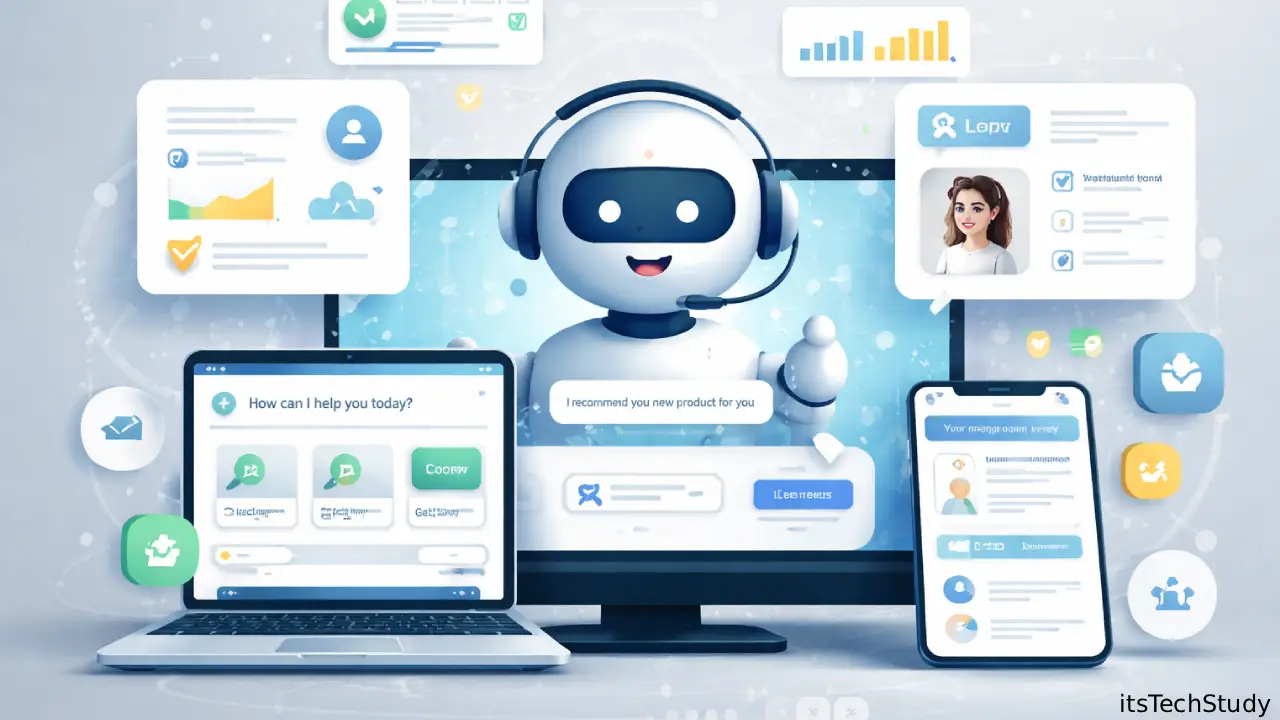
For years, chatbots had a reputation problem.
Most people associated them with frustrating customer support pop-ups, rigid decision trees, and canned replies that felt more like automated roadblocks than helpful digital assistants. You asked a simple question, and the bot pushed you into a loop of “Please choose from the following options.” It was efficient for companies, maybe – but rarely delightful for users.
That’s exactly why generative chatbots have become one of the most important technology shifts in recent years.
Unlike traditional bots, generative chatbots can understand context, generate human-like responses, summarize information, reason through follow-up questions, and adapt to different conversation styles. In practical terms, they’re changing how businesses handle customer support, internal knowledge management, sales enablement, onboarding, content assistance, and even workflow automation.
In 2026, this is no longer a niche experiment. Industry research suggests enterprise adoption of generative AI is accelerating rapidly, with many organizations moving beyond pilots and into production systems, especially in customer service and productivity workflows. At the same time, businesses are learning a hard truth: a chatbot that “sounds smart” is not enough. Accuracy, integration, governance, and user trust now matter just as much as conversational quality.
So if you’re a founder, developer, marketer, support leader, or simply a tech enthusiast trying to understand where conversational AI is heading, this guide breaks it down in a clear, practical way.
What Are Generative Chatbots?
A generative chatbot is an AI-powered conversational system that uses large language models (LLMs) or related generative AI models to create dynamic, context-aware responses in natural language.
Instead of relying only on predefined rules or scripted flows, generative chatbots can:
- Interpret open-ended user questions
- Maintain conversational context
- Generate unique responses in real time
- Pull information from connected data sources
- Summarize documents, tickets, or chat history
- Escalate or hand off to human agents when needed
In simple terms, they’re the next evolution of AI chatbots and conversational AI.
Traditional Chatbots vs Generative Chatbots
| Feature | Traditional Chatbots | Generative Chatbots |
|---|---|---|
| Response Style | Predefined / scripted | Dynamic / AI-generated |
| Flexibility | Limited | High |
| Handles Follow-up Questions | Often weak | Stronger contextual memory |
| Integration with Knowledge Bases | Basic | Advanced with RAG and APIs |
| Personalization | Minimal | High potential |
| Best Use Case | FAQs, simple routing | Support, sales, research, workflows |
This shift is why businesses are now replacing older support bots with generative AI chatbot systems that can do more than just deflect tickets.
Why Generative Chatbots Matter More in 2026
The rise of generative chatbots is not just about better UX. It’s about business pressure.
Companies today need to:
- Reduce support costs
- Offer 24/7 customer service
- Scale without massive hiring
- Improve response speed
- Deliver personalized digital experiences
- Make internal knowledge instantly accessible
Generative chatbots sit at the intersection of all of these goals.
Recent industry coverage and research show a few major trends shaping 2026:
- Enterprise AI adoption is accelerating, with many companies already testing or deploying generative AI across operations.
- ROI is under pressure – leaders want measurable outcomes, not flashy demos.
- Agentic workflows are rising, meaning chatbots are evolving from “answer machines” into action-oriented assistants.
- Context and integration matter most, especially when bots need access to CRM, help desk, knowledge base, and internal systems.
That’s the real story: generative chatbots are becoming business infrastructure.
How Generative Chatbots Work
At a high level, most modern LLM chatbots work through a layered architecture.
Core Components
- Language Model (LLM): Generates responses
- Prompt/Instruction Layer: Defines behavior, tone, boundaries
- Retrieval System (RAG): Pulls accurate data from docs, FAQs, databases
- Memory/Context Layer: Tracks session history or user context
- Tool Integrations: Connects to APIs, CRM, ticketing, order systems
- Safety & Governance Controls: Filters harmful or risky outputs
- Analytics Layer: Measures resolution, satisfaction, and failure points
Typical Flow
- User asks a question
- Chatbot interprets intent
- System retrieves relevant data from connected sources
- LLM generates a contextual answer
- Bot may take an action (create ticket, check order, summarize policy)
- If confidence is low, it escalates to a human
This is where RAG chatbots (Retrieval-Augmented Generation) have become especially important. Instead of relying only on the model’s internal knowledge, they ground responses in company-approved sources, which helps reduce hallucinations and improves trust.
Top Use Cases for Generative Chatbots
Generative chatbots are valuable because they’re not limited to one department.
1. Customer Support
The most obvious and mature use case.
Common tasks:
- Answer FAQs
- Track orders
- Reset passwords
- Explain billing issues
- Triage support tickets
- Route complex cases to human agents
2. Sales and Lead Qualification
AI chatbots can:
- Capture leads
- Recommend products
- Qualify prospects
- Book demos
- Handle pre-sales questions
3. Internal Knowledge Assistants
These are becoming increasingly popular in enterprise settings.
Examples:
- HR policy lookup
- IT troubleshooting
- SOP search
- Employee onboarding
- Document summarization
4. E-commerce and Product Discovery
Generative chatbots can act like shopping assistants:
- Compare products
- Recommend bundles
- Explain return policies
- Reduce cart abandonment
5. Workflow Automation
This is where the market is heading fast.
Instead of just answering, chatbots can:
- Create tickets
- Update CRM records
- Draft emails
- Summarize meetings
- Trigger internal workflows
Benefits of Generative Chatbots
There’s a reason so many companies are investing in chatbot automation.
Pros
- 24/7 availability for global users
- Faster response times than human-only teams
- Lower support costs over time
- Scalable handling of high conversation volume
- Better personalization with context-aware responses
- Improved employee productivity for internal help desks
- Multi-language support for international operations
- Consistent tone and policy delivery
Business Benefits in Practice
- Reduced ticket backlog
- Better self-service adoption
- Faster onboarding
- Lower average handling time
- Higher agent efficiency
- More accessible knowledge systems
The Downsides: Risks and Limitations You Shouldn’t Ignore
Generative chatbots are powerful, but they are not magic.
Cons
- Hallucinations (confidently wrong answers)
- Privacy concerns when sensitive data is shared
- Poor performance without strong data sources
- Unexpected tone or off-brand responses
- Compliance and governance challenges
- Customer frustration when bots block human help
- Integration complexity in enterprise environments
Academic and industry research continues to highlight two major issues: trust and privacy. Studies show users often treat chatbot conversations as sensitive, yet still share personal or business-critical information, which raises major governance concerns. Researchers also warn that hallucinations are not just factual mistakes – they can create false confidence, misleading recommendations, and operational risk if not properly constrained.
Big Lesson
A generative chatbot is only as good as:
- The data it can access
- The boundaries it follows
- The workflows it can support
- The escalation path behind it
Generative Chatbots vs AI Agents: What’s the Difference?
This is one of the most important distinctions in 2026.
A generative chatbot mainly focuses on conversation.
An AI agent can go beyond conversation and complete multi-step tasks.
Example
- Chatbot: “Your refund request is eligible. Here’s the policy.”
- AI Agent: “Your refund is eligible. I’ve created the request, notified billing, and emailed your confirmation.”
This shift from answers to actions is becoming a major enterprise trend, especially as organizations move from pilot projects to systems that actually produce operational value. Analysts and recent enterprise case studies point to a growing focus on task-specific AI integrated into real business applications rather than standalone chat interfaces.
Best Practices for Building a High-Performing Generative Chatbot
If you’re planning to deploy one, avoid the “demo trap.”
1. Start With One Clear Business Outcome
Don’t launch a chatbot because it’s trendy.
Pick one KPI:
- Ticket deflection
- Faster first response time
- Better lead qualification
- Reduced internal support load
2. Use Retrieval-Augmented Generation (RAG)
Ground answers in:
- Help center articles
- Product docs
- Internal SOPs
- Policy manuals
- CRM/account data
3. Design Human Handoffs Early
Users should never feel trapped.
Include:
- Live agent escalation
- Confidence thresholds
- Priority routing
- Emotional or complaint triggers
4. Train for Real Conversations, Not Ideal Ones
Test:
- Misspellings
- Angry users
- Ambiguous questions
- Multi-intent requests
- Edge cases
5. Measure the Right Metrics
Track:
- Resolution rate
- Containment rate
- Escalation rate
- CSAT
- Hallucination incidents
- Cost per conversation
- Time to resolution
6. Add Governance and Safety Controls
Set:
- Allowed actions
- Restricted topics
- PII redaction
- Logging policies
- Approval flows for sensitive tasks
Generative Chatbot Implementation Checklist
Here’s a practical rollout framework for teams.
Before Launch
- Define the primary use case
- Identify trusted data sources
- Choose LLM provider or model strategy
- Set privacy and compliance rules
- Map escalation paths
- Create fallback responses
During Pilot
- Limit scope to one workflow
- Collect real user transcripts
- Measure failure patterns
- Improve prompts and retrieval
- Tune guardrails
After Deployment
- Monitor response quality weekly
- Refresh knowledge sources regularly
- Audit hallucination cases
- Compare AI vs human resolution
- Expand only after proven ROI
Key Trends Shaping Generative Chatbots in 2026
1. Chatbots Are Becoming Embedded, Not Standalone
Users increasingly interact with AI inside:
- CRMs
- Help desks
- eCommerce systems
- Internal portals
- Collaboration tools
2. Multimodal Capabilities Are Expanding
Bots are starting to understand:
- Text
- Images
- Screenshots
- PDFs
- Voice inputs
3. Vertical-Specific Chatbots Are Winning
Generic bots are crowded. Specialized bots for:
- SaaS support
- Healthcare admin
- Banking service flows
- Education platforms
- eCommerce support
…are seeing stronger adoption.
4. Governance Is Becoming a Buying Requirement
Security, data residency, access control, and audit logs are no longer “nice to have.”
5. Businesses Want Resolution, Not Just Conversation
This may be the biggest shift of all.
A chatbot that sounds impressive but cannot resolve a real issue will not survive budget reviews.
Conclusion: Generative Chatbots Are No Longer Optional for Digital-First Businesses
Generative chatbots have moved far beyond the old stereotype of clunky website pop-ups and scripted FAQ loops.
In 2026, they are becoming a foundational part of customer support, sales operations, internal productivity, and AI workflow automation. But the winners won’t be the companies with the flashiest demos. They’ll be the ones that build chatbots around real outcomes: faster resolutions, better service, stronger knowledge access, and measurable ROI.
If you’re evaluating AI chatbots today, remember this simple rule:
A great generative chatbot is not the one that talks the most – it’s the one that solves the problem fastest, safest, and most accurately.
That’s where the next wave of value is.

About the Author
Amelia Morgan is a Editor at itsTechStudy.com with 15+ years of experience in the technology industry. I write about emerging innovations, AI, and digital trends-making complex topics simple and engaging for readers.
FAQ: Generative Chatbots
Q1: What is the difference between a generative chatbot and a normal chatbot?
Ans: A normal chatbot typically follows scripts, menus, or rules-based flows. A generative chatbot uses AI models to create dynamic responses, understand context, and handle more natural, open-ended conversations. It feels less robotic and can support more complex tasks.
Q2: Are generative chatbots accurate enough for customer support?
Ans: They can be, but only when designed correctly. The most reliable setups use RAG, approved knowledge bases, and strong escalation rules. Without grounded data and guardrails, generative chatbots can hallucinate or provide incomplete answers.
Q3: Do generative chatbots replace human support agents?
Ans: Not entirely. In most successful deployments, they handle repetitive or low-risk interactions while human agents manage complex, emotional, high-value, or sensitive issues. The best systems are collaborative, not fully replacement-driven.
Q4: What industries benefit most from generative chatbots?
Ans: Some of the strongest use cases are in: SaaS and software support E-commerce Banking and fintech (for low-risk service flows) Education platforms Internal enterprise help desks Telecom and subscription services
Q5: What is RAG in generative chatbots?
Ans: RAG (Retrieval-Augmented Generation) is a method where the chatbot retrieves relevant information from trusted sources before generating a response. This improves factual accuracy and makes the bot more useful for business-specific knowledge.
Q6: What are the biggest risks of using generative chatbots?
Ans: The main risks include: Hallucinations Privacy exposure Compliance issues Poor customer experience from weak handoffs Outdated knowledge sources Over-automation without real problem resolution



No Comments Yet
Be the first to share your thoughts.
Leave a Comment