

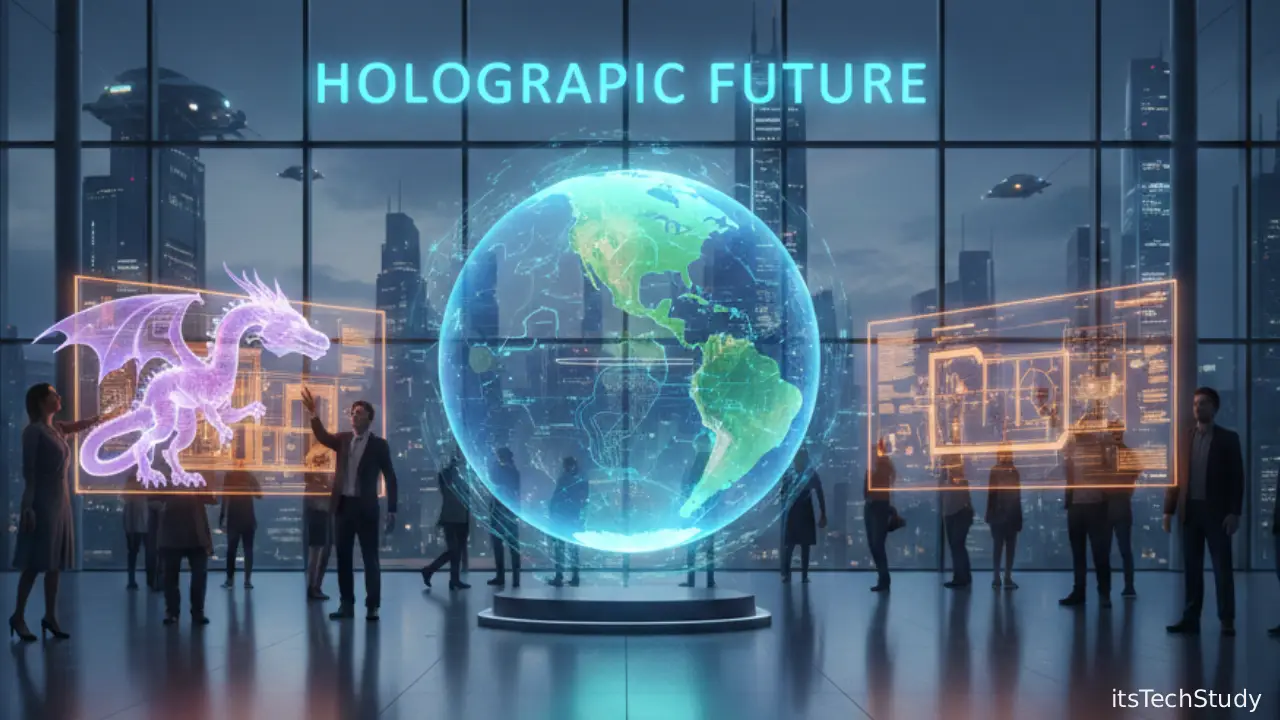
Introduction: From 2D Screens to the Dawn of Holographic Reality
For decades, our world has been shaped by flat displays – televisions, smartphones, monitors, and tablets. While screen resolution kept improving year after year, from HD to 4K to 8K, the fundamental experience remained the same: a two-dimensional image on a rectangular surface. But technology never stands still. Consumers now expect deeper immersion, lifelike visuals, and interfaces that feel almost tangible.
Enter holographic display technology, one of the most transformative visual innovations in modern tech.
Holography is no longer a futuristic fantasy seen only in sci-fi movies. It is slowly evolving into a real-world solution powering next-gen communication, virtual collaboration, medical imaging, product visualization, and immersive entertainment. However, the journey hasn’t been smooth. Holography faces challenges like high computational demand, expensive hardware, limited consumer adoption, and the need for advanced light-field rendering techniques.
Still, despite hurdles, holographic displays are poised to redefine how humans interact with digital information, much like touchscreens transformed the early 2000s. As tech giants and emerging startups invest heavily in 3D visualization, it’s clear that the world is inching closer to a future where holograms become as common as smartphones.
This article dives deep into how holographic display technology works, its current trends, innovations, industry use cases, benefits, limitations, and what the future holds.
What Is Holographic Display Technology?
A holographic display is an advanced imaging technology that creates three-dimensional visuals that appear to float in space without the need for VR/AR headsets. Unlike traditional screens, which rely on pixels arranged on a flat panel, holographic displays use light diffraction to generate depth, parallax, and real volumetric effects.
Key Features of Holographic Displays
- True 3D visual representation
- No glasses or headsets required
- Realistic depth perception
- Interactive and immersive
- Can be viewed from multiple angles
The main goal is to replicate how we see real-world objects – with depth, volume, and perspective – to make digital content feel naturally integrated into the physical environment.
How Holographic Display Technology Works
Holographic displays rely on complex optical physics and digital processing. Here’s a breakdown of its foundational components:
1. Light Field Generation
Holographic systems capture or generate a light field, which is a pattern of light rays coming from all directions of a 3D object. This enables viewers to see different angles of the object based on their position.
2. Diffraction Patterns
Holograms store and reconstruct information using interference patterns created by splitting and recombining beams of coherent light (usually lasers).
3. Spatial Light Modulators (SLMs)
SLMs manipulate light waves to project holograms. They adjust amplitude, phase, or intensity of light at high precision.
4. Computational Holography
Software calculates holographic patterns using advanced algorithms. With GPU-accelerated rendering, real-time holograms are increasingly feasible.
5. Projection Medium
Holograms can be projected on:
- Transparent films
- Special glass panels
- Fog/water vapor (volumetric projection)
- Air with laser ionization
This complex interplay of optics and computation results in floating, photo-realistic visuals visible from multiple angles – a true 3D experience.
Types of Holographic Displays
Holographic display technology comes in several forms, each suited for different use cases.
1. Reflection Holographic Displays
Uses reflected light to create 3D images, offering high clarity. Commonly used in museum exhibits and high-end visual displays.
2. Transmission Holographic Displays
Light passes through the hologram medium, producing bright and detailed visuals. Used in scientific and engineering applications.
3. Volumetric Holographic Displays
Creates 3D images suspended within air or a medium. These are closest to the sci-fi holograms seen in movies.
4. Holographic Projection Systems
Large-scale displays used for concerts, advertising, interactive booths, and product showcases.
5. Light Field Holographic Panels
These are increasingly integrated into smartphones, tablets, AR devices, and automotive dashboards.
Holographic Displays vs. Traditional Displays: A Comparison
Below is a side-by-side table comparing holographic displays with conventional digital screens:
| Feature / Parameter | Holographic Displays | Traditional Displays (LCD/LED/OLED) |
|---|---|---|
| Visual Experience | True 3D, floating visuals, multi-angle | Flat 2D |
| Immersion Level | Extremely high | Moderate |
| Device Dependence | No glasses or headsets needed | Direct viewing only |
| Real-time Interaction | Yes, supports gesture-based interaction | Limited |
| Cost | High | Affordable |
| Computing Power | Requires advanced rendering | Standard GPU/CPU |
| Ideal Use Cases | Medical imaging, simulation, advertising | Everyday media consumption |
Applications of Holographic Display Technology
Holographic displays are fueling innovation across multiple industries. Below are the most promising applications.
1. Medical Visualization
Surgeons can view 3D organs, nerves, and tissues in real-time, enhancing accuracy during procedures. Medical students benefit from interactive anatomy holograms.
2. Education and Training
Holographic lessons transform subjects like biology, astronomy, and engineering into immersive learning experiences.
3. Entertainment and Gaming
Concerts featuring holographic artists, immersive gaming worlds, and interactive storytelling are becoming more popular.
4. Retail and Advertising
Holographic product demos grab attention, increase engagement, and improve brand recall.
5. Architecture and Engineering
Professionals can explore 3D models of buildings and machinery without VR headsets.
6. Defense and Simulation
Holograms help in battlefield simulation, tactical analysis, and mission training.
7. Communication
Future video calls may use holographic avatars instead of flat video feeds, creating near-life presence.
Advantages of Holographic Display Technology
Pros
- Provides true 3D visualization with depth and realism
- No need for wearable devices like VR headsets
- Enhances user engagement and understanding
- Ideal for professional fields like medicine, architecture, and engineering
- Offers futuristic marketing and branding opportunities
- Supports hands-free interaction in some implementations
Cons
- Expensive hardware and setup requirements
- High computational power needed
- Limited consumer-level devices available
- Can be affected by ambient light conditions
- Requires specialized software and rendering systems
Current Trends Driving Holographic Technology
1. AI-Powered Holographic Rendering
Artificial intelligence helps process light-field data faster, enabling real-time holographic visualization with lower energy consumption.
2. 5G and Low-Latency Networks
High-speed networks support cloud-rendered holograms streamed directly to displays.
3. Holographic Smartphones
Brands are experimenting with 3D displays integrated into handheld devices. Light-field screens may soon become mainstream.
4. Holographic Meetings
Companies are developing solutions for holographic telepresence that mimic real-life interactions.
5. Mixed Reality Integration
Holographic display surfaces are merging with AR technologies in retail, healthcare, automotive dashboards, and smart homes.
Challenges Facing Holographic Display Adoption
1. Hardware Cost
Developing holographic systems involves precision optics, lasers, and high-end processors, making final products expensive.
2. Limited Content Availability
Mass adoption requires a rich ecosystem of holographic content – games, movies, educational graphics, and professional tools.
3. Power Consumption
High-resolution holograms demand significant processing and energy.
4. Technical Complexity
Optical alignment, diffraction accuracy, and rendering quality are difficult to perfect for consumer-grade products.
How Businesses Can Leverage Holographic Displays
Businesses can use holographic technology to stand out and improve engagement. Here are practical strategies:
1. Retail Stores
- 3D product walkthroughs
- Holographic mannequins
- Interactive catalogs
2. Events and Exhibitions
- Product launches
- Virtual celebrity appearances
- Futuristic booth attractions
3. Real Estate
- 3D walkthroughs of interiors and landscapes
4. Healthcare Providers
- Pre-surgery planning
- Diagnostic visualization
5. Automotive Industry
- Holographic dashboards
- Advanced driver training simulations
Future of Holographic Display Technology
The next decade will bring major breakthroughs:
1. Consumer-Level Holographic Devices
Holographic TVs, tablets, and smartphones may become mainstream as manufacturing costs fall.
2. Fully Interactive 3D Interfaces
Gesture, voice, and eye-tracking will make holographic interfaces feel natural.
3. Holographic AI Assistants
Imagine an AI assistant appearing as a 3D avatar floating beside you — dynamic, responsive, and personalized.
4. Decentralized Holographic Content Platforms
Blockchain-driven ecosystems may enable secure sharing and trading of holographic assets.
5. Smarter Mixed-Reality Ecosystems
Holograms will be seamlessly integrated into everyday environments, enhancing learning, productivity, and entertainment.
The future is not just digital – it’s holographic.
Conclusion: A Glimpse Into a Holographic Future
Holographic display technology is redefining digital interaction. While challenges such as cost, complexity, and power demands exist, the progress in AI, optics, rendering engines, and light-field technologies is rapidly accelerating adoption.
From medical breakthroughs to immersive entertainment, holography is not just a visual upgrade – it’s a new dimension of digital experience. Companies, creators, and developers who adopt early will be at the forefront of the next major technological evolution.
As holographic displays grow more affordable and powerful, we are moving toward a future where holograms enhance everyday tasks – from communication to education to exploration.
The screen is no longer the limit. The world is becoming holographic.

About the Author
Tobias Hale is a technology writer and software analyst with a sharp eye on the ever-evolving world of digital innovation. With a deep passion for clean code, secure systems, and emerging technologies, Tobias brings clarity to complex topics - from the latest in operating system updates to cutting-edge software security practices.
Frequently Asked Questions (FAQ)
Q1: What is a holographic display?
Ans: A holographic display is a technology that produces real 3D visuals in space using light diffraction, creating images that appear to float without the need for external devices like VR headsets.
Q2: Are holographic displays available for consumers?
Ans: Consumer-level holographic devices are still in early stages but are emerging in smartphones, advertising panels, and interactive displays. Large-scale adoption is expected in the next few years.
Q3: How much do holographic displays cost?
Ans: Prices vary widely. Small holographic fans may start around a few hundred dollars, while large volumetric systems can cost thousands to tens of thousands.
Q4: What industries use holographic technology the most?
Ans: Medicine, education, engineering, entertainment, defense, retail, and automotive industries actively use holographic displays for visualization, training, and marketing.
Q5: Are holograms harmful to the eyes?
Ans: High-quality holograms are generally safe. They reduce strain compared to VR headsets because they reproduce natural depth cues.
Q6: What is the future potential of holographic displays?
Ans: Future potential includes holographic smartphones, telepresence communication, 3D learning environments, and holographic AI companions - making them a core part of next-generation computing.





No Comments Yet
Be the first to share your thoughts.
Leave a Comment