

Introduction: From Standalone LLMs to Real-World AI Systems
Not long ago, large language models (LLMs) felt almost magical. You could ask a single model a question, and it would generate surprisingly human-like responses. But as businesses and developers rushed to integrate LLMs into real products-chatbots, AI agents, search systems, analytics tools, and automation pipelines-one major problem became clear..
LLMs alone are not enough.
Modern AI applications rarely rely on a single prompt and response. They need memory, tools, APIs, workflows, fallback logic, monitoring, cost control, and multi-model coordination. As systems grow more complex, managing these interactions manually becomes fragile, expensive, and error-prone.
This is where LLM orchestration enters the picture.
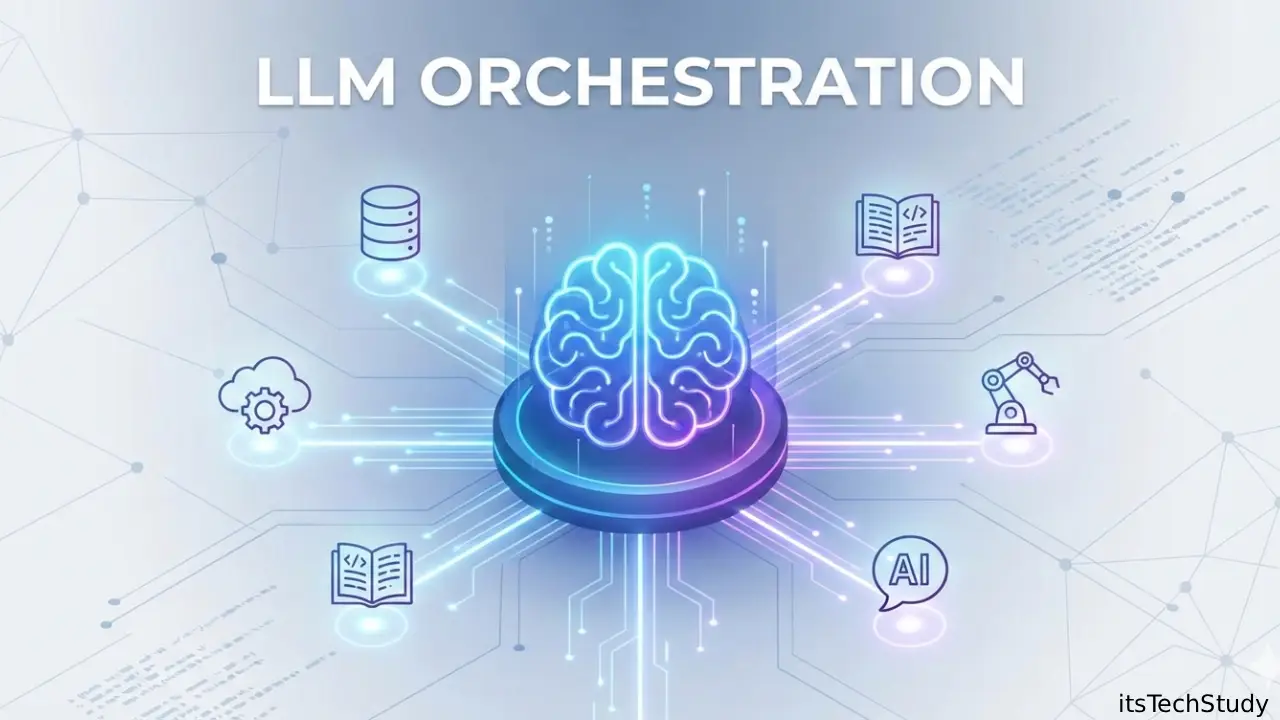
LLM orchestration is the behind-the-scenes layer that turns raw language models into reliable, scalable, production-ready AI systems. It helps developers coordinate prompts, models, tools, data sources, and decision logic-without drowning in complexity.
In this article, we’ll break down what LLM orchestration really is, why it matters, how it works, its benefits and limitations, and where it’s heading next. Whether you’re a beginner exploring AI development or an experienced engineer building advanced systems, this guide will help you understand why orchestration is becoming a core part of modern AI architecture.
What Is LLM Orchestration?
Defining LLM Orchestration in Simple Terms
LLM orchestration refers to the process of managing, coordinating, and controlling how large language models interact with data, tools, APIs, workflows, and other models to complete complex tasks.
Instead of treating an LLM as a single black box, orchestration allows you to:
- Chain multiple prompts together
- Route tasks to different models
- Call external tools or APIs
- Store and retrieve memory or context
- Handle errors and retries
- Monitor performance and costs
In short, orchestration transforms LLMs from isolated text generators into intelligent, multi-step problem solvers.
Why LLM Orchestration Is Becoming Essential
The Shift from Demos to Production AI
Early LLM demos focused on impressive outputs. Production systems focus on reliability, scalability, and control. As soon as you deploy an AI feature for real users, new challenges appear:
- Prompts break when inputs change
- Costs spike unpredictably
- Hallucinations impact trust
- APIs fail or time out
- One model isn’t good at everything
LLM orchestration addresses these challenges by introducing structure, rules, and observability into AI workflows.
Key Problems Orchestration Solves
- Managing complex multi-step tasks
- Combining LLMs with databases and APIs
- Reducing hallucinations through grounding
- Handling long-term memory and context
- Optimizing performance and latency
- Controlling usage and cost
Without orchestration, AI systems remain brittle experiments instead of dependable products.
Core Components of LLM Orchestration
Prompt Management and Chaining
Rather than relying on a single prompt, orchestration systems break tasks into prompt chains, where each step builds on the previous output.
Examples include:
- Extract -> Analyze -> Summarize
- Plan -> Execute -> Verify
- Search -> Filter -> Answer
This approach improves accuracy, transparency, and maintainability.
Tool and API Integration
Modern LLMs become far more powerful when they can use tools.
LLM orchestration enables models to:
- Call external APIs
- Query databases
- Run calculations
- Search documents
- Trigger workflows
This bridges the gap between language understanding and real-world action.
Model Routing and Multi-LLM Strategies
Not all LLMs are equal. Some are better at reasoning, others at speed or cost efficiency.
Orchestration systems can:
- Route tasks to specialized models
- Use smaller models for simple tasks
- Fall back to stronger models for complex queries
This balance improves both performance and cost control.
Memory and Context Handling
LLM orchestration supports different memory types:
- Short-term conversation memory
- Long-term user preferences
- Vector-based semantic memory
This allows AI systems to feel consistent, personalized, and context-aware across sessions.
LLM Orchestration vs Traditional AI Pipelines
| Feature | Traditional AI Pipelines | LLM Orchestration |
|---|---|---|
| Workflow flexibility | Rigid | Highly dynamic |
| Tool usage | Limited | Native integration |
| Context handling | Static | Memory-aware |
| Model usage | Single model | Multi-model routing |
| Adaptability | Low | High |
| Scalability | Manual | Built-in support |
This comparison highlights why orchestration is better suited for modern AI applications built around large language models.
Popular Use Cases of LLM Orchestration
AI Agents and Autonomous Systems
LLM orchestration powers AI agents that can:
- Plan tasks
- Make decisions
- Use tools
- Adapt based on feedback
Without orchestration, agent behavior quickly becomes chaotic.
Enterprise Chatbots and Virtual Assistants
In business environments, chatbots must:
- Access internal knowledge bases
- Follow compliance rules
- Maintain conversation history
- Escalate to humans when needed
LLM orchestration ensures consistency, accuracy, and safety.
Retrieval-Augmented Generation (RAG)
Orchestration plays a critical role in RAG systems by:
- Retrieving relevant documents
- Injecting context into prompts
- Verifying responses
This significantly reduces hallucinations and improves trust.
Pros and Cons of LLM Orchestration
Advantages of LLM Orchestration
Pros:
- Improved reliability and accuracy
- Better cost optimization
- Scalable system design
- Easier debugging and monitoring
- Enhanced user experience
- Supports complex, real-world workflows
Limitations and Challenges
Cons:
- Additional architectural complexity
- Learning curve for beginners
- Performance overhead if poorly designed
- Requires careful prompt engineering
- Dependency on orchestration frameworks
Despite these challenges, the benefits usually outweigh the drawbacks for production systems.
Key LLM Orchestration Techniques
Common Orchestration Patterns
- Sequential chaining – step-by-step processing
- Parallel execution – running multiple prompts simultaneously
- Conditional routing – branching logic based on outputs
- Human-in-the-loop – manual review when confidence is low
- Fallback strategies – backup models or prompts
These patterns help developers design resilient AI systems.
LLM Orchestration and SEO-Friendly AI Applications
From content generation tools to AI-powered search engines, orchestration ensures:
- Fact-based responses
- Controlled tone and style
- Reduced duplication
- Compliance with AdSense guidelines
- Consistent output quality
This makes LLM orchestration especially valuable for content platforms and SaaS products.
The Future of LLM Orchestration
As AI systems grow more autonomous, LLM orchestration will evolve into a standard infrastructure layer, similar to how backend frameworks support web applications today.
Future trends include:
- Smarter agent coordination
- Automated prompt optimization
- Real-time cost and performance tuning
- Better observability and explainability
- Deeper integration with business workflows
In many ways, orchestration is what will separate experimental AI tools from truly intelligent systems.
Conclusion: Why LLM Orchestration Matters More Than Ever
Large language models are powerful, but power without control creates risk. LLM orchestration provides the structure, reliability, and scalability needed to transform raw models into trustworthy AI systems.
By managing prompts, tools, memory, and models in a coordinated way, orchestration enables developers to build AI that is not only impressive-but dependable, efficient, and ready for real-world use.
As AI adoption accelerates, understanding and applying LLM orchestration will no longer be optional. It will be a core skill for anyone serious about building the next generation of intelligent applications.

About the Author
Amelia Morgan is a Editor at itsTechStudy.com with 15+ years of experience in the technology industry. I write about emerging innovations, AI, and digital trends-making complex topics simple and engaging for readers.
Frequently Asked Questions (FAQ)
Q1: What is LLM orchestration in simple words?
Ans: LLM orchestration is the process of managing how language models interact with prompts, tools, data, and workflows to perform complex tasks reliably and at scale.
Q2: Is LLM orchestration only for large companies?
Ans: No. While enterprises benefit greatly, startups and solo developers also use orchestration to build stable, cost-efficient AI products faster.
Q3: How is LLM orchestration different from prompt engineering?
Ans: Prompt engineering focuses on crafting good prompts. Orchestration goes further by managing workflows, memory, tools, models, and decision logic.
Q4: Does LLM orchestration reduce hallucinations?
Ans: Yes. By grounding responses in data, splitting tasks, and verifying outputs, orchestration significantly lowers hallucination risks.
Q5: Is LLM orchestration future-proof?
Ans: As LLMs evolve, orchestration becomes even more important. It abstracts complexity and allows systems to adapt without constant rewrites.





No Comments Yet
Be the first to share your thoughts.
Leave a Comment