

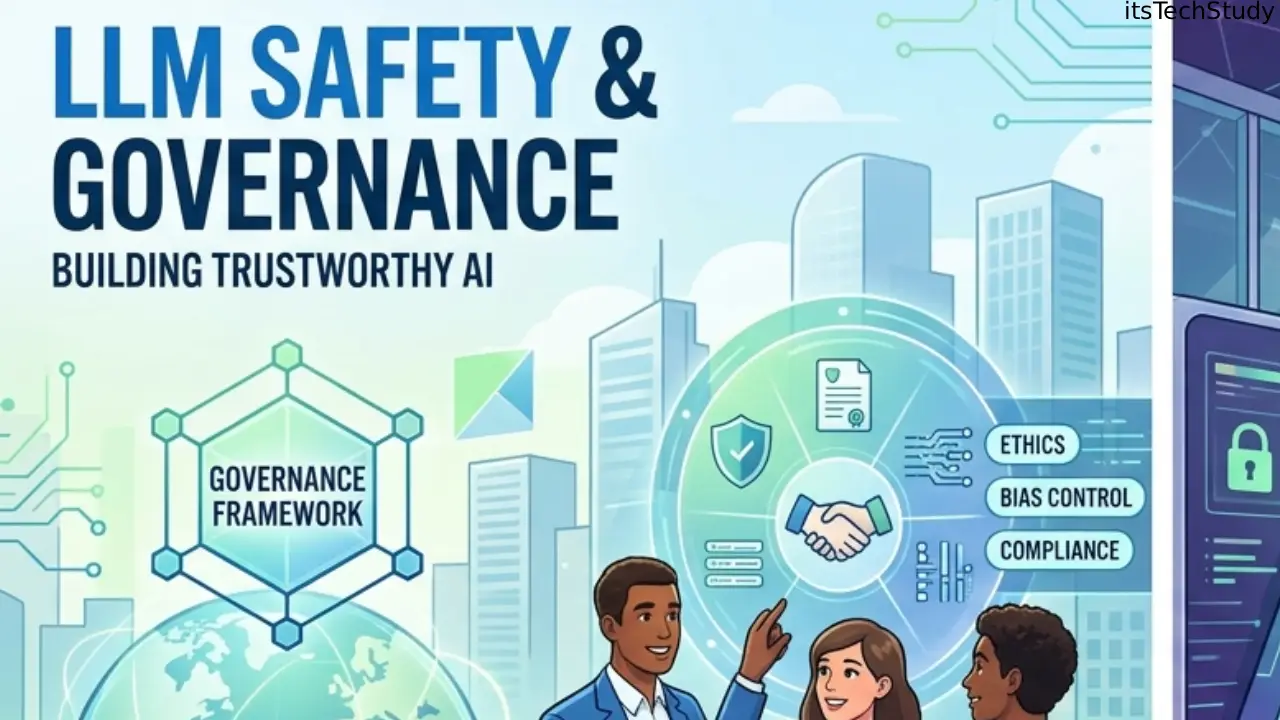
Introduction: The Race to Build Bigger AI Models Is Over – Now the Real Challenge Begins
A year ago, most conversations around large language models (LLMs) were dominated by speed, scale, and capability. Companies rushed to integrate AI chatbots, copilots, internal assistants, automated support tools, and content generation systems into nearly every digital workflow. The industry obsession was simple: who could build or deploy the smartest model first?
That phase is fading.
In 2026, the conversation has matured. Enterprises are no longer asking only “What can an LLM do?” They are asking a much harder question: “Can we trust it at scale?”
That shift matters more than most people realize.
As LLMs become deeply embedded in customer support, finance workflows, developer tools, legal document review, HR systems, and healthcare-adjacent automation, the risks have become impossible to ignore. Hallucinated answers can damage trust. Prompt injection can expose sensitive data. Weak access controls can lead to model abuse. Poor oversight can create compliance headaches. And when AI systems make decisions or influence outcomes, organizations need more than innovation – they need accountability.
This is where LLM safety and governance becomes essential.
Safety is no longer just a research topic or a philosophical debate for AI labs. It is now a practical requirement for businesses, developers, product teams, CISOs, compliance leaders, and regulators. Governance is the operational layer that turns “responsible AI” from a slogan into a real framework: policies, controls, audits, documentation, human oversight, and measurable risk management.
In other words, the future of enterprise AI will not be decided only by model performance. It will be decided by who can deploy powerful AI responsibly, securely, and sustainably.
This guide breaks down what LLM safety and governance actually means in 2026, why it matters now more than ever, the real risks organizations face, the frameworks shaping best practices, and how businesses can build AI systems that are useful and trustworthy.
What Is LLM Safety and Governance?
At a high level, LLM safety refers to the practices, technical safeguards, and operational controls used to reduce harmful, insecure, misleading, or non-compliant behavior from large language models.
LLM governance, on the other hand, is the broader organizational framework that defines how LLMs are selected, deployed, monitored, audited, and controlled over time.
In simple terms:
- Safety = preventing bad outcomes from the model
- Governance = managing responsibility, oversight, and accountability around the model
These two areas overlap constantly. A company can have a powerful AI assistant, but if it has no review process, no data controls, no logging, and no fallback rules, it does not have governance. Likewise, if a company has policies but ignores model misuse, unsafe outputs, or prompt attacks, it lacks real safety.
Core areas of LLM safety and governance include:
- Prompt injection defense
- Data privacy and access control
- Output filtering and moderation
- Hallucination reduction
- Human-in-the-loop review
- Audit logging
- Model evaluation and red teaming
- Vendor risk management
- Regulatory compliance
- Incident response for AI systems
- Documentation and accountability structures
Why LLM Safety and Governance Matter More in 2026
The first wave of generative AI adoption was driven by experimentation. The second wave is being driven by operational reality.
Organizations now understand that LLMs are not just “smart tools.” They are high-impact systems that can influence customer trust, legal exposure, security posture, brand reputation, and internal decision-making.
Why this topic is now mission-critical:
- LLMs are moving from demos to production
- AI is increasingly connected to real business systems
- Security threats targeting LLM apps are growing
- Regulators and enterprise buyers now expect governance
- Trust has become a competitive advantage
The NIST AI Risk Management Framework: Generative AI Profile specifically provides a structured way for organizations to manage trustworthiness risks in generative AI systems, reinforcing that governance must be applied across the AI lifecycle, not just at deployment.
Meanwhile, ISO/IEC 42001 has become a major reference point because it formalizes AI management systems and provides organizations with a structured approach to responsible AI operations, risk handling, traceability, and continuous improvement.
The Biggest Risks in LLM Systems Today
Not all AI risks are obvious. Some are technical, some are operational, and some only appear once an LLM is integrated into a real workflow.
1. Hallucinations and Fabricated Outputs
LLMs can confidently generate incorrect information. In a consumer chatbot, this may be annoying. In legal, finance, healthcare, or enterprise operations, it can be expensive or dangerous.
Why it matters
- False compliance guidance
- Incorrect code suggestions
- Inaccurate summaries of contracts or policies
- Misleading customer support answers
2. Prompt Injection and Instruction Hijacking
Prompt injection remains one of the most discussed LLM security risks. Attackers can craft inputs that manipulate the model into ignoring system instructions or revealing restricted data.
The OWASP Top 10 for LLM Applications continues to list Prompt Injection as a critical risk, alongside insecure output handling, sensitive information disclosure, excessive agency, and model theft.
Common examples
- Hidden instructions in user-uploaded files
- Malicious web content in RAG pipelines
- Tool-use manipulation in agentic systems
- Prompt chaining attacks across plugins or APIs
3. Sensitive Data Leakage
If LLMs are connected to internal knowledge bases, ticket systems, CRM tools, or document repositories, they can accidentally expose confidential or role-restricted information.
Risk areas
- Internal policy documents
- Customer PII
- Proprietary source code
- Contracts and legal documents
- Financial reports
- Support tickets with sensitive context
4. Overreliance on AI Outputs
One of the most underrated governance failures is not a bug – it is human behavior.
Teams may trust AI outputs too much simply because they sound polished and authoritative. The result is automation bias, where humans stop verifying results.
This becomes dangerous when AI is used for:
- Risk scoring
- Decision support
- Candidate screening
- Legal drafting
- Security triage
- Executive summaries
5. Excessive Agency in AI Agents
As LLM systems evolve into agents that can call tools, run workflows, query databases, or trigger actions, the risk profile changes dramatically.
Instead of just generating text, the system may:
- Send emails
- Execute code
- Open tickets
- Approve requests
- Query internal APIs
- Trigger purchases or workflows
This is why “agent governance” is rapidly becoming one of the most important subfields in enterprise AI safety.
LLM Safety vs LLM Governance: A Practical Comparison
| Area | LLM Safety | LLM Governance |
|---|---|---|
| Primary focus | Preventing harmful or unsafe model behavior | Managing oversight, policy, and accountability |
| Typical owners | AI engineers, security teams, platform teams | Leadership, compliance, legal, risk, AI governance boards |
| Examples | Guardrails, filters, red teaming, evals | Policies, approvals, audits, documentation, escalation paths |
| Time horizon | Real-time and short-term mitigation | Long-term lifecycle management |
| Key question | “Can the model behave safely?” | “Can the organization use this model responsibly?” |
| Success metric | Fewer unsafe incidents and better reliability | Traceable, compliant, auditable AI operations |
Key Frameworks Shaping LLM Governance in 2026
Organizations no longer need to invent governance from scratch. Several frameworks now help teams build structured programs.
1. NIST AI RMF + Generative AI Profile
The NIST AI RMF and its Generative AI Profile offer a practical, lifecycle-based structure for identifying and managing AI risks. It is widely respected because it is flexible, cross-sector, and practical rather than overly prescriptive.
Why it matters
- Useful for enterprise AI programs
- Good for internal governance design
- Strong for risk mapping and control planning
- Helpful when building AI policies and review workflows
2. ISO/IEC 42001
ISO/IEC 42001 is the world’s first international AI management system standard. It gives organizations a formal model for creating, implementing, maintaining, and improving an AI management system (AIMS).
Why it matters
- Excellent for enterprise maturity
- Supports audits and structured governance
- Helps align AI initiatives with repeatable processes
- Useful for vendors selling into regulated or large enterprise markets
3. OWASP Top 10 for LLM Applications
The OWASP Top 10 for LLM Applications is one of the most practical security references for teams building LLM-powered products. It highlights real-world risks that engineering and AppSec teams should actively test for.
Why it matters
- Security-focused and actionable
- Great for threat modeling
- Useful for red teaming and secure design reviews
- Especially relevant for RAG apps, copilots, and AI agents
A Practical LLM Governance Framework for Businesses
If you are building an AI policy for a startup, SaaS company, enterprise team, or internal platform group, a practical governance model should include these layers:
1. AI Use-Case Classification
Not all LLM applications deserve the same level of scrutiny.
Classify by risk level
- Low risk: blog drafting, internal brainstorming, summarization
- Medium risk: customer support suggestions, developer copilots, workflow assistance
- High risk: legal analysis, financial recommendations, hiring decisions, security actions, regulated workflows
The higher the risk, the stronger the controls should be.
2. Data Governance Controls
Before deployment, define:
- What data the model can access
- What data it must never access
- How prompts and outputs are logged
- How retention works
- Whether data is used for vendor training
- What role-based access rules apply
Best practices
- Mask sensitive data before inference
- Apply least-privilege access
- Separate environments (dev/staging/prod)
- Restrict retrieval sources in RAG pipelines
- Encrypt logs where appropriate
3. Model Evaluation and Red Teaming
Testing an LLM once is not enough.
You need recurring evaluations for:
- Hallucination rates
- Toxicity and unsafe content
- Prompt injection resistance
- Data leakage scenarios
- Tool misuse
- Bias or unfair behavior
- Reliability across edge cases
Red team prompts should include:
- Adversarial user inputs
- Malicious documents in retrieval systems
- Role-confusion attacks
- Hidden instructions in external content
- Boundary testing for sensitive information
4. Human-in-the-Loop Oversight
Some AI tasks should never be fully autonomous.
Human review is especially important for:
- Legal or compliance outputs
- Hiring-related recommendations
- Security actions
- External customer messaging in high-stakes cases
- Financial or contractual summaries
- Policy interpretation
This is where governance becomes operational: the model may draft, but a human approves.
5. Monitoring, Logging, and Incident Response
AI systems need observability just like cloud infrastructure or security systems.
Track these metrics
- Unsafe output rate
- Refusal rate
- Escalation rate
- Prompt injection attempts
- Tool execution failures
- Data access anomalies
- User feedback on bad answers
- Drift in model behavior after updates
Create an AI incident response playbook
- Who owns the incident?
- How do you disable a failing model?
- How are users notified?
- How are logs preserved?
- How is the issue triaged and documented?
- When is legal/compliance involved?
Pros and Cons of Strong LLM Governance
Pros
- Reduces security and compliance risk
- Improves trust with customers and stakeholders
- Makes enterprise AI adoption more sustainable
- Helps teams scale AI responsibly
- Supports vendor due diligence and audits
- Prevents expensive AI-related incidents
- Creates clearer ownership across teams
Cons
- Can slow down experimentation if over-engineered
- Requires cross-functional alignment
- Adds process overhead for smaller teams
- May increase tooling and compliance costs
- Needs ongoing maintenance as models evolve
Bottom line
Good governance should not block innovation. It should make innovation safer, more repeatable, and easier to defend when something goes wrong.
Top Best Practices for LLM Safety in 2026
Here are the practices that matter most right now:
1. Start with the use case, not the model
Choose the business workflow first. Then decide whether an LLM is actually appropriate.
2. Treat prompts as untrusted input
User prompts, uploaded files, retrieved content, and third-party connectors can all be attack surfaces.
3. Limit model permissions
If an LLM can trigger actions, apply strict authorization, sandboxing, and approval rules.
4. Separate generation from execution
Never allow raw model output to directly run code, call APIs, or trigger sensitive workflows without validation.
5. Build layered guardrails
Use:
- System prompts
- Policy filters
- Retrieval restrictions
- Output validation
- Tool permission checks
- Human approvals
6. Re-evaluate after every model update
Even small model changes can affect safety behavior, refusal style, latency, and hallucination patterns.
7. Document decisions
Keep records of:
- Why the model was selected
- Known limitations
- Approved use cases
- Risk classification
- Mitigations in place
- Review owners
How Enterprises Are Evolving From “Responsible AI Statements” to Real Governance
In 2023 and 2024, many organizations published “responsible AI principles.” These were useful, but often abstract.
In 2026, mature organizations are moving beyond principles into operational governance:
- AI review boards
- Model inventory systems
- Vendor assessment checklists
- Approval workflows for new AI use cases
- Standardized red teaming
- AI risk registers
- Model cards and system cards
- AI audit trails
- Policy-based deployment gates
This is the real transition happening in the market.
The companies that win with LLMs won’t just be the ones with the best prompts or biggest models. They will be the ones that build repeatable trust.
Conclusion: The Future of AI Belongs to Teams That Can Prove Trust, Not Just Performance
The age of blindly shipping generative AI is ending.
In 2026, LLM safety and governance are no longer optional extras or “nice to have” checklists. They are becoming the foundation of serious AI adoption. Whether you are building an internal knowledge assistant, a customer-facing AI chatbot, a coding copilot, or an autonomous workflow agent, the real challenge is no longer just capability. It is control, trust, and accountability.
The most successful teams will be the ones that understand this early:
- Powerful models are not enough
- Good prompts are not enough
- Fast deployment is not enough
What matters is building AI systems that are:
- Secure against misuse
- Reliable under real-world pressure
- Transparent enough to audit
- Controlled enough to trust
- Flexible enough to evolve with new risks
If your organization is investing in LLMs right now, the smartest next move is not just choosing a better model. It is building a better governance layer around the model.
Because in the next phase of AI, trust will be the real differentiator.

About the Author
Amelia Morgan is a Editor at itsTechStudy.com with 15+ years of experience in the technology industry. I write about emerging innovations, AI, and digital trends-making complex topics simple and engaging for readers.
Frequently Asked Questions (FAQ)
Q1: What is the difference between AI safety and LLM safety?
Ans: AI safety is a broad umbrella covering risks across all types of AI systems, including machine learning, computer vision, robotics, and generative AI. LLM safety is a more specific area focused on the unique risks of large language models, such as hallucinations, prompt injection, unsafe outputs, data leakage, and excessive autonomy in agent workflows.
Q2: Why is LLM governance important for small businesses and startups too?
Ans: Because AI risk scales faster than team size. A startup may think governance is only for enterprises, but even a simple AI chatbot can leak data, damage customer trust, or create legal headaches if it produces misleading information. Lightweight governance — clear use cases, logging, approvals, and vendor checks — can prevent expensive mistakes early.
Q3: Is LLM governance only about compliance and regulation?
Ans: No. Compliance is part of it, but governance is much broader. It includes security, reliability, accountability, data handling, monitoring, human oversight, vendor management, and incident response. Even in markets with minimal regulation, governance is still essential because it protects product quality and business reputation.
Q4: What are the most common LLM security threats today?
Ans: Some of the most common threats include: Prompt injection Sensitive information disclosure Insecure output handling Overreliance on model answers Excessive agency in AI agents Model theft Supply chain vulnerabilities These risk areas align closely with the OWASP guidance for LLM applications.
Q5: How can teams reduce hallucinations in production AI apps?
Ans: No method eliminates hallucinations completely, but teams can reduce them by: Using retrieval-augmented generation (RAG) carefully Restricting trusted sources Adding citation or source-grounding requirements Validating outputs against rules or databases Requiring human review in high-risk tasks Running recurring evals on real production scenarios
Q6: What is the best framework to start with for LLM governance?
Ans: A strong starting point is: NIST AI RMF + Generative AI Profile for practical risk management OWASP Top 10 for LLM Applications for security design and testing ISO/IEC 42001 for structured enterprise governance and long-term maturity Together, these provide a balanced approach across risk, security, and operational governance.




No Comments Yet
Be the first to share your thoughts.
Leave a Comment