

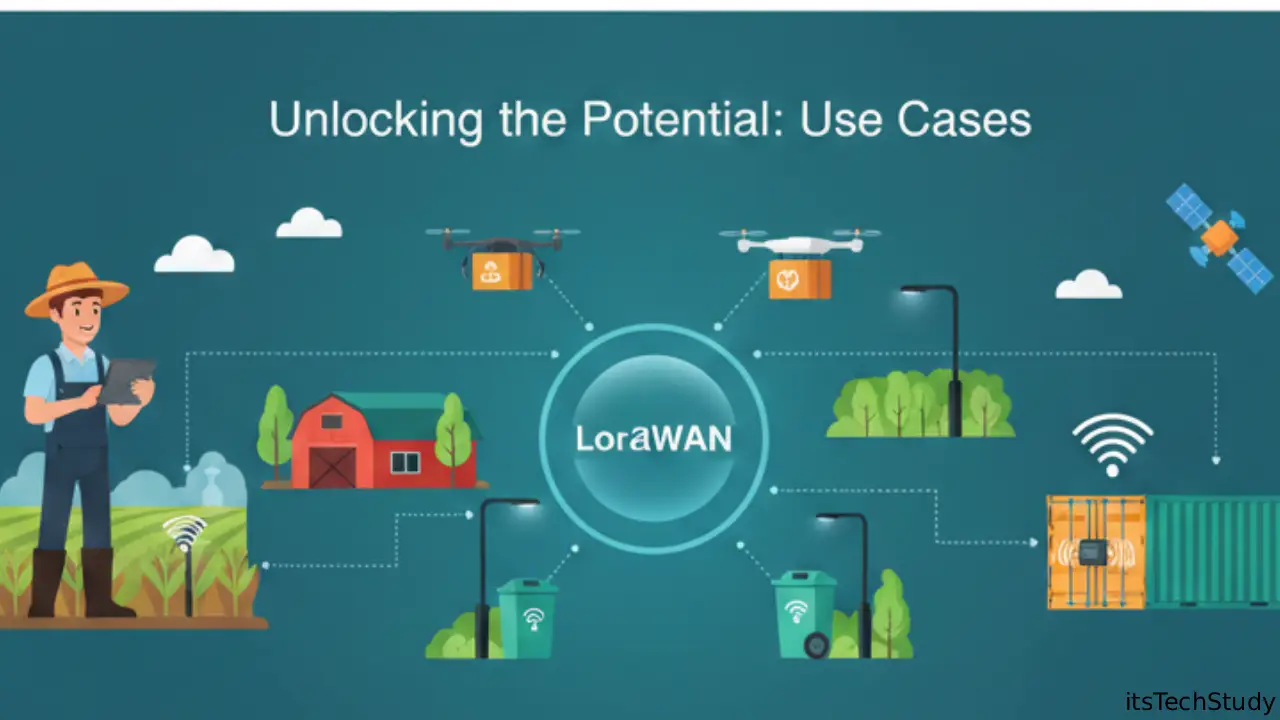
Introduction: Why Traditional Connectivity Falls Short in the IoT Era
For decades, the internet has relied on familiar connectivity options like Wi-Fi, cellular networks, and Ethernet. These technologies work brilliantly for smartphones, laptops, and high-bandwidth applications. But as the world moves deeper into the Internet of Things (IoT) era, a new challenge has emerged: how do you connect millions of small, low-power devices spread across cities, farms, factories, and remote locations-without draining batteries or breaking budgets?
Smart meters, environmental sensors, asset trackers, and smart agriculture systems don’t need high speeds. What they need is long range, ultra-low power consumption, and reliable communication. Traditional networks struggle here due to limited coverage, high energy usage, and recurring operational costs.
This gap is exactly where LoRa and LoRaWAN step in. Together, they have become a cornerstone technology for modern IoT deployments, enabling scalable, cost-effective, and energy-efficient communication across vast distances. As IoT adoption accelerates worldwide, understanding how LoRa and LoRaWAN work-and why they matter-has never been more important.
What Is LoRa?
Understanding LoRa Technology
LoRa (Long Range) is a wireless modulation technique developed to enable long-distance communication while consuming very little power. It operates in unlicensed radio frequency bands, such as 868 MHz in Europe and 915 MHz in many other regions.
At its core, LoRa uses chirp spread spectrum (CSS) modulation. This allows signals to travel farther and remain resilient even in noisy environments. Unlike Wi-Fi or Bluetooth, LoRa sacrifices data speed in favor of range and reliability, making it ideal for small data packets sent intermittently.
Key Characteristics of LoRa
- Communication range up to 15 km in rural areas
- Extremely low power consumption
- Works well in dense urban and remote environments
- Designed for low data rate transmissions
- Supports years of battery life on IoT devices
LoRa itself defines only the physical layer of communication. To manage devices, data, and networks at scale, another layer is required-and that’s where LoRaWAN comes in.
What Is LoRaWAN?
LoRaWAN Explained Simply
LoRaWAN (Long Range Wide Area Network) is a communication protocol and system architecture built on top of LoRa. While LoRa handles how data is transmitted over radio waves, LoRaWAN defines how devices communicate with gateways, servers, and applications securely and efficiently.
LoRaWAN enables a star-of-stars network topology, where end devices communicate with gateways, which then forward data to a central network server.
Core Components of a LoRaWAN Network
- End Devices: Sensors or IoT nodes collecting data
- Gateways: Receive LoRa signals and forward them to servers
- Network Server: Manages routing, security, and device authentication
- Application Server: Processes and displays data for end users
Together, these components make LoRaWAN a scalable and secure solution for massive IoT deployments.
How LoRa and LoRaWAN Work Together
LoRa and LoRaWAN are often mentioned together, but they serve different roles. LoRa handles the radio transmission, while LoRaWAN governs network management and data handling.
Communication Flow (Step-by-Step)
- An IoT sensor collects data (temperature, location, moisture, etc.)
- The device sends data using LoRa modulation
- Nearby LoRaWAN gateways receive the signal
- Gateways forward data to the LoRaWAN network server
- Data is processed and delivered to applications or dashboards
This separation of responsibilities allows LoRaWAN networks to scale efficiently while maintaining low power usage.
Key Features That Make LoRaWAN Stand Out
Long Range Coverage
LoRaWAN enables communication across several kilometers with minimal infrastructure. A single gateway can cover an entire town or large industrial site.
Ultra-Low Power Consumption
Devices can operate on small batteries for 5 to 10 years, drastically reducing maintenance costs.
Secure by Design
LoRaWAN uses end-to-end encryption, ensuring data integrity and privacy.
Scalability
Thousands of devices can connect to a single network without congestion.
LoRa vs Other IoT Connectivity Technologies
| Technology | Range | Power Consumption | Data Rate | Typical Use Case |
|---|---|---|---|---|
| LoRaWAN | Very Long | Very Low | Low | Smart cities, agriculture |
| Wi-Fi | Short | High | High | Homes, offices |
| Bluetooth | Very Short | Low | Medium | Wearables |
| Cellular (LTE/5G) | Long | High | Very High | Mobile broadband |
| Zigbee | Short | Low | Low | Home automation |
This comparison clearly shows why LoRaWAN is ideal for large-scale, low-power IoT systems.
Common Use Cases of LoRa and LoRaWAN
Smart Cities
- Smart street lighting
- Waste management systems
- Air quality monitoring
- Smart parking solutions
Smart Agriculture
- Soil moisture sensors
- Livestock tracking
- Weather monitoring
- Automated irrigation systems
Industrial IoT (IIoT)
- Equipment monitoring
- Predictive maintenance
- Asset tracking
- Energy management
Utilities and Metering
- Smart water meters
- Gas and electricity monitoring
- Leak detection systems
Pros and Cons of LoRa and LoRaWAN:
Advantages
- Long-range connectivity
- Low operational cost
- Excellent battery life
- Open ecosystem
- Works in unlicensed spectrum
Limitations
- Low data throughput
- Not suitable for real-time video or audio
- Duty cycle restrictions in some regions
- Latency not ideal for time-critical applications
Understanding these trade-offs helps organizations choose the right technology for their specific needs.
Deployment Models for LoRaWAN Networks
Public LoRaWAN Networks
Operated by telecom providers or network operators, these offer quick deployment with minimal infrastructure investment.
Private LoRaWAN Networks
Organizations deploy their own gateways for full control, security, and customization—ideal for factories, campuses, and farms.
Hybrid Models
A mix of public and private networks, offering flexibility and resilience.
Conclusion: Why LoRa and LoRaWAN Matter for the Future of IoT
As IoT continues to expand into every corner of our physical world, the need for efficient, scalable, and low-power connectivity becomes critical. LoRa and LoRaWAN address this challenge head-on by enabling long-range communication without the cost and complexity of traditional networks.
From smart cities and agriculture to industrial automation and utilities, LoRaWAN is proving to be a reliable foundation for modern IoT ecosystems. While it’s not designed for high-bandwidth use cases, its strengths in power efficiency, coverage, and scalability make it a standout choice for millions of connected devices.
Looking ahead, as IoT deployments grow smarter and more distributed, LoRa and LoRaWAN will continue to play a central role in shaping a connected, data-driven future.

About the Author
Amelia Morgan is a Editor at itsTechStudy.com with 15+ years of experience in the technology industry. I write about emerging innovations, AI, and digital trends-making complex topics simple and engaging for readers.
Frequently Asked Questions (FAQ)
Q1: s LoRa the same as LoRaWAN?
Ans: No. LoRa is the physical radio modulation technology, while LoRaWAN is the network protocol that manages communication, security, and data routing.
Q2: How far can LoRaWAN signals travel?
Ans: LoRaWAN can reach up to 15 km in rural areas and 2–5 km in urban environments, depending on obstacles and antenna placement.
Q3: Is LoRaWAN suitable for real-time applications?
Ans: LoRaWAN is best for non-real-time, low-data transmissions. It’s not ideal for applications requiring high speed or low latency.
Q4: Is LoRaWAN secure?
Ans: Yes. LoRaWAN uses AES-128 encryption for both network and application layers, making it highly secure.
Q5: Can I build my own LoRaWAN network?
Ans: Absolutely. Many organizations deploy private LoRaWAN networks using commercially available gateways and open-source network servers.








No Comments Yet
Be the first to share your thoughts.
Leave a Comment