

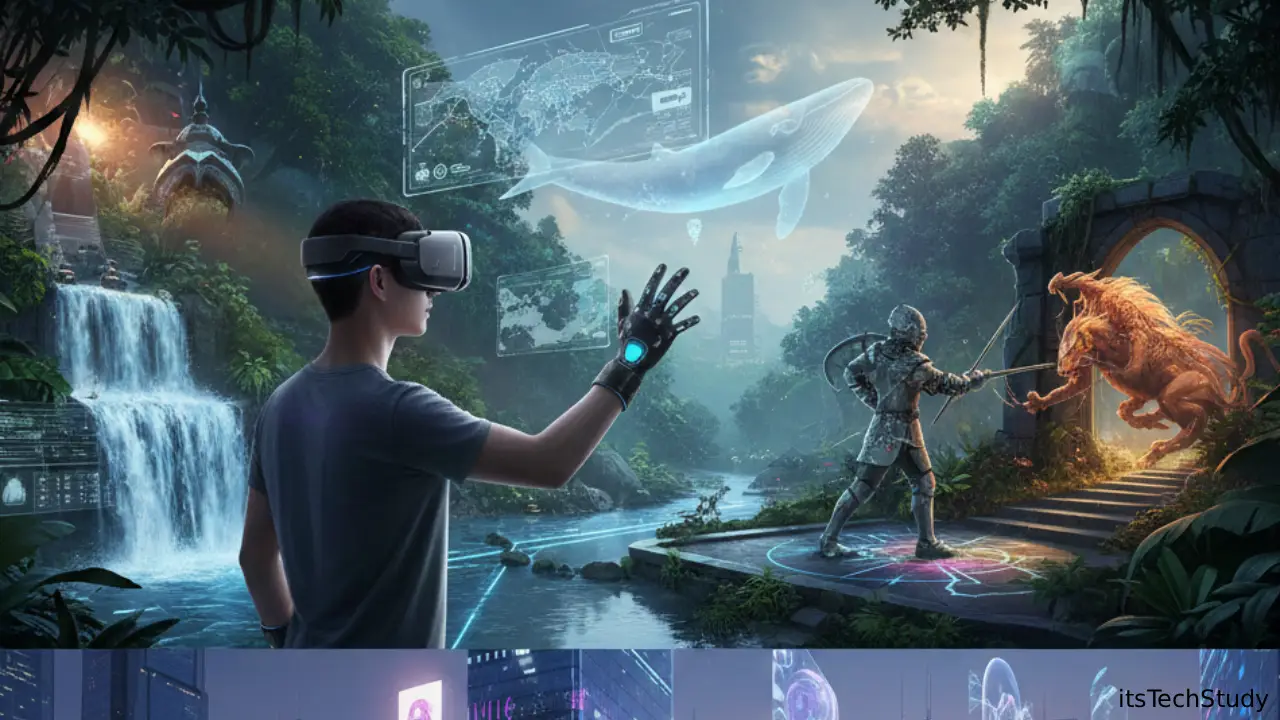
Introduction: When Digital and Physical Worlds Finally Start to Blur
For decades, digital experiences lived safely behind screens. We clicked, swiped, and watched-always aware of the invisible barrier between the real world and the virtual one. But today, that boundary is collapsing. Thanks to rapid advances in Augmented Reality (AR), Virtual Reality (VR), holographic displays, and real-time video capture, technology is moving toward a single, blended reality where digital and physical elements coexist naturally.
This shift isn’t just about better visuals or cooler demos. Industries like entertainment, education, healthcare, manufacturing, and remote collaboration are facing a common challenge: how to create immersive environments that feel real, responsive, and intuitive-without overwhelming users or breaking immersion. Fragmented tools, hardware limitations, and inconsistent user experiences have slowed adoption in the past.
Now, powerful spatial computing, AI-driven rendering, and real-time sensors are making it possible to merge AR, VR, holograms, and real footage into seamless environments that respond to human movement, context, and intent. This convergence is shaping the next generation of digital interaction-and redefining how we work, learn, and connect.
Merging AR, VR, holograms, and real footage into seamless environments is redefining how digital experiences are designed, delivered, and understood across industries. What was once limited to science fiction is now becoming a practical innovation layer for entertainment, education, retail, healthcare, architecture, and enterprise training. By blending augmented reality overlays, fully immersive virtual reality spaces, volumetric holographic visuals, and high-quality live-action footage, creators can build interactive environments that feel more natural, responsive, and emotionally engaging. For tech professionals, this convergence represents more than a visual upgrade-it marks a shift toward spatial computing ecosystems where users can move fluidly between physical and digital contexts without noticing the boundaries. As hardware becomes more capable and real-time rendering engines continue to improve, the demand for seamless mixed-reality production pipelines is growing rapidly, opening new opportunities for developers, designers, content studios, and businesses aiming to create next-generation immersive experiences.
Understanding the Core Technologies Behind Seamless Environments
Before exploring how these technologies merge, it’s important to understand what each one brings to the table.
Augmented Reality (AR): Enhancing the Real World
Augmented Reality overlays digital information-such as 3D objects, text, or animations-onto the physical environment. Unlike VR, AR does not replace reality; it enhances it.
Common use cases include navigation overlays, interactive product previews, and real-time data visualization. Modern AR relies heavily on computer vision, depth sensing, and spatial mapping to anchor digital content accurately in real space.
Virtual Reality (VR): Fully Immersive Digital Worlds
Virtual Reality creates entirely simulated environments that users can explore using headsets and motion controllers. VR excels at immersion, making users feel present inside a digital space.
While VR offers unmatched focus and immersion, its biggest limitation is isolation from the physical world—something newer hybrid approaches aim to overcome.
Holograms: 3D Presence Without Screens
Holographic technology projects three-dimensional visuals that appear to exist in real space. Whether through light-field displays, volumetric capture, or mixed-reality headsets, holograms add a sense of physical presence that flat screens cannot match.
Holograms are increasingly used for remote collaboration, medical visualization, and live events.
Real Footage: Grounding Experiences in Reality
Real footage-captured through cameras, LiDAR sensors, and depth scanners—adds realism and authenticity to immersive environments. When combined with AR, VR, or holograms, real-world video provides context and emotional connection that purely digital assets often lack.
Why Merging These Technologies Matters Now
The Problem with Isolated Experiences
Historically, AR, VR, and holographic systems were developed in silos. Each required different hardware, software pipelines, and interaction models. This fragmentation made it difficult to create consistent user experiences across platforms.
Users often had to switch devices, relearn controls, or accept visual inconsistencies—breaking immersion and limiting scalability.
The Rise of Spatial Computing and Real-Time Rendering
Recent breakthroughs in spatial computing, edge processing, and AI-assisted rendering are changing the game. These technologies allow digital elements to understand physical space, respond instantly to user actions, and blend naturally with real-world visuals.
The result is a new class of environments where AR, VR, holograms, and real footage coexist without obvious seams.
How Seamless Environments Are Created
Creating a truly seamless mixed-reality environment requires multiple technologies working in sync.
Key Components of a Unified Reality System
- Spatial mapping and environment scanning
- Real-time 3D rendering engines
- AI-driven object recognition
- Low-latency camera and sensor input
- Cross-platform development frameworks
Each component ensures that digital and physical elements align correctly, respond naturally, and remain visually consistent.
Role of Game Engines and AI
Modern game engines like Unity and Unreal Engine play a central role in merging these technologies. AI enhances realism by predicting user behavior, optimizing performance, and dynamically adjusting lighting, shadows, and physics.
Real-World Applications of Seamless Immersive Environments
Entertainment and Media Production
Film studios now combine real footage with virtual sets, holographic actors, and AR overlays during live production. This reduces post-production costs while giving directors creative freedom in real time.
Education and Training
Students can explore historical events, scientific simulations, or industrial equipment in environments that blend real classrooms with interactive holograms and VR modules.
Healthcare and Medical Visualization
Doctors use holographic scans layered onto real patients, while VR environments incorporate real footage for realistic surgical training and diagnostics.
Remote Work and Collaboration
Seamless environments enable remote teams to meet as holographic avatars in shared virtual spaces that reflect real-world offices, tools, and workflows.
Comparison Table: AR, VR, Holograms, and Real Footage
| Technology | Level of Immersion | Interaction with Real World | Key Strength |
|---|---|---|---|
| AR | Medium | High | Contextual enhancement |
| VR | Very High | Low | Full immersion |
| Holograms | High | Medium | 3D presence |
| Real Footage | Realistic | Very High | Authenticity |
| Merged Environments | Very High | Very High | Seamless realism |
Pros and Cons of Merged Immersive Environments:
Pros
- Enhanced realism and user engagement
- Greater flexibility across industries
- Improved collaboration and communication
- Reduced learning curves through natural interaction
- Scalable across devices and platforms
Cons
- High hardware and development costs
- Complex integration requirements
- Performance challenges on low-end devices
- Privacy and data-handling considerations
Technical Challenges Developers Still Face
Despite progress, building seamless environments is not without hurdles.
Latency and Performance Optimization
Even minor delays can break immersion. Developers must optimize rendering pipelines and network performance to ensure real-time responsiveness.
Consistent User Experience Across Devices
Designing for headsets, mobile devices, and spatial displays simultaneously requires adaptive interfaces and flexible interaction models.
Content Creation at Scale
High-quality 3D assets, holographic captures, and real footage require specialized skills and tools, increasing production complexity.
Best Practices for Building Seamless Environments
- Design with user comfort in mind to reduce motion sickness
- Use modular content pipelines for scalability
- Optimize for real-time performance early in development
- Prioritize natural interactions over complex controls
- Test across multiple devices and lighting conditions
Conclusion: Toward a Unified Digital Reality
Merging AR, VR, holograms, and real footage is more than a technical evolution-it’s a shift in how humans interact with information and each other. As hardware becomes more accessible and software more intelligent, seamless environments will move from experimental labs into everyday life.
For developers, businesses, and creators, the opportunity is clear: those who invest early in immersive, blended realities will help define the next era of digital experience. The future isn’t fully virtual or purely physical-it’s seamlessly both.

About the Author
Amelia Morgan is a Editor at itsTechStudy.com with 15+ years of experience in the technology industry. I write about emerging innovations, AI, and digital trends-making complex topics simple and engaging for readers.
Frequently Asked Questions (FAQ)
Q1: What does it mean to create a seamless immersive environment?
Ans: It means blending AR, VR, holograms, and real footage so smoothly that users no longer perceive boundaries between digital and physical elements.
Q2: Is this technology only for gaming and entertainment?
Ans: No. Industries like healthcare, education, manufacturing, and remote work are adopting seamless environments for training, visualization, and collaboration.
Q3: What hardware is required for these environments?
Ans: Depending on the use case, this can include AR glasses, VR headsets, depth cameras, LiDAR sensors, and high-performance computing devices.
Q4: How does AI improve immersive environments?
Ans: AI helps with spatial understanding, object recognition, predictive rendering, and performance optimization—making environments feel more natural and responsive.
Q5: Are seamless environments accessible for beginners?
Ans: Yes. Many platforms now offer low-code tools and frameworks that make development more approachable for newcomers.






No Comments Yet
Be the first to share your thoughts.
Leave a Comment