

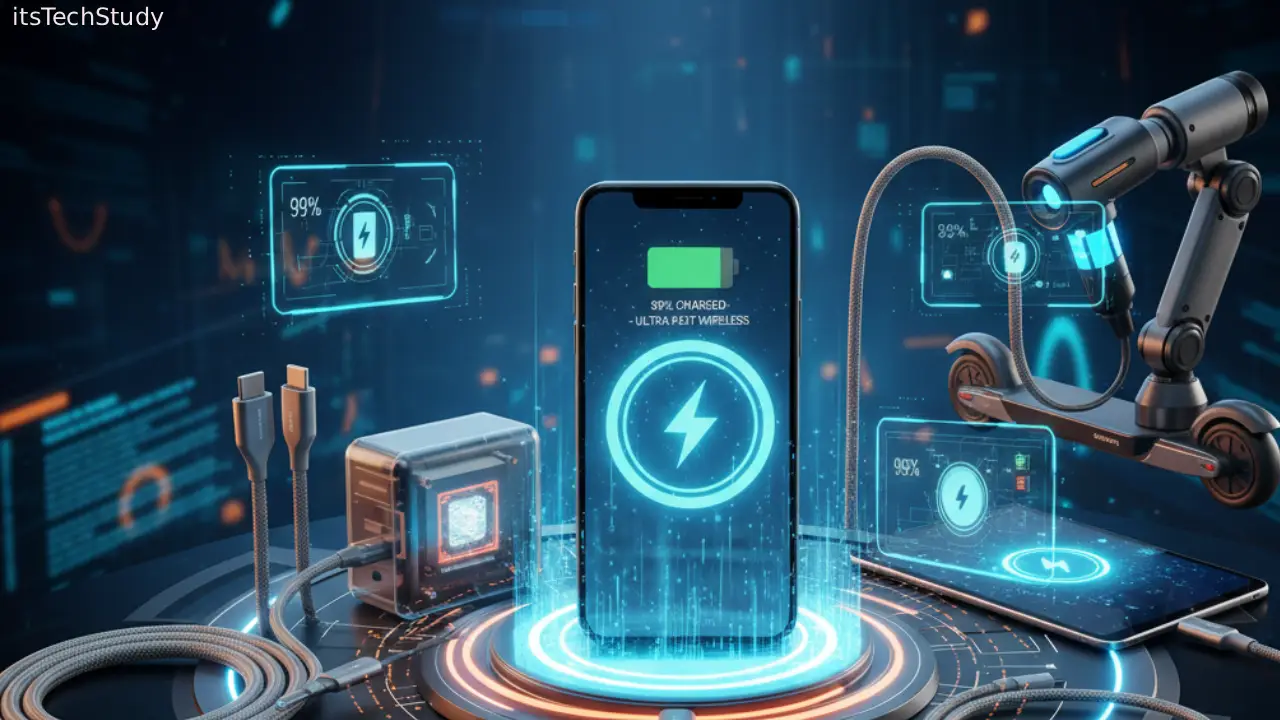
Understanding how your smartphone charges is more important today than ever.
Mobile phones have become the center of our personal and professional worlds. But as smartphones grow more powerful, feature-rich, and always connected, one major challenge continues to frustrate users globally-the need for faster, safer, and more reliable charging technology.
Years ago, charging a phone overnight was normal. Today, people expect their devices to reach 50% battery in 10–15 minutes and last all day. We watch 4K videos, play graphically intensive games, run multiple apps, and rely on constant connectivity via 5G, Wi-Fi 6, and Bluetooth. This increased demand has pushed smartphone manufacturers and battery engineers to innovate faster charging solutions.
From USB-C, Quick Charge, and Power Delivery to wireless charging, MagSafe, reverse wireless, GaN chargers, and even upcoming over-the-air charging, mobile charging technology has evolved dramatically in the last decade.
This article explores everything you need to know: how different charging technologies work, the pros and cons, battery health tips, comparisons, current trends, and the future of mobile power systems.
Let’s dive in.
What Is Mobile Charging Technology?
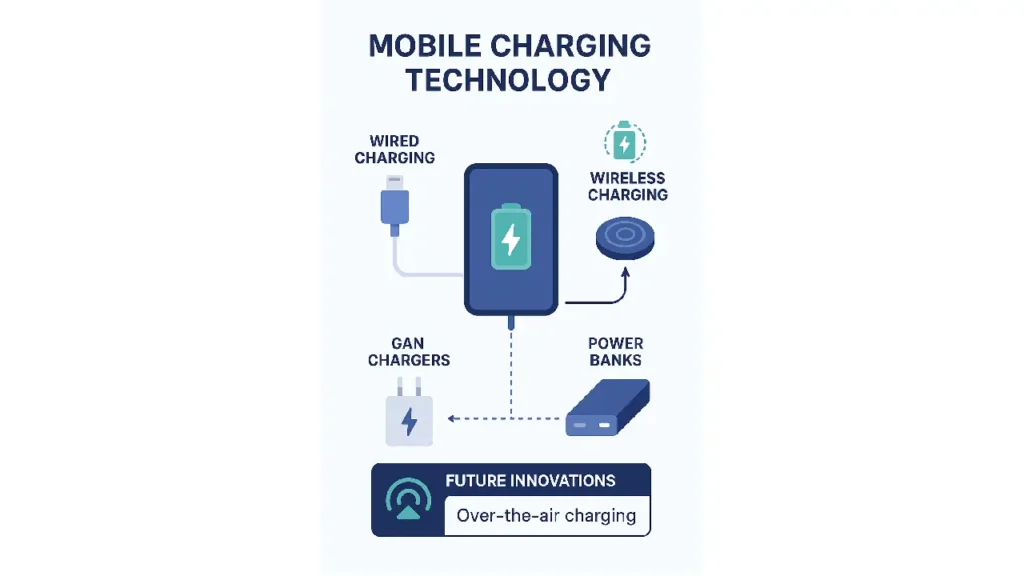
Mobile charging technology refers to all the methods and hardware systems that allow smartphones to recharge their batteries. It includes:
- Battery design (Lithium-ion / Lithium-polymer / Solid-state batteries)
- Charging standards (USB Power Delivery, Quick Charge, VOOC, Warp Charge, etc.)
- Charging connectors (USB-A, USB-C, Lightning)
- Wireless power transfer (Qi charging coils & magnetic systems)
- Fast-charging chipsets, power adapters, and cables
- Power regulation and thermal management
In simple words: mobile charging technology determines how fast, safe, and efficient your phone charges.
Why Charging Technology Matters Today
As battery sizes increase beyond 5000mAh and power-hungry applications continue to expand, users demand:
Faster charging
People rarely have time to wait hours for their device to refill.
Longer battery lifespan
Fast charging can cause heat, which affects battery health if uncontrolled.
Portability
Travelers and remote workers need lighter and smaller chargers.
Convenience
Wireless charging and power banks allow cable-free, on-the-go power.
Universal compatibility
Different chargers historically created confusion-USB-C solves most of it.
Types of Mobile Charging Technologies
1. Wired Charging
Standard Charging
Traditional charging outputs around 5V/1A or 5W. It is slow by today’s standards and mostly used on older devices or small gadgets.
Fast Charging
Fast charging increases power delivery using higher current, voltage, or both.
| Charging Standard | Max Power Output | Devices/Brands |
|---|---|---|
| USB-C Power Delivery (PD) | Up to 240W | Apple, Google, Samsung, Laptops |
| Qualcomm Quick Charge 5 | Up to 100W | Snapdragon-based Androids |
| VOOC / SuperVOOC | Up to 240W | OPPO, OnePlus, Realme |
| Warp/Dash Charge | 30W–150W | OnePlus |
| Xiaomi HyperCharge | Up to 210W | Xiaomi |
| Samsung Super Fast Charge | 25W–45W | Samsung Galaxy |
| Apple Fast Charging | 20W–30W via USB-C PD | iPhone 8 and newer |
How Fast Charging Works
Fast charging adjusts voltage and current intelligently based on:
- Battery temperature
- Battery percentage
- Charger capability
- Cable quality
- Power management chip
Modern devices use smart controllers to protect the battery from overheating.
2. Wireless Charging
Wireless charging uses electromagnetic induction coils to transfer power without a cable.
How It Works
- The charger coil generates a magnetic field
- The smartphone coil receives it
- The battery converts it into charge
Wireless Charging Standards
| Standard | Max Power Output | Technology Used |
|---|---|---|
| Qi Wireless Charging | Up to 15W | Induction |
| MagSafe Charging | 15W | Magnetic alignment |
| Reverse Wireless Charging | 5W–10W | Phone to accessories |
Benefits
- No need to plug and unplug cables
- Reduced wear on charging ports
- More convenient for desks and cars
Limitations
- Slower compared to wired fast chargers
- Generates more heat
- Requires precise alignment
3. GaN (Gallium Nitride) Chargers
GaN chargers are replacing traditional silicon-based adapters.
Why GaN is a Big Breakthrough
- Smaller and lighter
- More efficient, less heat
- Supports high-power charging up to 240W
- Better for travel and multi-device charging
4. Power Banks & Portable Solutions
Modern power banks include:
- Fast charging power banks
- Wireless power banks
- MagSafe magnetic power banks
- Solar charging power banks
Useful for travelers, creators, and gamers.
Pros & Cons of Modern Mobile Charging Technologies
Pros
- Extremely fast charging in minutes
- More convenient wireless options
- Improved battery safety and smart control
- Compact high-power GaN chargers
- Universal connectivity with USB-C
- Portable power solutions available
Cons
- Fast charging may reduce battery lifespan if heavily used
- Heat generation remains a concern
- Expensive proprietary chargers
- Wireless charging wastes more energy
How Mobile Charging Technology Has Evolved (Timeline Table)
| Year | Milestone | Technology |
|---|---|---|
| 2005 | Basic USB charging | 5W |
| 2013 | Qualcomm Quick Charge introduced | 10W |
| 2018 | USB-C + PD becomes universal | 30W-60W |
| 2020 | MagSafe wireless + multi-device charging | 15W |
| 2023–2024 | 200W–240W super-fast charging | 0-100% in 10 minutes |
| Upcoming | Over-the-air wireless | No contact needed |
How to Extend Battery Life While Using Fast Charging
Even though fast charging is safe, good habits increase lifespan.
Battery Care Tips
- Keep charge between 20%–80%
- Avoid charging while gaming or video streaming
- Remove phone case during fast charging to reduce heat
- Use original or certified chargers
- Turn on Optimized Charging (iPhone/Samsung/Android)
- Avoid overnight charging whenever possible
Future of Mobile Charging Technology
Innovation is accelerating, and the next five years may bring:
450W ultra-fast charging
Full charge in under 5 minutes
Solid-State Batteries
More efficient, safer, longer-lasting
Over-the-Air Charging
Charging without touching a charger using radio frequencies
Eco-friendly energy-saving charging
Recycled chargers, solar technology integration
Universal EU-mandated USB-C standard
End of multiple cables
The future is clearly wireless, ultra-fast, and more eco-efficient.
Conclusion
Mobile charging technology has evolved rapidly-from slow 5W chargers to 240W hyper-charging and wireless magnetic charging solutions. Today’s charging landscape focuses on speed, portability, safety, and convenience, supported by innovations like GaN chargers, QC/PD standards, and smart battery management systems. As we move towards over-the-air charging and solid-state batteries, the future promises even more revolutionary improvements.
Understanding how charging works empowers users to:
- Choose the right chargers for maximum efficiency
- Protect battery health
- Benefit from emerging technologies
The charging industry is clearly moving toward faster, safer, universal, and wireless solutions, making mobile power simpler, smarter, and more sustainable.

About the Author
Amelia Morgan is a Editor at itsTechStudy.com with 15+ years of experience in the technology industry. I write about emerging innovations, AI, and digital trends-making complex topics simple and engaging for readers.
Frequently Asked Questions (FAQ)
Q1: Does fast charging damage the battery?
Ans: No—modern devices use smart power management to prevent heat and control voltage. However, excessive fast charging may slightly increase long-term battery wear.
Q2: Is wireless charging slower than wired charging?
Ans: Yes. Most wired systems offer 30W–240W, while wireless charging is typically around 10W–15W.
Q3: Can I use any USB-C charger for my phone?
Ans: You can, but power may vary. For maximum speed, use USB-C PD, QC-compatible, or your phone brand’s recommended charger.
Q4: Is it safe to leave the phone charging overnight?
Ans: Smartphones stop charging at 100%, but heat buildup can affect battery health. Use optimized charging features for safety.
Q5: What is GaN technology in chargers?
Ans: GaN chargers use gallium nitride components, making them smaller, cooler, and more efficient than silicon chargers.
Q6: Are power banks good for battery health?
Ans: Yes, if they are certified and used properly. Avoid cheap, unbranded power banks.








No Comments Yet
Be the first to share your thoughts.
Leave a Comment