

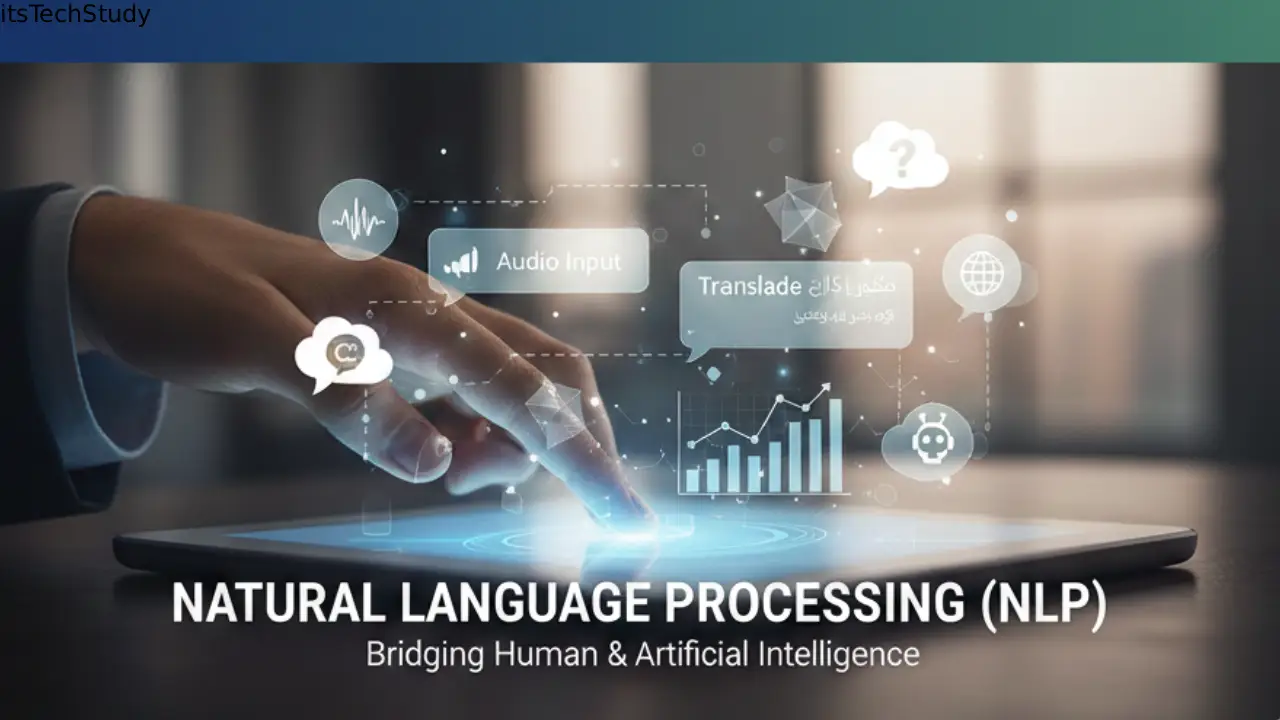
Introduction: Why Teaching Machines Human Language Became a Necessity
For decades, computers excelled at numbers but struggled with words. Early software could process structured commands, yet it completely failed when faced with natural human language-full of ambiguity, emotion, slang, and context. As the internet exploded with emails, social media posts, chat messages, and digital documents, this limitation became a serious challenge. Businesses were drowning in unstructured text data with no efficient way to analyze it..
This growing gap gave rise to Natural Language Processing (NLP)-a critical branch of artificial intelligence that enables machines to read, understand, interpret, and respond to human language. Today, NLP powers virtual assistants, search engines, chatbots, spam filters, translation tools, and sentiment analysis systems. As demand for smarter, more human-like digital interactions increases, NLP has moved from being an academic concept to a core technology shaping modern AI solutions.
What Is Natural Language Processing (NLP)?
Natural Language Processing (NLP) is a field of artificial intelligence (AI) and machine learning that focuses on enabling computers to understand, process, and generate human language in both written and spoken forms.
Unlike traditional programming, NLP systems learn language patterns from massive datasets. They analyze grammar, syntax, semantics, context, and even intent. This allows machines not just to read words, but to understand meaning behind them-something once thought impossible.
At its core, NLP bridges the gap between human communication and computer understanding, making technology more intuitive and accessible.
How NLP Works: From Raw Text to Meaningful Insights
NLP involves multiple stages that transform raw text into usable data. Each step plays a critical role in helping machines interpret language accurately.
Key Components of NLP
- Tokenization – Breaking text into words or phrases
- Part-of-Speech Tagging – Identifying nouns, verbs, adjectives, etc.
- Named Entity Recognition (NER) – Detecting names, places, dates, and organizations
- Sentiment Analysis – Understanding emotional tone
- Syntax and Semantic Analysis – Interpreting sentence structure and meaning
Modern NLP models rely heavily on deep learning, especially transformer-based architectures, to achieve high accuracy and contextual understanding.
Key Applications of Natural Language Processing
NLP is already embedded in everyday digital experiences. Its real-world applications continue to expand across industries.
Common Use Cases of NLP
- Search Engines – Delivering relevant results based on intent
- Chatbots and Virtual Assistants – Providing real-time customer support
- Machine Translation – Converting languages accurately
- Email Spam Filtering – Detecting unwanted messages
- Voice Recognition Systems – Powering smart devices
- Text Summarization – Extracting key information quickly
These applications demonstrate how NLP improves efficiency, accuracy, and user experience.
NLP vs Traditional Text Processing: A Comparison
| Feature | Traditional Text Processing | Natural Language Processing |
|---|---|---|
| Understanding Context | Limited | High |
| Learning Capability | Rule-based | Machine learning-based |
| Handling Ambiguity | Poor | Strong |
| Scalability | Low | High |
| Real-world Language Use | Minimal | Advanced |
This comparison highlights why NLP is essential for modern AI-driven systems.
Pros and Cons of Natural Language Processing
Advantages of NLP
- Improves human-computer interaction
- Automates large-scale text analysis
- Enhances decision-making using insights
- Saves time and operational costs
- Enables multilingual communication
Limitations of NLP
- Requires large, high-quality datasets
- Struggles with sarcasm and cultural nuances
- Computationally expensive models
- Bias can exist in training data
Understanding both strengths and limitations helps businesses adopt NLP responsibly.
NLP in Business and Industry
Organizations use NLP to extract value from vast amounts of unstructured data. From customer feedback analysis to compliance monitoring, NLP provides actionable insights that were previously hidden.
Industries Benefiting from NLP
- Healthcare – Medical record analysis and clinical documentation
- Finance – Fraud detection and sentiment-based trading
- E-commerce – Product recommendations and review analysis
- Education – Automated grading and learning tools
- Marketing – Social media monitoring and brand sentiment
NLP enables data-driven strategies that enhance productivity and customer satisfaction.
Essential NLP Techniques You Should Know
To fully understand NLP, it’s important to recognize the core techniques behind it.
- Bag of Words (BoW) – Basic text representation
- TF-IDF – Measures word importance
- Word Embeddings – Captures semantic meaning
- Transformers – Context-aware language models
- Sequence-to-Sequence Models – Used in translation and summarization
These techniques form the foundation of modern NLP systems.
Future Trends in Natural Language Processing
The future of NLP lies in context-aware systems, low-resource language processing, and ethical AI development. As models become more efficient and transparent, NLP will continue to reshape how humans interact with machines, making technology more inclusive and intelligent.
Conclusion: Why NLP Matters More Than Ever
Natural Language Processing has transformed the way machines interpret human communication. From powering everyday tools to enabling advanced AI applications, NLP is now a foundational technology in the digital world. As businesses and developers continue to harness its potential, the focus must remain on accuracy, ethics, and real-world usability. The evolution of NLP is not just about smarter machines—it’s about creating more meaningful human-technology interactions.

About the Author
Tobias Hale is a technology writer and software analyst with a sharp eye on the ever-evolving world of digital innovation. With a deep passion for clean code, secure systems, and emerging technologies, Tobias brings clarity to complex topics - from the latest in operating system updates to cutting-edge software security practices.
Frequently Asked Questions (FAQ)
Q1: What is Natural Language Processing in simple terms?
Ans: Natural Language Processing is a technology that helps computers understand and communicate using human language, both written and spoken.
Q2: Is NLP part of artificial intelligence?
Ans: Yes, NLP is a core subfield of artificial intelligence that combines machine learning, linguistics, and data science.
Q3: What programming languages are used for NLP?
Ans: Popular languages include Python, Java, and R, with Python being the most widely used due to its extensive NLP libraries.
Q4: How accurate is NLP technology?
Ans: Accuracy depends on data quality, model complexity, and context. Modern NLP models achieve high accuracy but are not perfect.
Q5: Can NLP understand emotions?
Ans: NLP can detect emotional tone through sentiment analysis, but understanding deep emotions remains a challenge.



No Comments Yet
Be the first to share your thoughts.
Leave a Comment