

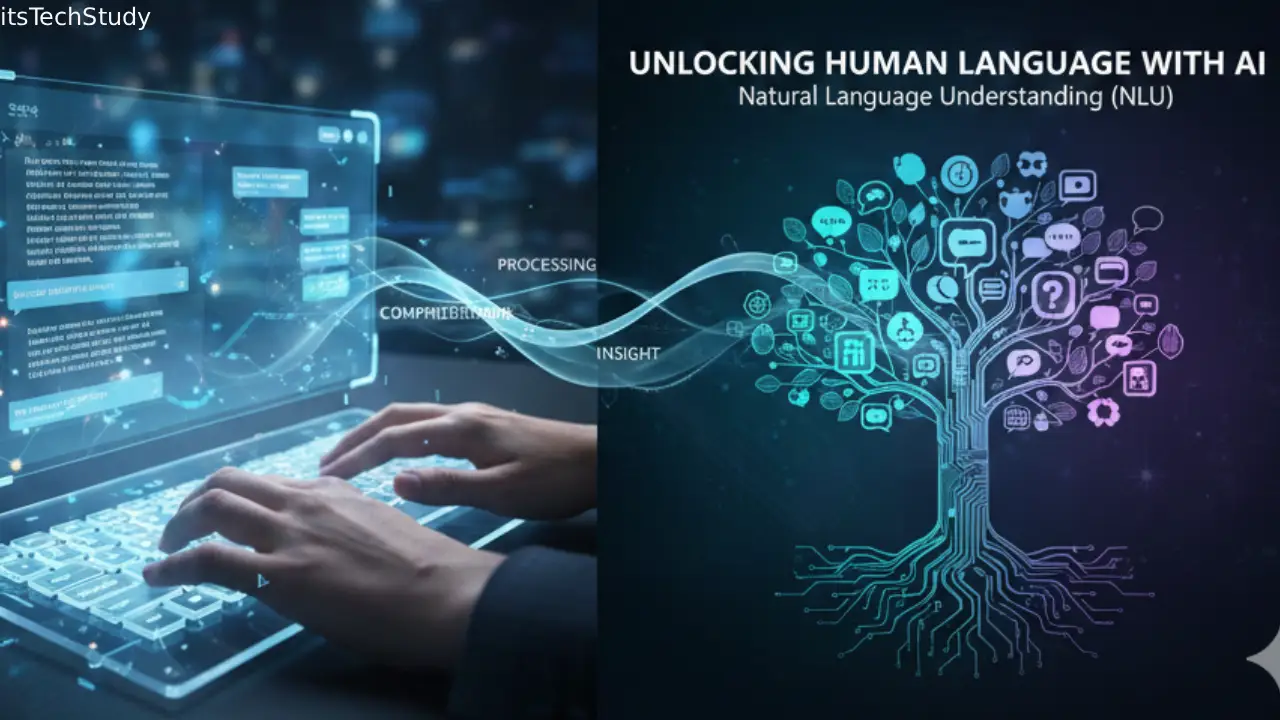
Introduction: Why NLU Matters More Than Ever
For decades, computers have excelled at crunching numbers, running simulations, and performing precise calculations. But one major challenge has always stood in the way of truly intelligent technology: understanding human language — with all its complexities, variations, slang, emotion, and context. This is where Natural Language Understanding (NLU) plays a transformative role..
As more businesses adopt AI-powered tools, users expect chatbots to answer with accuracy, virtual assistants to understand commands effortlessly, and automation systems to extract meaning from unstructured data. However, today’s digital interactions are more conversational than ever, and traditional NLP techniques often struggle to interpret nuanced intent, sarcasm, or ambiguous text.
This rising demand for deeper comprehension has pushed NLU to the forefront of modern AI. Whether it’s in customer service, healthcare, automation, or daily applications like Siri and Google Assistant, NLU is shaping how machines interpret, learn, and interact with human language.
What Is Natural Language Understanding (NLU)?
Natural Language Understanding (NLU) is a subfield of Natural Language Processing (NLP) that focuses on helping machines interpret the meaning and intent behind human language. NLU goes beyond reading text or recognizing speech — it analyzes context, semantics, and user intent.
While NLP handles “processing,” NLU focuses on “understanding.”
NLU ensures AI systems can:
- Recognize intent
- Extract entities from text
- Interpret sentiment
- Decode context
- Understand relationships between words and phrases
This makes NLU essential for chatbots, virtual assistants, semantic search engines, and intelligent automation workflows.
How NLU Works: Key Components Behind the Technology
1. Intent Recognition
Intent recognition helps AI understand what the user wants to achieve.
Example:
- “Book me a table at 8 PM.” – Intent: make a reservation
2. Entity Extraction
This identifies key elements in a sentence.
Example:
- “Book me a table at 8 PM at Olive Garden.”
- Entity 1: 8 PM
- Entity 2: Olive Garden
3. Syntactic and Semantic Analysis
- Syntax → Structure of a sentence
- Semantics → Meaning of words and context
NLU models blend both to understand sentence-level meaning.
4. Contextual Interpretation
NLU uses machine learning language models to recognize variations in tone, implied meaning, and user intent.
Comparison Table: NLU vs NLP vs NLG
| Feature | NLU (Understanding) | NLP (Processing) | NLG (Generation) |
|---|---|---|---|
| Core Function | Interprets meaning & intent | Processes text data | Creates human-like text |
| Examples | Chatbots, intent detection | Text cleaning, tokenization | Content generation, summaries |
| Focus | Semantics & context | Structure & patterns | Fluency & coherence |
| User Benefit | More accurate responses | Standardized data | Natural communication |
Applications of Natural Language Understanding in Everyday Technology
1. Chatbots and Virtual Assistants
Modern assistants like Alexa, Google Assistant, and chatbot platforms rely heavily on NLU to deliver accurate responses that match user intent.
2. Customer Support Automation
NLU helps businesses reduce workload by enabling automated ticket classification, sentiment detection, and user intent routing.
3. Healthcare Insights
Medical text, patient reports, and clinical notes can be analyzed to support diagnosis and documentation tasks.
4. Smart Search Engines
Semantic search powered by NLU delivers results based on meaning – not just keywords.
5. Enterprise Automation
Business workflows use NLU to extract data, classify content, and streamline operations.
Benefits of NLU in Modern AI
Pros
- Improved conversational accuracy
- Enhanced user experiences
- Better handling of unstructured data
- Faster automation with fewer errors
- Supports personalization in applications
Cons
- Requires large training datasets
- Can struggle with highly ambiguous or sarcastic statements
- Computationally expensive for deep learning models
- Performance varies based on language diversity
Why NLU Is a Game-Changer for Businesses
Companies adopting NLU-powered tools enjoy major advantages:
1. Reduced Operational Costs
Automated chat systems and AI-driven customer support reduce human workload.
2. Better Decision-Making
Insights extracted from unstructured text give companies a clearer understanding of customer needs.
3. Enhanced Customer Satisfaction
With better context understanding, interactions feel more personalized and intelligent.
4. Faster Task Automation
Document processing, sentiment tagging, and text classification become effortless.
How to Implement NLU in Your AI Projects
1. Choose an NLU Platform
Popular NLU tools include:
- Rasa NLU
- Google Dialogflow
- IBM Watson
- Microsoft LUIS
- Hugging Face Transformers
2. Define Intents & Entities
Organize user inputs into clear categories such as:
- Book appointment
- Check order status
- Give feedback
3. Train with Quality Data
The more diverse and clean the training data, the better your NLU accuracy.
4. Continuous Improvement
Monitor performance and refine your models to adapt to new user queries and language patterns.
Conclusion
Natural Language Understanding is becoming one of the foundational pillars of modern AI. As language-driven interactions dominate the digital world, NLU empowers machines to interpret meaning, extract insights, and communicate more naturally. Whether you’re building chatbots, improving customer service, or automating business processes, NLU provides the intelligence needed to transform raw text into meaningful action. Looking ahead, as models evolve and datasets expand, NLU will continue to redefine how humans and machines understand each other.

About the Author
Tobias Hale is a technology writer and software analyst with a sharp eye on the ever-evolving world of digital innovation. With a deep passion for clean code, secure systems, and emerging technologies, Tobias brings clarity to complex topics - from the latest in operating system updates to cutting-edge software security practices.
FAQs on Natural Language Understanding (NLU)
Q1: How is NLU different from NLP?
Ans: NLP deals with processing language, while NLU focuses on interpreting meaning, intent, and context. NLU is a deeper layer built on top of NLP.
Q2: Is NLU used in chatbots?
Ans: Yes, NLU is the core technology that enables chatbots to understand questions, detect intent, and respond appropriately.
Q3: Can NLU understand emotions?
Ans: Advanced NLU models incorporate sentiment analysis, allowing them to detect emotions such as happiness, frustration, or urgency.
Q4: Does NLU require machine learning?
Ans: Most modern NLU systems rely on machine learning, especially deep learning models, to interpret human language accurately.
Q5: Is NLU the same as AI?
Ans: NLU is a branch of AI focused on understanding natural language. AI includes many other areas like vision, robotics, and predictive analytics.
Q6: What industries benefit most from NLU?
Ans: Sectors like healthcare, finance, customer service, retail, and technology gain significant improvements through NLU-driven automation.



No Comments Yet
Be the first to share your thoughts.
Leave a Comment