

The Real Problem Everyone Is Facing Right Now
If you’ve tried building anything with AI agents recently, you’ve probably hit this wall:
Everything looks easy in demos… until you try it yourself.
A few years ago, working with AI mostly meant calling an API and getting a response. Simple. Predictable. Linear.
Now?
You’re dealing with agents, tools, memory, orchestration, multi-step reasoning, and suddenly you’re asking:
- Which framework should I even start with?
- Why does my agent behave differently every time?
- Am I overengineering this?
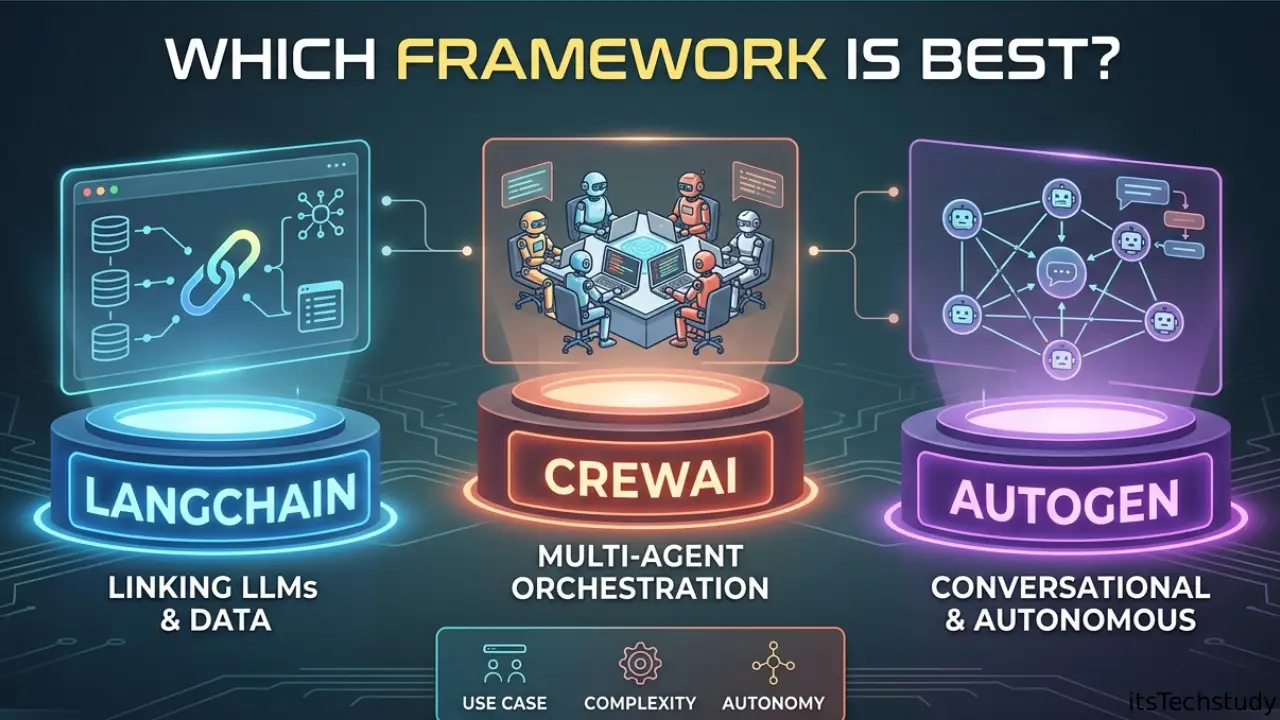
That’s exactly where frameworks like LangChain, CrewAI, and AutoGen come in.
But here’s the problem:
Most comparisons online are surface-level. They tell you what these tools are-not when they actually work or break down in real use.
Let’s fix that.
Real-World Experience: What Happens When You Actually Use These
When I first tried building an AI workflow, I started with LangChain.
My First Attempt (and Mistake)
I built a simple document Q&A system. It worked fine. So I thought:
“Let’s add agents, tools, and automation!”
That’s where things got messy.
- Debugging became painful
- Outputs became inconsistent
- I spent more time managing chains than solving the problem
Lesson: Just because a framework can do everything doesn’t mean you should use everything.
Then I Tried CrewAI
CrewAI felt… different.
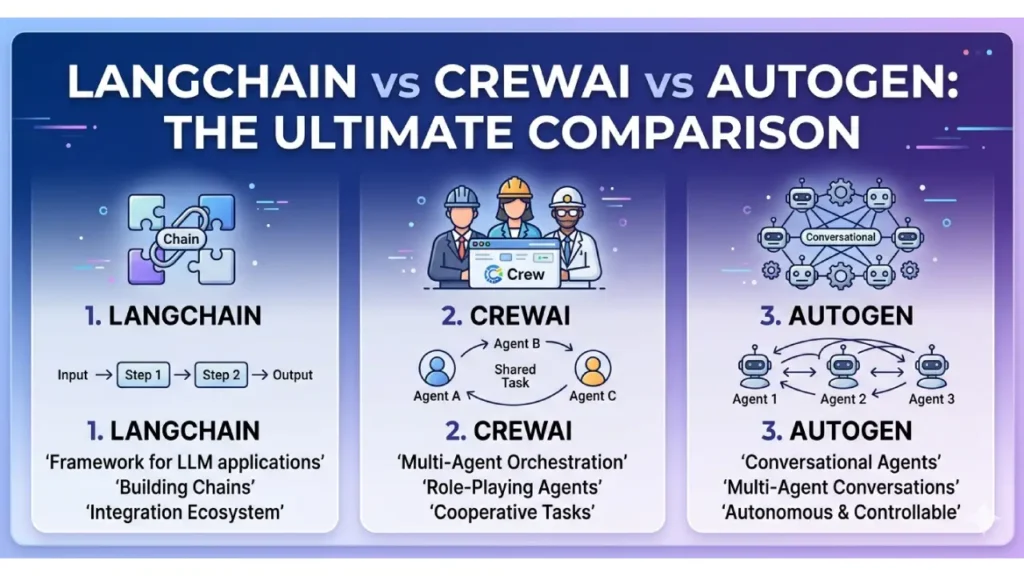
Instead of thinking in chains, I thought in roles:
- Researcher
- Writer
- Reviewer
It felt more natural for multi-step workflows.
But then I hit another issue:
- Harder to customize deeply
- Less mature ecosystem compared to LangChain
Finally, AutoGen
AutoGen surprised me the most.
It felt closer to “real AI collaboration”:
- Agents talking to each other
- Iterative refinement
- More dynamic behavior
But…
- It can get unpredictable fast
- Requires careful control to avoid infinite loops
Quick Comparison Table
| Feature | LangChain | CrewAI | AutoGen |
|---|---|---|---|
| Learning Curve | Medium–High | Low–Medium | Medium |
| Best For | Complex pipelines | Structured workflows | Autonomous agents |
| Flexibility | Very High | Moderate | High |
| Debugging | Difficult | Easier | Moderate |
| Production Ready | Yes | Growing | Yes |
| Multi-Agent Support | Basic | Strong | Native |
Step-by-Step: How to Choose the Right Framework
Instead of asking “Which is best?”, ask:
Step 1: What Are You Building?
- Simple chatbot -> LangChain
- Content workflow (research -> write -> edit) -> CrewAI
- Autonomous AI system -> AutoGen
Step 2: How Much Control Do You Need?
- Full control over logic -> LangChain
- Controlled collaboration -> CrewAI
- Emergent behavior -> AutoGen
Step 3: How Important Is Debugging?
Here’s something beginners underestimate:
Debugging AI workflows is harder than building them.
- LangChain -> hardest to debug
- CrewAI -> easiest to reason about
- AutoGen -> somewhere in between
Step 4: Start Small (Seriously)
One mistake I made early:
I tried to build a multi-agent system on day one.
Bad idea.
Start with:
- 1 agent
- 1 task
- 1 tool
Then expand.
Mini Case Study: Building a Blog Writing Agent
Let’s say you want to automate blog writing.
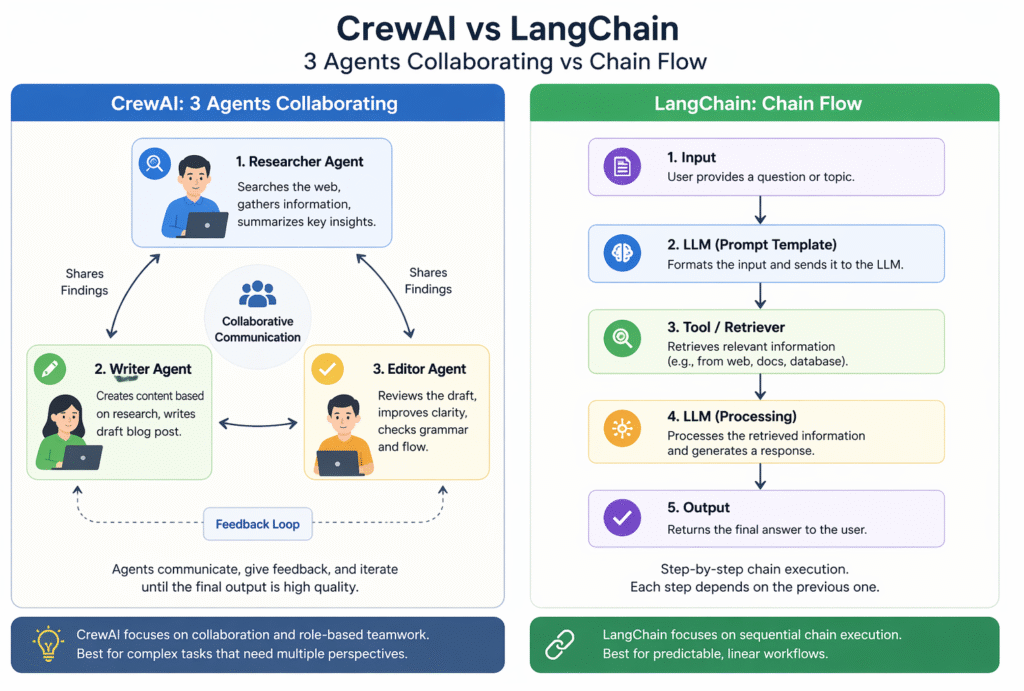
Option 1: LangChain
You create:
- Prompt templates
- Chains
- Tools (search, summarization)
Result:
Highly customizable, but requires careful orchestration.
Option 2: CrewAI
You define:
- Researcher agent
- Writer agent
- Editor agent
They collaborate sequentially.
Result:
Cleaner structure, faster setup.
Option 3: AutoGen
You let agents:
- Discuss
- Refine
- Iterate
Result:
More “human-like” output—but less predictable.
[Screenshot placeholder: A diagram showing 3 agents collaborating in CrewAI vs a chain flow in LangChain]
Common Mistakes (That Cost Me Hours)
1. Overengineering Too Early
You don’t need 5 agents.
You need 1 agent that works reliably.
2. Ignoring Token Costs
Multi-agent systems = more API calls.
One of my test setups:
- 3 agents
- 5 iterations
Result: 10x cost increase
3. Trusting Agents Too Much
Agents hallucinate more when:
- Tasks are vague
- Instructions are open-ended
4. Not Logging Conversations
This is critical.
If you’re not logging:
- Inputs
- Outputs
- Agent conversations
You can’t debug anything.
Pros and Cons
LangChain
Pros
- Extremely flexible
- Large ecosystem
- Production-ready
Cons
- Steep learning curve
- Debugging is painful
- Easy to overcomplicate
CrewAI
Pros
- Simple mental model
- Great for workflows
- Easy to get started
Cons
- Less flexibility
- Smaller ecosystem
- Not ideal for complex logic
AutoGen
Pros
- Powerful multi-agent interactions
- Natural collaboration model
- Strong for research-style tasks
Cons
- Can become unpredictable
- Requires careful control
- Harder to optimize costs
Pro Tips (From Real Usage)
1. Determinism > Intelligence
A slightly “dumber” but predictable system is better than a smart chaotic one.
2. Use Guardrails Early
Don’t wait.
Add:
- Output validation
- Role constraints
- Iteration limits
3. Hybrid Approach Works Best
One setup that worked well for me:
- LangChain -> tool integration
- CrewAI -> workflow orchestration
4. Limit Agent Conversations
More messages ≠ better output.
In fact:
- Quality often drops after 3–4 iterations
Unique Insights You Won’t Usually Hear
1. Multi-Agent Systems Often Reduce Reliability
More agents = more points of failure.
Sometimes a single well-designed prompt beats a 3-agent system.
2. Prompt Design Matters More Than Framework Choice
You can switch frameworks…
..but bad prompts will break everything regardless.
3. CrewAI Is Great for Teams, Not Just Code
If you think in human roles, CrewAI clicks instantly.
4. AutoGen Needs “Conversation Design”
Not just prompts-dialogue structure matters.
This is rarely discussed but critical.
5. LangChain Is a Toolkit, Not a Solution
Many beginners expect it to “do things automatically.”
It doesn’t.
You still design everything.
Quick Takeaway Box
- Use LangChain if you want full control and scalability
- Use CrewAI if you want structured workflows quickly
- Use AutoGen if you want autonomous agent collaboration
If you’re a beginner: start with CrewAI, then expand
Final Thoughts (Honest + Opinionated)
If I had to start again today?
I wouldn’t begin with LangChain.
I’d start with CrewAI, build something small, understand agent behavior…
…and only then move to LangChain or AutoGen.
Because here’s the truth:
The hardest part isn’t the framework-it’s designing systems that behave reliably.
And no framework solves that for you.

About the Author
Amelia Morgan is a Editor at itsTechStudy.com with 15+ years of experience in the technology industry. I write about emerging innovations, AI, and digital trends-making complex topics simple and engaging for readers.
FAQ (Beginner-Friendly)
Q1: Which framework is easiest to learn?
Ans: CrewAI. Its role-based approach is intuitive.
Q2: Is LangChain still relevant?
Ans: Yes—especially for production systems and integrations.
Q3: Can I combine these frameworks?
Ans: Yes, and in practice, that’s often the best approach.
Q4: Which is best for startups?
Ans: Fast MVP ->CrewAI Scalable backend -> LangChain
Q5: Is AutoGen production-ready?
Ans: Yes, but requires careful design to control behavior and cost.
Q6: Do I need multi-agent systems?
Ans: Not always. Many problems are solved better with a single agent.




No Comments Yet
Be the first to share your thoughts.
Leave a Comment