


The Problem: Everyone Learns Python, But Few Become Employable
A few years ago, simply listing Python on your resume could attract attention from recruiters.
That isn’t the reality anymore.
Today, thousands of beginners complete Python tutorials every week. Many finish online courses, solve coding exercises, and even earn certificates. Yet they still struggle to land interviews.
Why?
Because employers are no longer hiring people who know Python. They’re hiring people who can use Python to solve business problems.
I’ve reviewed dozens of beginner portfolios over the past couple of years, and the pattern is surprisingly consistent. Most projects look nearly identical:
- Calculator app
- To-do list
- Number guessing game
- Weather app tutorial clone
The problem isn’t that these projects are bad.
The problem is that they don’t demonstrate the skills companies actually pay for.
In 2026, AI can generate basic Python code in seconds. That changes the hiring equation completely.
The question employers ask is no longer:
“Can this person write Python?”
It’s:
“Can this person use Python effectively in a real workflow?”
And that’s exactly what we’ll focus on in this guide.
What Hiring Managers Actually Want
When I talk with developers involved in hiring, the conversation rarely revolves around advanced algorithms.
Instead, they care about questions like:
- Can this person work with APIs?
- Can they automate repetitive tasks?
- Can they debug problems?
- Can they understand existing code?
- Can they use AI tools productively?
- Can they deploy something that works?
These skills create business value immediately.
That’s why they matter.
Quick Summary
If you only learn one thing from this article, learn this:
The most employable Python developer in 2026 is not the person who knows the most syntax.
It’s the person who can combine:
- Python
- APIs
- Automation
- AI tools
- Databases
- Git
- Deployment
Into practical solutions.
The Python Skills That Actually Matter in 2026
1. API Integration
If I had to pick one skill that dramatically improves employability, this would be it.
Modern software runs on APIs.
Companies connect:
- Payment systems
- AI models
- CRMs
- Marketing tools
- Analytics platforms
And Python is often the glue holding everything together.
What You Should Learn
- REST APIs
- HTTP requests
- Authentication tokens
- JSON handling
- Error handling
Practical Project
Build a tool that:
- Pulls customer data
- Summarizes it using AI
- Sends a report automatically
This mirrors actual business workflows surprisingly well.
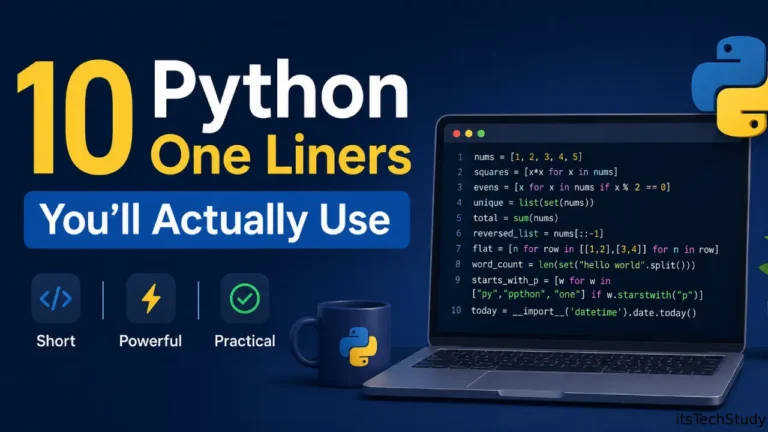
10 Python One Liners You’ll Actually Use
1. Fetch API Data & Print JSON
import urllib.request, json; print(json.dumps(json.loads(urllib.request.urlopen(“https://api.github.com”).read().decode()), indent=2))
2. List Comprehension with Condition
filtered_squares = [x**2 for x in range(10) if x % 2 == 0]
3. Ternary Operator (Conditional Assignment)
status = “Access Granted” if user.is_authenticated else “Access Denied”
4. Read File into a List of Lines
lines = [line.strip() for line in open(“data.txt”)]
5. Profile a Python Script
Run in terminal: python -m cProfile script.py
6. Start a Quick Web Server in Current Directory
Run in terminal: python -m http.server 8000
7. Merge Two Dictionaries
merged_dict = {**dict1, **dict2}
8. Swap Two Variables
a, b = b, a
9. Flatten a Multi-dimensional List
flat_list = [item for sublist in matrix for item in sublist]
10. Lambda Functions for Quick Math
square = lambda x: x ** 2
2. Automation and Workflow Building
Automation remains one of Python’s biggest strengths.
Many companies don’t need another website.
They need someone who can eliminate repetitive work.
In my experience, automation projects often impress employers more than flashy beginner apps.
Why?
Because they immediately save time.
Examples
- Rename thousands of files
- Generate reports
- Process spreadsheets
- Scrape internal data
- Send scheduled emails
One mistake I made early on was assuming automation wasn’t “real software development.”
I was wrong.
Several companies hire specifically for workflow automation because the ROI is easy to measure.
3. Working With AI APIs
This is perhaps the biggest hiring trend of 2026.
Many beginners think they need deep machine learning knowledge.
Most employers don’t.
They need people who can integrate AI into products and workflows.
Learn How To
- Send prompts programmatically
- Process AI responses
- Build AI-powered tools
- Manage costs
- Evaluate outputs
What Doesn’t Matter As Much
For many entry-level roles:
- Building neural networks from scratch
- Advanced research papers
- Training large models
Those are specialized skills.
AI integration is becoming mainstream.
Mini Case Study: Two Beginners, Different Outcomes
Consider two hypothetical beginners after six months of learning.
Candidate A
Built:
- Calculator
- Tic-Tac-Toe
- Password generator
Candidate B
Built:
- Automated invoice processor
- AI-powered document summarizer
- API dashboard
Both know Python.
But Candidate B demonstrates business value.
Guess who gets more interviews?
This is one of the most overlooked realities in tech hiring.
4. SQL and Databases
Many Python learners postpone databases.
That’s a mistake.
Most business applications involve data storage.
Learn
- SQL basics
- Joins
- Filtering
- Aggregations
- Database design fundamentals
Recommended Databases
| Database | Difficulty | Job Relevance |
|---|---|---|
| SQLite | Easy | Good for beginners |
| PostgreSQL | Medium | Very high |
| MySQL | Medium | High |
Python plus PostgreSQL is a combination that appears in countless job descriptions.
5. Git and Collaboration
Many beginners underestimate Git.
Employers don’t.
Even junior developers need to work with existing codebases.
Essential Skills
- Commits
- Branches
- Pull requests
- Merge conflicts
When I first joined a team environment, Git felt harder than Python itself.
That’s normal.
Learning collaboration skills early creates a significant advantage.
6. Debugging and Problem Solving
This skill is rarely highlighted in tutorials.
Yet it may be the most valuable.
Professional developers spend far more time debugging than writing new code.
Learn To
- Read error messages
- Use logging
- Trace program flow
- Reproduce bugs
A surprising truth:
Companies often prefer someone who can debug effectively over someone who memorizes obscure Python syntax.
7. Deployment and Cloud Basics
A project that only works on your laptop isn’t finished.
Learning deployment instantly separates you from many beginners.
Learn
- Docker basics
- Cloud hosting
- Environment variables
- Linux fundamentals
You don’t need to become a cloud engineer.
You simply need to demonstrate that your projects can run somewhere other than your own machine.
The Best Learning Path for Beginners
Here’s the roadmap I’d recommend today.
Phase 1: Python Foundations (4–6 Weeks)
Focus on:
- Variables
- Functions
- Loops
- Classes
- File handling
Avoid spending months here.
Many people get stuck in tutorial mode.
Phase 2: Build Real Projects (6–8 Weeks)
Create projects involving:
- APIs
- Databases
- Automation
The goal is not perfection.
The goal is exposure to real problems.
Phase 3: Learn Git and Deployment
Add:
- GitHub repositories
- Documentation
- Cloud deployment
This makes your projects feel professional.
Phase 4: Add AI Integration
Learn:
- Prompt engineering
- AI APIs
- Workflow automation
This combination is increasingly valuable across industries.
Common Mistakes Beginners Make
Mistake #1: Learning Without Building
Watching tutorials feels productive.
Building projects reveals what you actually know.
Mistake #2: Chasing Every New Framework
A new tool appears every week.
Most beginners spread themselves too thin.
Master a small stack first.
Mistake #3: Ignoring Documentation
Documentation reading is a career skill.
Many developers avoid it.
Employers notice those who don’t.
Mistake #4: Over-Focusing on Algorithms
Algorithms matter.
But many entry-level jobs care more about:
- APIs
- Databases
- Automation
Than advanced coding puzzles.
Mistake #5: Building Projects Nobody Needs
Ask yourself:
“Would this solve a real problem for someone?”
If not, rethink the project.
Pros and Cons of Learning Python in 2026
Pros
Massive job market
Strong AI ecosystem
Beginner-friendly syntax
Excellent automation capabilities
Large community support
Cons
More competition than before
Basic Python knowledge isn’t enough
Requires project-based learning
AI has reduced the value of simple coding skills
Five Non-Obvious Insights Most Career Guides Miss
1. Employers Care More About Maintenance Than Creation
Writing code is only half the job.
Reading, fixing, and improving existing code often matters more.
2. Small Business Problems Are Great Portfolio Projects
Many beginners build apps for developers.
Businesses hire people who solve business problems.
Think invoices, reporting, scheduling, and data cleanup.
3. Documentation Quality Can Outweigh Code Quality
A decent project with excellent documentation often beats an impressive project nobody understands.
4. AI Makes Communication More Valuable
As coding becomes easier, explaining decisions becomes more important.
Technical communication is becoming a competitive advantage.
5. Debugging Logs Are Portfolio Gold
This is rarely mentioned online.
Keep examples showing:
- A bug
- Your investigation
- Your fix
Employers love seeing problem-solving processes.
Key Takeaway
The fastest route to employability isn’t learning more Python.
It’s learning how Python fits into real systems:
- APIs
- Databases
- Automation
- AI workflows
- Deployment
That’s where hiring demand is moving.
Conclusion
Python remains one of the best programming languages to learn in 2026.
But the hiring market has changed.
Simply knowing syntax is no longer enough.
The developers who stand out are the ones who can connect Python to real-world workflows, automate tedious tasks, integrate AI tools, work with databases, and deploy solutions that actually solve problems.
If I were starting again today, I wouldn’t spend months chasing every Python feature or framework.
I’d build practical projects, document them well, and focus relentlessly on solving real problems.
That’s the skill set employers consistently reward-and it’s far more achievable than many beginners realize.

About the Author
Amelia Morgan is a Editor at itsTechStudy.com with 15+ years of experience in the technology industry. I write about emerging innovations, AI, and digital trends-making complex topics simple and engaging for readers.
Frequently Asked Questions
Q1: Do I need a computer science degree to get hired with Python?
Ans: No. Many employers focus more on projects, problem-solving ability, and practical skills.
Q2: How long does it take to become job-ready?
Ans: For most beginners, six to twelve months of consistent project-based learning is realistic.
Q3: Is AI replacing Python developers?
Ans: AI is replacing some repetitive coding tasks, but it is increasing demand for people who can build useful systems using AI tools.
Q4: Should I learn data science or backend development?
Ans: Choose based on interest. Backend development currently offers a broader range of entry-level opportunities.
Q5: Is Django still worth learning in 2026?
Ans: Yes. Many businesses continue to use it for internal tools and web applications.
Q6: Which project should I build first?
Ans: An automation tool connected to an API and database is often more impressive than traditional beginner projects.
Q7: Do certifications help?
Ans: They can help demonstrate commitment, but projects and practical experience usually carry more weight.

No Comments Yet
Be the first to share your thoughts.
Leave a Comment