

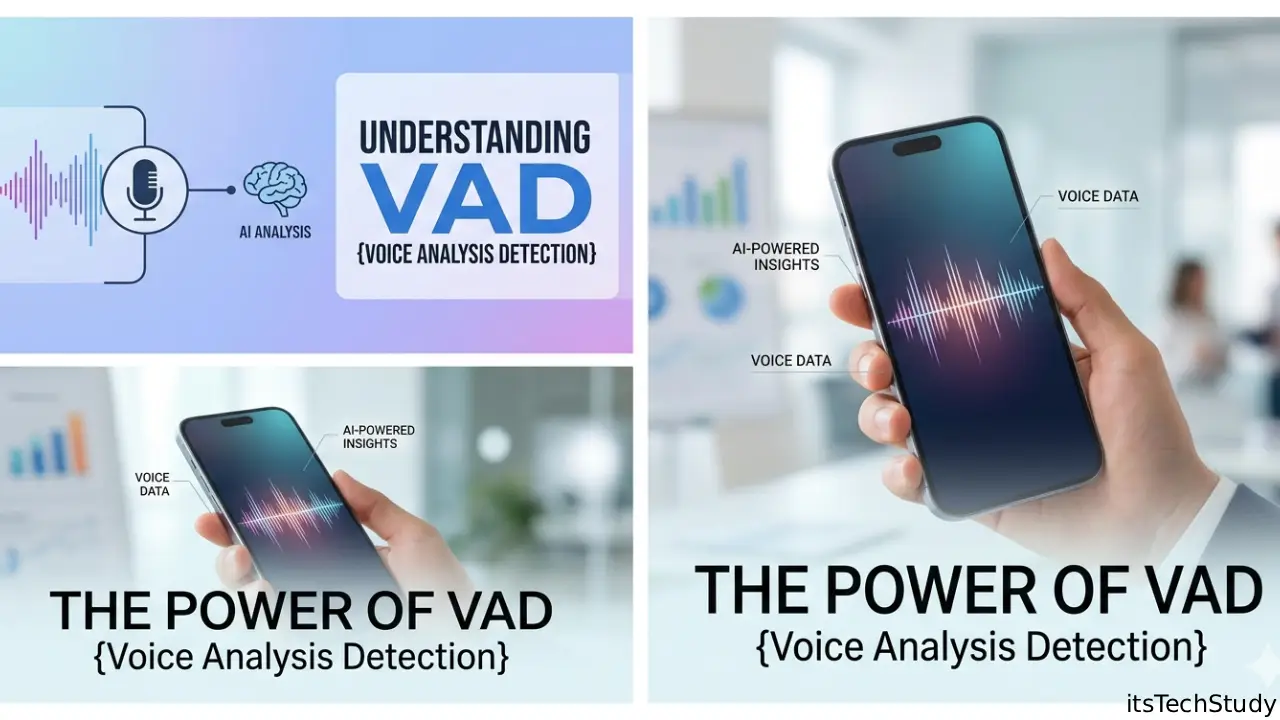
Introduction: Why Voice Is Becoming One of the Most Valuable Data Signals in Modern Technology
For years, text data dominated the digital world. Emails, chat messages, search queries, and social media posts gave businesses and platforms enough structured information to analyze customer intent, user behavior, and service quality. But today, the technology landscape is changing fast. As voice assistants, smart devices, remote support systems, and AI-powered customer service platforms continue to expand, voice is becoming one of the richest and most underused data sources in modern computing.
That is exactly where VAD (Voice Analysis Detection) enters the picture.
In a world where businesses need faster decisions, more accurate automation, better fraud prevention, and improved customer engagement, simply recording audio is no longer enough. Organizations now want systems that can detect speech activity, analyze vocal patterns, identify emotion or stress cues, separate noise from speech, and turn raw audio into actionable intelligence. Whether it’s a call center trying to improve customer satisfaction, a security platform looking for suspicious audio behavior, or an AI assistant trying to know when you are speaking, VAD has become a critical layer in modern voice technology.
The demand for real-time speech processing, voice biometrics, audio intelligence, and AI-powered voice analytics has made VAD a major topic across industries. However, there is still a lot of confusion around the term. In some technical contexts, VAD means Voice Activity Detection, while in broader enterprise and AI discussions, it can also be interpreted as Voice Analysis Detection—a more expansive concept that includes identifying speech presence and extracting meaningful signals from voice.
This matters because as audio-driven systems become more intelligent, businesses and developers need to understand not just when someone is speaking, but also what the voice reveals about intent, authenticity, urgency, sentiment, and interaction quality.
In this guide, we’ll break down what Voice Analysis Detection really means, how it works, where it’s used, its benefits and limitations, and why it is quickly becoming a foundational technology in the future of human-machine interaction.
What Is VAD (Voice Analysis Detection)?
VAD (Voice Analysis Detection) refers to a set of technologies used to detect, isolate, and analyze human voice signals from audio streams in order to extract useful information.
Depending on context, VAD can involve:
- Detecting whether speech is present in an audio signal
- Distinguishing human voice from background noise
- Identifying speaking segments for transcription or processing
- Analyzing vocal tone, stress, pitch, rhythm, and energy
- Supporting voice biometrics and speaker recognition
- Improving speech recognition accuracy in noisy environments
- Enabling real-time audio intelligence for AI systems
In simpler terms, VAD acts like a smart audio gatekeeper. Instead of treating every sound equally, it helps systems focus only on the parts of an audio stream that actually matter.
Why This Matters
Without voice analysis detection, many modern systems would struggle with:
- Constant background noise
- Wasted compute power
- Poor speech-to-text accuracy
- Delayed AI responses
- False activations in voice assistants
- Inaccurate call analytics
- Weak fraud or spoof detection
That’s why VAD is now widely used in:
- Call center analytics
- Voice assistants and smart speakers
- Speech recognition software
- Telemedicine platforms
- Security and surveillance systems
- Voice authentication tools
- Meeting transcription platforms
- Automotive voice control systems
Voice Analysis Detection vs Voice Activity Detection: Understanding the Difference
One of the biggest sources of confusion is that VAD traditionally stands for Voice Activity Detection in signal processing. That classic definition is still very important.
Traditional VAD (Voice Activity Detection)
This is the core signal-processing task of determining:
- Is someone speaking right now?
- Where does speech start?
- Where does speech end?
This is essential for:
- Speech codecs
- Noise suppression
- Audio compression
- Wake-word systems
- Automatic speech recognition (ASR)
Broader VAD (Voice Analysis Detection)
In a broader enterprise and AI context, Voice Analysis Detection goes beyond just detecting speech presence.
It may include:
- Acoustic pattern recognition
- Speaker segmentation
- Emotion detection
- Stress or sentiment analysis
- Voice anomaly detection
- Fraud or spoof detection
- Audio event classification
Quick Comparison Table
| Aspect | Voice Activity Detection | Voice Analysis Detection |
|---|---|---|
| Primary Goal | Detect speech presence | Detect + interpret voice signals |
| Core Function | Speech/non-speech segmentation | Speech intelligence and analysis |
| Complexity | Lower | Higher |
| Common Use | ASR preprocessing, call filtering | Call analytics, security, biometrics, AI |
| Real-Time Capability | Very high | High, but more compute-intensive |
| AI/ML Dependency | Sometimes basic DSP | Often relies on ML/AI models |
For many modern platforms, the best way to think about it is this:
Voice Activity Detection is the foundation, and Voice Analysis Detection is the intelligent layer built on top of it.
How VAD Works in Real-World Systems
At its core, VAD processes an incoming audio stream and tries to determine whether the sound contains meaningful human speech and what that speech signal can reveal.
The Basic Workflow of Voice Analysis Detection
1. Audio Capture
The system first captures raw audio from a source such as:
- Microphone
- Phone call stream
- Meeting recording
- Smart device input
- Surveillance microphone
- In-car infotainment system
2. Preprocessing and Noise Reduction
Before any analysis happens, the audio is cleaned up:
- Background noise filtering
- Echo cancellation
- Gain normalization
- Frequency band isolation
- Silence trimming
This step is crucial because real-world audio is rarely clean.
3. Speech Detection
Now the system identifies:
- Speech start time
- Speech end time
- Silent intervals
- Non-speech noise
- Overlapping voice segments
Traditional VAD algorithms often use:
- Energy thresholding
- Zero-crossing rate
- Spectral entropy
- Statistical models
Modern systems increasingly use:
- Deep neural networks
- CNNs for audio feature extraction
- RNN/LSTM/GRU-based temporal modeling
- Transformer-based speech models
4. Feature Extraction
Once voice segments are identified, the system extracts useful acoustic features such as:
- Pitch (fundamental frequency)
- Formants
- Mel-frequency cepstral coefficients (MFCCs)
- Spectral flux
- Voice energy
- Speaking rate
- Pause duration
- Prosody and intonation patterns
These features are the raw ingredients for higher-level analysis.
5. Voice Interpretation or Classification
Depending on the application, the system may then:
- Convert speech to text
- Identify the speaker
- Detect emotion
- Flag abnormal vocal behavior
- Check for spoofing or synthetic voice
- Score call quality
- Trigger downstream AI actions
Key Technologies Behind Modern Voice Analysis Detection
VAD is not just one algorithm. It is usually a combination of digital signal processing (DSP) and machine learning.
Core Technologies Commonly Used
- Digital Signal Processing (DSP): Filters, transforms, noise suppression
- Automatic Speech Recognition (ASR): Converts voice into text
- Natural Language Processing (NLP): Understands spoken content after transcription
- Voice Biometrics: Identifies or verifies speakers
- Emotion AI / Affective Computing: Detects sentiment or stress cues
- Deep Learning Models: Improves detection in noisy and dynamic environments
- Edge AI: Enables on-device, low-latency processing
Popular Audio Features Used in Voice AI
- MFCCs
- Spectrograms
- Pitch contours
- Harmonics-to-noise ratio
- Voice onset time
- Jitter and shimmer (in some advanced systems)
- Pause and interruption patterns
Top Use Cases of Voice Analysis Detection in 2026
As voice-first technology becomes more mainstream, VAD is now central to several fast-growing markets.
1. Call Center and Customer Experience Analytics
This is one of the most important enterprise applications.
VAD helps call center platforms:
- Detect when customers are speaking
- Measure agent interruptions
- Identify long silence periods
- Track emotional escalation
- Improve transcription quality
- Power quality assurance dashboards
Why It Matters
A modern contact center wants more than transcripts. It wants to know:
- Was the customer frustrated?
- Did the agent talk over them?
- Were there signs of urgency or churn risk?
- How much dead air occurred during the call?
2. Voice Assistants and Smart Devices
Devices like smart speakers and mobile assistants rely heavily on VAD to:
- Know when a user starts speaking
- Avoid false wake-ups
- Ignore TV noise or background chatter
- Improve command recognition
- Reduce battery and compute usage
This is especially important in edge computing environments where every millisecond counts.
3. Speech-to-Text and Real-Time Transcription
Transcription systems become far more efficient when they process only relevant speech segments.
Benefits include:
- Lower latency
- Better word accuracy
- Less wasted cloud compute
- Improved meeting summaries
- More reliable captions
This is essential in:
- Video conferencing
- Podcast editing
- Legal dictation
- Medical transcription
- Education technology platforms
4. Security, Fraud Detection, and Voice Biometrics
One of the fastest-growing areas for VAD is voice security.
Modern systems can use voice analysis detection to:
- Verify speaker identity
- Detect replay attacks
- Flag synthetic or cloned voices
- Identify suspicious vocal inconsistencies
- Support risk scoring during authentication
Example Security Applications
- Banking phone verification
- Secure enterprise access
- Fraud detection in customer support
- Anti-spoofing in voice login systems
5. Healthcare and Telemedicine
Healthcare platforms increasingly use voice intelligence to support:
- Remote patient monitoring
- Symptom pattern analysis
- Mental wellness screening signals
- Speech clarity tracking
- Elder care voice alerts
Important note: VAD can assist clinical workflows, but it should not be treated as a standalone diagnostic system without professional oversight.
6. Automotive and In-Car Voice Interfaces
In connected vehicles, VAD helps by:
- Detecting commands in noisy cabins
- Separating driver voice from passengers
- Reducing distraction through hands-free control
- Improving navigation and infotainment response
As software-defined vehicles and AI cockpit systems evolve, this use case will only grow.
Benefits of Voice Analysis Detection
When implemented correctly, VAD offers both technical and business advantages.
Major Benefits
- Improved speech recognition accuracy
- Lower compute costs by ignoring silence and noise
- Faster response times in real-time AI systems
- Better user experience in voice interfaces
- Stronger fraud prevention with layered voice intelligence
- Richer customer insights in call analytics
- More scalable audio pipelines for enterprise platforms
Pros of VAD
- Excellent for real-time audio processing
- Reduces unnecessary cloud processing costs
- Enhances AI assistant reliability
- Helps filter noisy environments
- Valuable for voice biometrics and fraud detection
- Supports better transcription and sentiment workflows
Cons of VAD
- Accuracy can drop in very noisy environments
- Emotion detection from voice alone can be unreliable
- Different accents and speaking styles may affect results
- Requires tuning for domain-specific performance
- Privacy and consent concerns must be handled carefully
- Advanced models can be compute-intensive at scale
Common Challenges and Limitations of Voice Analysis Detection
Despite the hype, VAD is not magic.
1. Background Noise and Overlapping Speech
Busy environments create major issues:
- Traffic noise
- Office chatter
- Fan or AC hum
- Multiple people talking at once
2. Accent, Language, and Dialect Diversity
A model trained on limited speech data may perform poorly across:
- Regional accents
- Mixed-language conversations
- Fast or slow speaking styles
- Non-native pronunciation patterns
3. Synthetic Voice and Deepfake Audio
As AI voice cloning improves, detecting authentic speech becomes harder.
That means VAD systems increasingly need:
- Liveness detection
- Anti-spoofing layers
- Acoustic artifact analysis
- Behavioral voice pattern modeling
4. Privacy and Compliance
Voice data can be sensitive.
Organizations must consider:
- User consent
- Data retention policies
- On-device vs cloud processing
- Encryption at rest and in transit
- Regional privacy regulations
Best Practices for Implementing VAD in AI and Enterprise Systems
If you’re building or integrating a voice intelligence stack, these best practices matter.
1. Start with the Right Objective
Ask first:
- Do you only need speech detection?
- Do you need full voice analytics?
- Is latency more important than deep analysis?
- Will processing happen on-device or in the cloud?
2. Use Layered Architecture
A strong VAD pipeline usually looks like this:
- Audio capture
- Noise suppression
- Voice activity detection
- Feature extraction
- ASR / biometrics / sentiment / anomaly analysis
- Scoring or decision engine
3. Optimize for Real-World Noise
Always test with:
- Mobile audio
- Call center compression artifacts
- Echo-heavy rooms
- Multispeaker conversations
- Regional accents
4. Balance Privacy and Performance
Where possible:
- Use edge inference for initial detection
- Send only relevant voice segments to the cloud
- Minimize raw audio retention
- Anonymize metadata when practical
VAD and the Future of AI-Powered Voice Technology
The next phase of voice technology is not just about speech recognition. It is about contextual, adaptive, real-time voice intelligence.
Trends Shaping the Future
- On-device VAD for privacy-first AI
- Multimodal AI combining voice + text + visual signals
- Improved anti-spoofing for synthetic voice threats
- Emotion-aware customer support systems
- Low-latency edge AI for automotive and IoT
- Smarter meeting and collaboration analytics
- Voice-native interfaces for enterprise software
In the next few years, VAD will likely become a standard building block in:
- AI copilots
- Conversational commerce
- Smart home automation
- Digital health monitoring
- Enterprise CX platforms
- Secure voice authentication
Practical Comparison: Where VAD Adds the Most Value
| Use Case | Main Goal | Value of VAD | Complexity Level |
|---|---|---|---|
| Smart Speakers | Detect commands accurately | High | Medium |
| Call Centers | Analyze speech behavior and quality | Very High | High |
| Transcription Apps | Improve speech-to-text efficiency | High | Medium |
| Banking Security | Support voice authentication and anti-spoofing | Very High | High |
| Telemedicine | Monitor spoken interactions and clarity | Medium to High | High |
| Automotive Voice Systems | Enable safe hands-free interaction | High | Medium to High |
How Businesses Can Decide If They Need Voice Analysis Detection
Not every organization needs full-blown voice intelligence on day one.
You likely need VAD if you:
- Process large volumes of audio or calls
- Use speech-to-text at scale
- Build voice-enabled apps or devices
- Need voice authentication or fraud detection
- Want deeper customer interaction analytics
- Operate in noisy, real-time environments
You may not need advanced VAD yet if you:
- Only store occasional recordings
- Don’t need real-time response
- Don’t use voice as a primary interface
- Can rely on simple transcription alone
Conclusion: Why VAD Is Becoming a Core Layer of Modern Voice AI
Voice is no longer just another input method. It is rapidly becoming a high-value intelligence layer for businesses, developers, and AI platforms that want faster, smarter, and more human-aware digital experiences.
VAD (Voice Analysis Detection) sits at the center of that shift.
At its most basic level, it helps systems detect when someone is speaking. At its most advanced, it powers a much broader ecosystem of voice analytics, speech optimization, customer experience monitoring, security verification, and AI-driven decision-making. That makes it one of the most practical and scalable technologies in the modern audio stack.
For businesses, the takeaway is simple: if your platform depends on audio, calls, voice interfaces, or real-time speech intelligence, VAD is no longer optional—it is becoming foundational. The smartest implementations will combine low-latency speech detection, privacy-aware architecture, and domain-specific voice analytics to create systems that are faster, safer, and more useful.
As AI continues to move toward natural interaction, VAD will play a major role in shaping how machines listen, understand, and respond in the real world.

About the Author
Amelia Morgan is a Editor at itsTechStudy.com with 15+ years of experience in the technology industry. I write about emerging innovations, AI, and digital trends-making complex topics simple and engaging for readers.
FAQs About VAD (Voice Analysis Detection)
Q1: What does VAD stand for in voice technology?
Ans: In classic signal processing, VAD usually stands for Voice Activity Detection, which identifies when speech is present in an audio stream. In broader business or AI discussions, it can also be used informally as Voice Analysis Detection, referring to deeper voice intelligence beyond simple speech detection.
Q2: Is VAD the same as speech recognition?
Ans: No. VAD is not the same as speech recognition. VAD decides when speech is happening. Speech recognition (ASR) tries to determine what was said. Think of VAD as the front-end filter that helps ASR work more efficiently and accurately.
Q3: Where is VAD used the most today?
Ans: The most common uses include: Call center analytics Smart assistants Meeting transcription Voice biometrics Fraud prevention Telemedicine Automotive voice control Security monitoring systems
Q4: Can VAD detect emotions in voice?
Ans: Basic VAD alone usually cannot. However, advanced voice analysis systems built on top of VAD can estimate patterns related to stress, urgency, tone shifts, and sentiment. Still, emotion detection from voice is not always perfectly reliable and should be used carefully.
Q5: Is VAD useful for detecting AI-generated or cloned voices?
Ans: Yes, especially when combined with anti-spoofing models, voice biometrics, and audio anomaly detection. VAD helps isolate speech segments, while specialized models analyze whether the voice sounds authentic or synthetic.
Q6: Is VAD safe for privacy-sensitive applications?
Ans: It can be, but privacy depends on implementation. Best practices include: Clear user consent Minimal audio retention Encryption On-device preprocessing Sending only required voice segments for cloud analysis Compliance with local data regulations







No Comments Yet
Be the first to share your thoughts.
Leave a Comment