

The Problem: We’re Drowning in Data but Still Making Reactive Decisions
A few years ago, most organizations were happy just collecting data.
Website traffic? Track it.
Sales numbers? Store them.
Customer behavior? Record everything.
Today, that’s no longer enough.
The challenge isn’t gathering data anymore-it’s figuring out what will happen next.
A retailer wants to know which customers are likely to stop buying.
A hospital wants to predict patient readmission risks.
A logistics company wants to forecast delivery delays before they happen.
A small online business wants to know which products will sell next month.
This is where AI-powered predictive analytics has become one of the most valuable business technologies available.
Instead of simply telling you what happened yesterday, it helps estimate what is likely to happen tomorrow.
And right now, this matters more than ever.
Markets move faster. Customer expectations change quickly. Competition is increasingly data-driven.
Waiting until a problem appears often means you’ve already lost time, money, or customers.
In my experience, organizations rarely struggle because they lack data. They struggle because they discover patterns too late.
Predictive analytics aims to solve exactly that problem.
What Is AI-Powered Predictive Analytics?
At its core, predictive analytics uses historical data to forecast future outcomes.
Artificial intelligence improves this process by automatically identifying patterns that traditional methods often miss.
Think of it this way:
Traditional reporting answers:
- What happened?
- How many sales occurred?
- Which product performed best?
Predictive analytics answers:
- What will likely happen next?
- Which customers may leave?
- Which products might sell out?
- Which leads are most likely to convert?
The AI component allows systems to learn from large datasets and continuously improve predictions over time.
A Real-World Scenario: The Customer Churn Problem
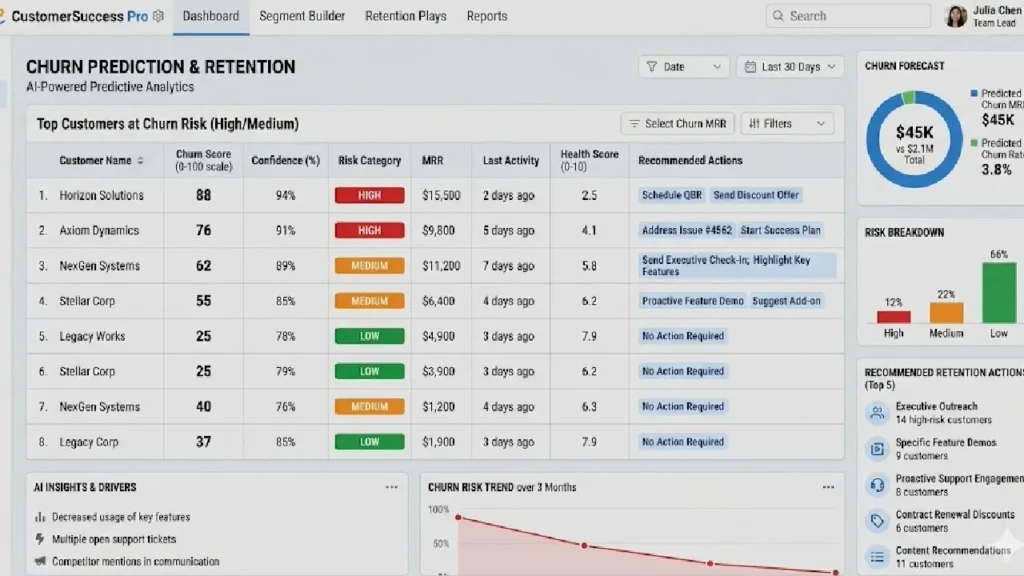
Let’s imagine a subscription-based software company.
The business notices customer cancellations increasing.
Traditionally, management would review reports after customers had already left.
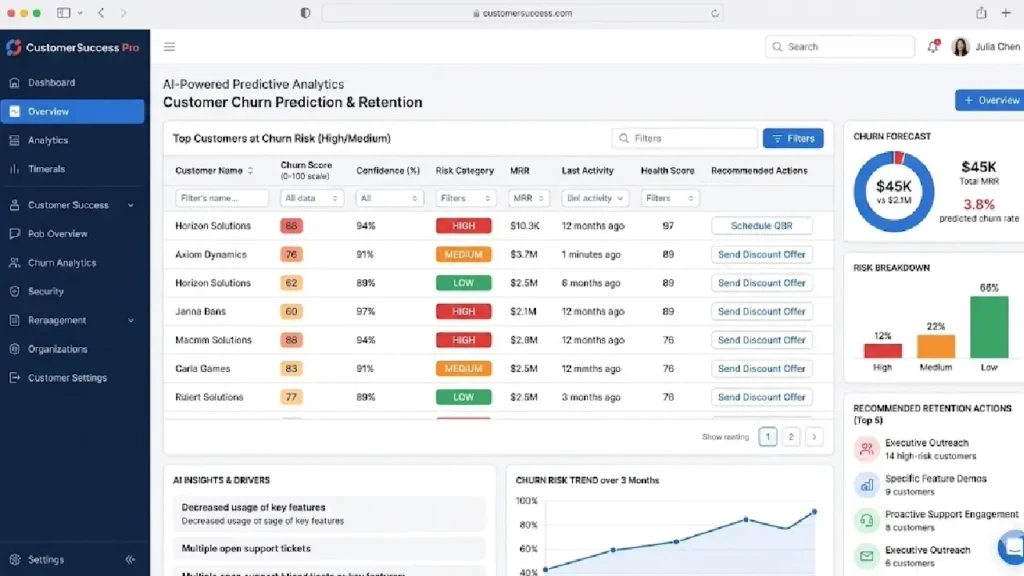
With AI-powered predictive analytics, the company can identify warning signals earlier.
For example:
- Reduced login frequency
- Declining feature usage
- Increased support tickets
- Longer response times
The system analyzes thousands of previous customer behaviors and discovers patterns associated with cancellation.
Now it predicts which current customers have a high probability of leaving.
Instead of reacting after cancellation, the company can intervene beforehand.
That shift-from reactive to proactive-is where most of the value comes from.
Why AI Makes Predictive Analytics More Powerful
Traditional forecasting models often depend on predefined rules.
AI models can uncover relationships humans never explicitly programmed.
For example:
A retailer may discover that:
- Rainy weather
- Payday schedules
- Social media mentions
- Regional events
Together influence demand for specific products.
No analyst may have manually connected those factors.
AI can.
Traditional Analytics vs AI-Powered Predictive Analytics
| Feature | Traditional Analytics | AI-Powered Predictive Analytics |
|---|---|---|
| Focus | Past performance | Future outcomes |
| Pattern Discovery | Mostly manual | Automated |
| Data Volume | Moderate | Very large |
| Adaptability | Limited | Continuously improves |
| Accuracy Potential | Good | Often significantly higher |
| Real-Time Learning | Rare | Common |
My First Experience with Predictive Models
When I first experimented with predictive models, I assumed model accuracy was everything.
I spent days trying to improve accuracy from 87% to 91%.
What I learned later surprised me.
The real challenge wasn’t prediction.
It was getting people to trust the prediction.
Managers wanted explanations.
Sales teams wanted evidence.
Executives wanted confidence levels.
A prediction nobody acts on has zero business value.
That’s a lesson many beginners miss.
The best predictive model isn’t necessarily the most accurate one.
It’s often the one stakeholders understand and use.
Step-by-Step Guide to Getting Started
Step 1: Define a Specific Business Question
Avoid vague goals like:
“Let’s use AI.”
Instead ask:
- Which customers may churn?
- Which products will sell next month?
- Which invoices might become overdue?
Specific questions produce useful predictions.
Step 2: Collect Historical Data
Predictive systems learn from past behavior.
Examples include:
- Sales records
- Customer transactions
- Marketing data
- Website analytics
- Support interactions
A good rule:
More relevant data beats more data.
One mistake I made early on was collecting everything available.
The result?
More noise, not better predictions.
Step 3: Clean the Data
This step is often boring.
It’s also where most project success comes from.
Check for:
- Missing values
- Duplicate records
- Inconsistent formatting
- Incorrect entries
Many predictive projects fail before modeling even begins because of poor data quality.
Step 4: Choose an AI Model
Common options include:
Regression Models
Useful for predicting numerical values.
Examples:
- Monthly sales
- Future revenue
- Demand forecasts
Classification Models
Useful for yes/no outcomes.
Examples:
- Customer churn
- Fraud detection
- Loan approval risk
Time-Series Models
Useful when data changes over time.
Examples:
- Inventory forecasting
- Traffic prediction
- Energy demand forecasting
Step 5: Train and Test the Model
The AI learns from historical examples.
Then it’s tested against unseen data.
This helps determine whether predictions generalize beyond past events.
A model that performs perfectly on training data but poorly on new data is usually overfitting.
That’s one of the most common beginner mistakes.
Step 6: Deploy and Monitor
Prediction is not the finish line.
It’s the beginning.
Monitor:
- Prediction accuracy
- Business impact
- Data quality changes
- User adoption
Models age.
Customer behavior changes.
Markets evolve.
A model built last year may become less useful today.
Mini Case Study: Retail Demand Forecasting
A mid-sized online retailer faced frequent inventory issues.
Some products sold out unexpectedly.
Others sat in warehouses for months.
The company implemented AI-powered predictive analytics using:
- Historical sales data
- Seasonal trends
- Marketing campaign schedules
- Regional demand patterns
Results after several months:
- Lower stock shortages
- Reduced excess inventory
- Improved purchasing decisions
Interestingly, the biggest improvement wasn’t forecast accuracy.
It was operational confidence.
Buyers stopped making decisions based purely on intuition.
That alone created measurable improvements.
Pros and Cons of AI-Powered Predictive Analytics
Pros
Better forecasting
Faster decision-making
Reduced operational risk
Improved customer retention
More efficient resource allocation
Scalable across large datasets
Cons
Requires quality data
Can be difficult to explain
Models degrade over time
Poor implementation can create false confidence
Initial setup requires expertise
Common Mistakes Beginners Make
1. Chasing Accuracy Instead of Business Value
A 95% accurate model can still be useless.
Example:
If only 1% of customers churn, predicting “nobody leaves” might appear highly accurate.
But it provides no actionable insight.
2. Ignoring Data Quality
Garbage in.
Garbage out.
AI cannot magically fix bad data.
3. Building Before Defining Success
Ask:
What decision will this prediction improve?
If you can’t answer that, stop and rethink.
4. Assuming AI Knows Why
Many systems predict outcomes well but cannot fully explain causation.
Prediction and explanation are different things.
5. Treating Models as Permanent
Customer behavior evolves.
Models require maintenance.
Many companies forget this entirely.
Pro Tips From Real Implementations
Focus on Prediction Windows
One insight rarely discussed:
The prediction horizon matters enormously.
Predicting customer churn next week is often easier than predicting churn next year.
Start with shorter prediction windows.
You’ll usually get better results.
Build Intervention Plans First
Another overlooked lesson:
Before creating predictions, define responses.
If a customer receives a 90% churn score:
What happens next?
Who contacts them?
What offer is made?
Predictions without actions are expensive dashboards.
Measure Economic Impact, Not Just Accuracy
Imagine:
Model A = 92% accurate
Model B = 88% accurate
Most people choose Model A.
But if Model B identifies high-value customers more effectively, it may generate more revenue.
Business outcomes matter more than leaderboard metrics.
5 Non-Obvious Insights Most Articles Miss
1. The Best Predictor Is Often Human Behavior Friction
Tiny behavioral changes often predict outcomes better than demographics.
Examples:
- Fewer logins
- Slower response times
- Abandoned workflows
Behavior usually beats profile data.
2. More Features Can Reduce Performance
Many beginners assume adding more variables helps.
Often it introduces noise.
I’ve seen simpler models outperform complex ones surprisingly often.
3. Prediction Confidence Matters More Than Prediction
A system predicting:
“80% chance of churn”
is far more useful than:
“Customer will churn.”
Confidence scores improve decision-making.
4. Explainability Drives Adoption
Even slightly less accurate models may create more business value if stakeholders understand them.
Trust increases usage.
Usage creates impact.
5. Most ROI Comes From Operational Changes
The AI itself rarely creates value.
The actions triggered by predictions create value.
This distinction changes how successful teams approach analytics projects.
Quick Summary
AI-powered predictive analytics uses historical data and machine learning to forecast future outcomes.
Success depends more on data quality and business processes than sophisticated algorithms.
Focus on solving a specific problem before choosing tools.
Predictions create value only when paired with action.
Simpler, explainable models often outperform complex systems in real-world environments.
Conclusion
AI-powered predictive analytics is often marketed as a crystal ball.
It isn’t.
What it actually provides is something far more useful: better odds.
The organizations seeing the strongest results aren’t necessarily using the most advanced algorithms. They’re using predictions to make faster, smarter decisions before problems become visible.
If you’re a beginner, don’t start by learning every machine learning algorithm.
Start by identifying one decision you repeatedly make with incomplete information.
Then ask:
“What data might help predict this outcome?”
That’s where predictive analytics becomes practical rather than theoretical.
And in 2026, that shift-from reacting to anticipating-is quickly becoming a competitive advantage rather than a luxury.

About the Author
Amelia Morgan is a Editor at itsTechStudy.com with 15+ years of experience in the technology industry. I write about emerging innovations, AI, and digital trends-making complex topics simple and engaging for readers.
Frequently Asked Questions
Q1: Is predictive analytics the same as AI?
Ans: No. Predictive analytics is the broader process of forecasting outcomes. AI is one technology that can improve prediction accuracy and scalability.
Q2: How much data do I need?
Ans: There is no universal number. Some projects succeed with thousands of records. Others require millions. Data quality matters more than raw volume.
Q3: Can small businesses use predictive analytics?
Ans: Absolutely. Many cloud platforms now offer affordable predictive tools without requiring large data science teams.
Q4: How accurate are AI predictions?
Ans: Accuracy varies significantly depending on data quality, business context, and prediction horizon. No model is perfect.
Q5: What industries benefit most?
Ans: Nearly all industries can benefit, including: Retail Healthcare Finance Manufacturing Logistics Marketing SaaS
Q6: Do I need coding skills?
Ans: Not necessarily. Many modern analytics platforms provide no-code or low-code interfaces. However, understanding data fundamentals remains valuable.
Q7: What's the biggest reason projects fail?
Ans: In my experience, it's not technology. It's unclear objectives and poor adoption. Many organizations build models before deciding how predictions will influence decisions.



No Comments Yet
Be the first to share your thoughts.
Leave a Comment